Halo-lit letters give Stirling premises a soft glow on the panel behind, with the name itself in crisp silhouette. Face-lit and trough options suit other brands and buildings, and we show you the difference on a scale drawing.
Your survey is where the price gets real, because widths, heights, levels and access are all taken on site in Stirling.
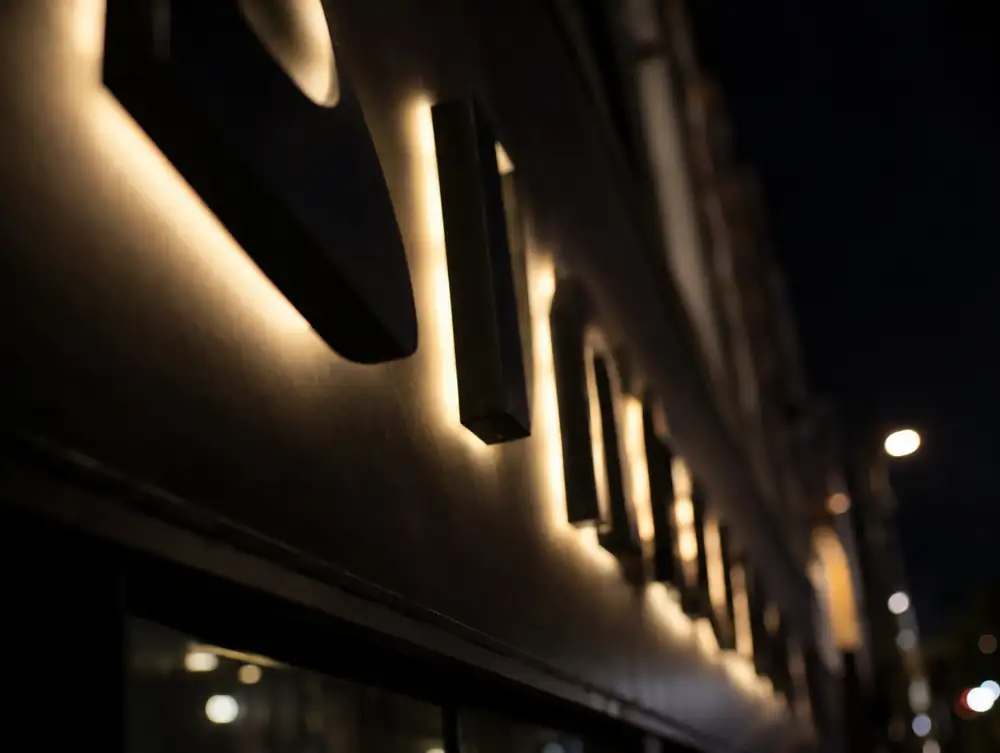
How would we approach illuminated signage for your Stirling premises?
If an old lightbox is coming down, we check the cable position and the wall behind it before designing the new sign. An existing supply can often be reused, which saves work on the inside.
On a timber frontage, a slim trough light usually keeps more of the daytime character than lit letters. We colour-match the bar to the fascia, so it almost disappears by day.
On a north-facing frontage the glass stays free of glare, but the interior can look dim from the street, so lighting needs to sit closer to the window. If your Stirling premises face south, the problem flips to reflections by day and fading stock.
What consents could affect illuminated signage in Stirling?
Scottish guidance says like-for-like windows need no permission, and a true like-for-like frontage replacement usually follows the same logic. Class 7A covers altering or replacing an existing window, but it doesn't mention shopfronts, so ask before relying on it for a display window. For illuminated signage at premises in the Stirling area, a material effect on the external appearance means planning permission, and the council confirms the position.
Class VI is the class for lit signs in Scotland, and it is tightly drawn: each character lit from within, the sign at least 2.5m up, no more than 0.25m of projection, and static lighting. One Scottish council says illuminated signs always need express consent, which doesn't match Class VI, so ask the council for the Stirling area before ordering.
We confirm the position at survey, because a boundary or a special designation can change who handles the file, but applications from Stirling premises normally go to Stirling Council.
What should you budget for illuminated signage in Stirling?
The guide for illuminated signage is £895 to £3,995 plus VAT per sign. Expect the lower end for simple work with clear access, and the upper end where detail, finish or awkward conditions add hours.
| Town | Stirling |
|---|---|
| Area | Stirling and Falkirk |
| Postcode districts | FK11, FK7, FK9 |
| Planning authority | Stirling Council |
| Building approval | Building warrant (Technical Handbook) |
| Distance from Great Barr | About 260 miles |
| Survey | Free for new work |
Questions about illuminated signage in Stirling
Can the sign in Stirling be switched off at night?
Yes. A timer, photocell or simple switch can be built in, and many premises set the sign to go off shortly after closing or late in the evening.
How will I know what my Stirling sign looks like at night?
We draw it on your elevation and describe the lighting effect in the specification, and a sample letter can be tested on your fascia where that helps. Colour temperature and output are agreed before manufacture.
What happens if a lit letter fails on my Stirling sign?
Usually a single LED driver or a damaged connection is to blame, and it can be traced from the access point. That is why drivers are placed where they can be reached without taking the sign down.
Do roller shutters need planning permission in the Stirling area?
Usually yes, if they materially affect the external appearance. Class 9A doesn't name shutters, so in Scotland treat them as falling to the appearance test rather than assuming a permitted development route. Ask the council before ordering, as this is a reading of the rules and not an official statement.
Do I need listed building consent for a shopfront in the Stirling area?
Almost certainly, if the building is listed and windows or doors are changing, according to Historic Environment Scotland. The planning authority decides, and Historic Environment Scotland is consulted on some applications. Scottish Ministers are notified if it objects.