Replacing an old lightbox on Kilsyth premises is a good moment to rethink how the name is lit. Slimmer letters and hidden LEDs can give a far more refined result from the same fascia.
A survey in Kilsyth usually starts outside, looking at the whole elevation before any tape comes out, because the frontage has to answer the building above it.
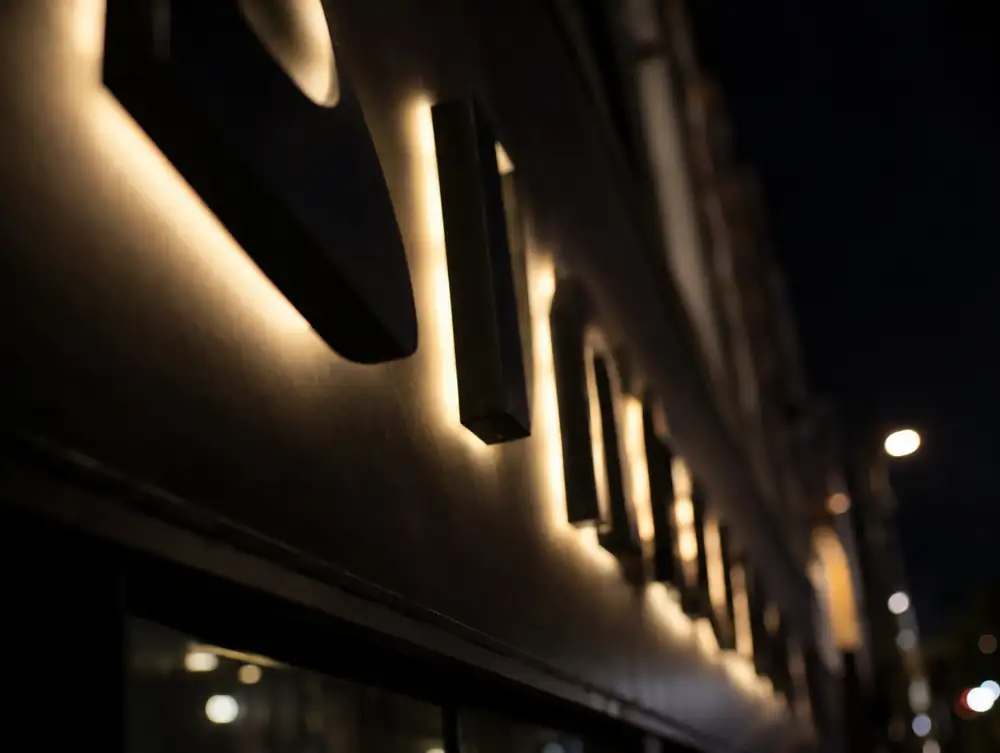
What should you think about before commissioning illuminated signage in Kilsyth?
Where the frontage faces a wide road, face-lit letters can carry further than halo lighting. On a narrower street the softer option usually reads well enough and looks more refined.
If there are flats above your Kilsyth premises, we would keep the output modest and put the sign on a timer. A warm white at lower brightness is kinder to neighbours and still does its job.
Where a fascia has crept down over the years, lifting it back to its original line can add real height to the glass. Check what sits behind it first at Kilsyth premises, since a shutter box or old beam may set the limit.
What is a realistic budget for illuminated signage in Kilsyth?
A sensible starting budget is £895 to £3,995 plus VAT per sign. What shifts the figure is whatever can't be seen yet, such as the condition behind the old frontage or the services running through it.
Who approves illuminated signage in Kilsyth?
Scottish guidance says like-for-like windows need no permission, and a true like-for-like frontage replacement usually follows the same logic. Class 7A covers altering or replacing an existing window, but it doesn't mention shopfronts, so ask before relying on it for a display window. For illuminated signage at premises in the Kilsyth area, a material effect on the external appearance means planning permission, and the council confirms the position.
The 0.25m projection limit in Class VI means most lit projecting signs in Scotland fall outside it. One at premises in the Kilsyth area will usually need advertisement consent, so allow for an application in the programme.
For Kilsyth, the usual route for planning and advert applications is through North Lanarkshire Council, and we confirm that when we visit.
| Town | Kilsyth |
|---|---|
| Area | Lanarkshire |
| Postcode districts | G65 |
| Planning authority | North Lanarkshire Council |
| Building approval | Building warrant (Technical Handbook) |
| Distance from Great Barr | About 252 miles |
| Survey | Free for new work |
Does North Lanarkshire Council publish shopfront guidance?
Yes, Shopfronts & Security (2011). It tells applicants what the council expects from new and altered shopfronts. A few of the things it asks for:
- Original stallrisers should be retained or reinstated, and new ones should be 450mm to 700mm high.
- Fascias should be horizontally proportioned and roughly 300mm to 450mm high.
- Demountable grilles are preferred, and externally stored roller shutters carry a high risk of refusal.
Questions about illuminated signage in Kilsyth
Can the sign in Kilsyth be switched off at night?
Yes. A timer, photocell or simple switch can be built in, and many premises set the sign to go off shortly after closing or late in the evening.
Will a lit sign in Kilsyth cost much to run?
Very little. A typical LED sign uses about the same power as a few domestic lamps, and a timer trims that further. Occasional driver changes are the larger long-term cost.
Can you replace a lightbox on my Kilsyth premises?
Yes. We take the old box down, check the wall and supply behind it, then fit the new sign. Built-up letters will often need a new panel, because the old box leaves a mark on the fascia.
Do I need a building warrant for a shopfront in the Kilsyth area?
Usually yes in Scotland, if the work alters a wall or structure. Schedule 3 of the Building (Scotland) Regulations 2004 lists some work that needs no warrant, such as replacing a door or window with its frame, but the standards still apply. Shopfronts aren't named there, so ask the council before relying on it.
Do I need planning permission to alter a shopfront in the Kilsyth area?
Usually yes, if the work materially affects the external appearance. Class 9A, Scotland's shop permitted development right, doesn't cover work that alters or extends beyond the existing front. A true like-for-like replacement usually needs no permission, and the council confirms the position.