Want a new front for your Kilsyth premises? An aluminium frame gives you slim sightlines and a hard-wearing finish in any RAL colour, proportioned to the building rather than picked from a range.
It helps if you can be there when we visit Kilsyth, since five minutes walking the frontage together answers more than a long email.
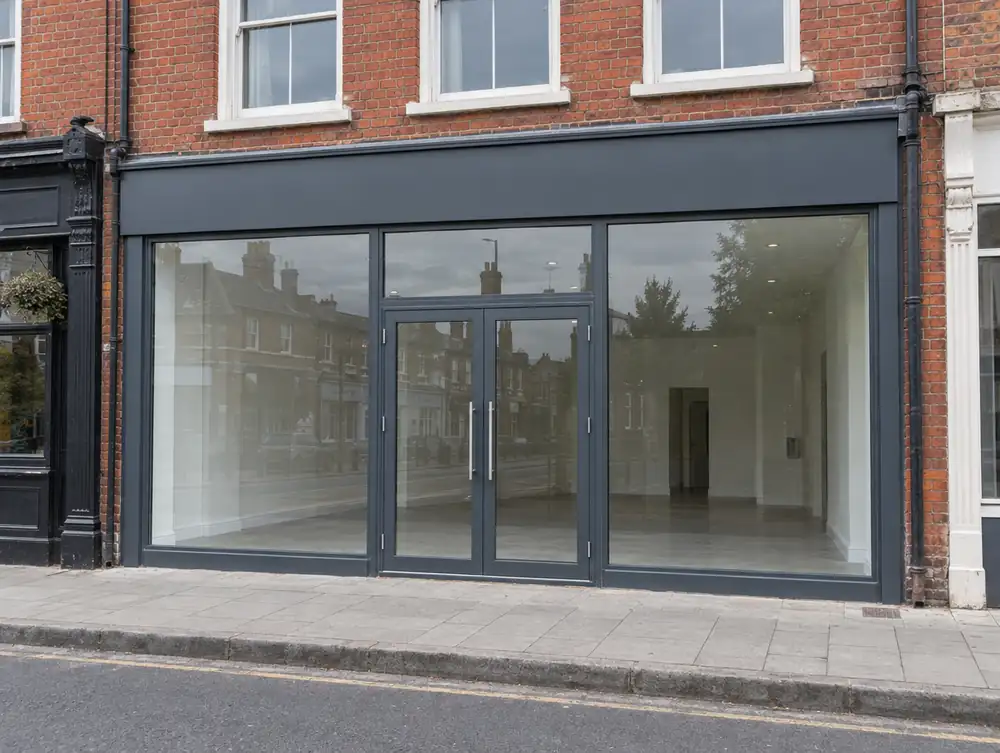
What makes aluminium shopfronts work well on Kilsyth premises?
If your unit sits in a parade in Kilsyth, we'd start with the neighbours: the fascia line, cill height and pier rhythm of the row. Holding those lines lets a slimmer section stand out for the right reasons, rather than fighting everything beside it.
Where Kilsyth premises have a deep recessed entrance, it's usually worth keeping. The angled returns add display length and shelter, and a slim frame with soffit lighting turns a dark corner into the brightest part of the front in the evening.
Where units share one long run of fascia, breaking the height makes you stand out for the wrong reason. If that describes your Kilsyth parade, keep the line and win attention with lettering, lighting and what's in the window.
How much should you set aside for aluminium shopfronts in Kilsyth?
We would budget £2,495 to £11,995 plus VAT for a typical 3 to 7 m frontage. Scope sets most of the figure, so a clear brief at the start does more for the budget than any later change of detail.
Could aluminium shopfronts in Kilsyth need planning permission?
Class 9A, Scotland's shop permitted development right, gives no route for a shopfront change. It covers Class 1A premises, but not work that alters or extends beyond the existing front, and it doesn't apply in conservation areas, National Parks or World Heritage Sites. For aluminium shopfronts at premises in the Kilsyth area, that generally means a planning application unless the external appearance isn't materially affected.
For Kilsyth, the usual route for planning and advert applications is through North Lanarkshire Council, and we confirm that when we visit.
| Town | Kilsyth |
|---|---|
| Area | Lanarkshire |
| Postcode districts | G65 |
| Planning authority | North Lanarkshire Council |
| Building approval | Building warrant (Technical Handbook) |
| Distance from Great Barr | About 252 miles |
| Survey | Free for new work |
Does North Lanarkshire Council publish shopfront guidance?
Yes, Shopfronts & Security (2011). It tells applicants what the council expects from new and altered shopfronts. A few of the things it asks for:
- Original stallrisers should be retained or reinstated, and new ones should be 450mm to 700mm high.
- Fascias should be horizontally proportioned and roughly 300mm to 450mm high.
- Demountable grilles are preferred, and externally stored roller shutters carry a high risk of refusal.
Questions about aluminium shopfronts in Kilsyth
Who carries out the work in Kilsyth?
Vetted teams working under S&K Glazing carry it out, with one named contact from survey to handover. The contract is with S&K Glazing Limited, and we travel to Kilsyth from Great Barr.
Will an aluminium front make my Kilsyth shop warmer?
It can, though the glass matters more than the frame. A thermally broken section with double-glazed units loses less heat than single glazing, and a well-sealed door is often the change you notice most on a cold day.
Can you match a shopfront I like elsewhere in Lanarkshire?
Usually, yes. Send the photo and address, and we'll work out the section, colour and proportions behind it, then adapt them to your Kilsyth opening.
Do I need a building warrant for a shopfront in the Kilsyth area?
Usually yes in Scotland, if the work alters a wall or structure. Schedule 3 of the Building (Scotland) Regulations 2004 lists some work that needs no warrant, such as replacing a door or window with its frame, but the standards still apply. Shopfronts aren't named there, so ask the council before relying on it.
Do I need listed building consent for a shopfront in the Kilsyth area?
Almost certainly, if the building is listed and windows or doors are changing, according to Historic Environment Scotland. The planning authority decides, and Historic Environment Scotland is consulted on some applications. Scottish Ministers are notified if it objects.