Canopies and awnings for Kilsyth premises start with the sun, the wind and the pavement in front of your door. We measure all three, then draw a cover that suits the frontage.
It helps if you can be there when we visit Kilsyth, since five minutes walking the frontage together answers more than a long email.
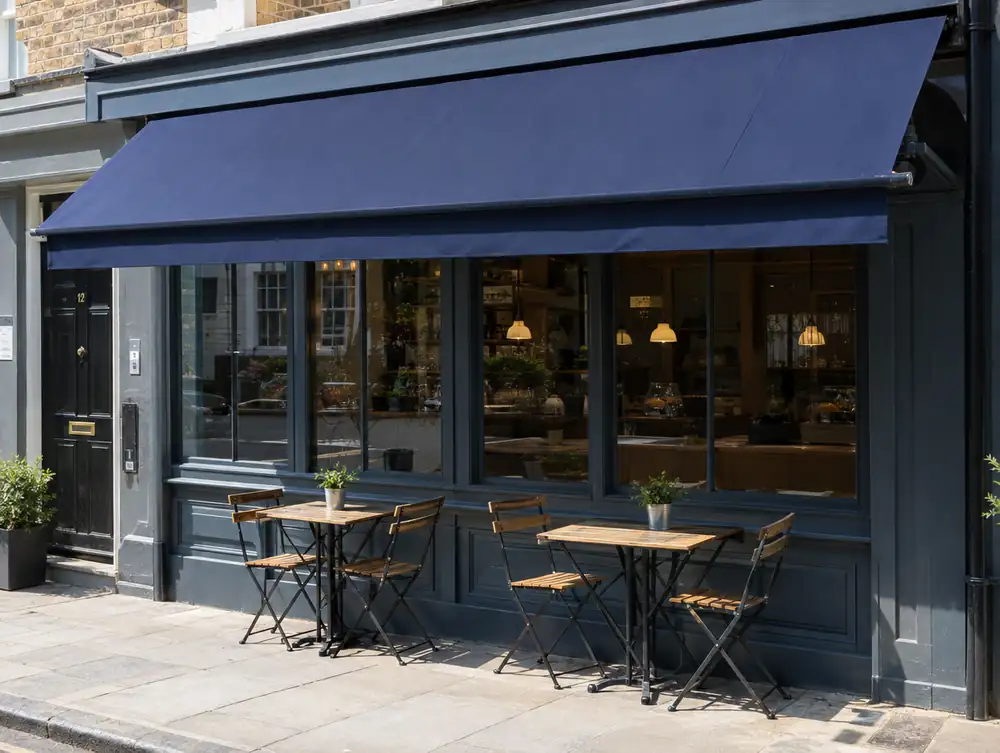
What should you think about before commissioning canopies and awnings in Kilsyth?
If your Kilsyth premises sell food from the front, we would avoid a strong fabric colour that tints the display. Neutral or striped canvas keeps produce looking natural.
If the wall is rendered or cavity-built, we check what lies behind it before designing brackets. Long anchors or a spreader plate can take the load where a standard fixing would pull out.
Where a fascia has crept down over the years, lifting it back to its original line can add real height to the glass. Check what sits behind it first at Kilsyth premises, since a shutter box or old beam may set the limit.
Who approves canopies and awnings in Kilsyth?
Section 26 of the Town and Country Planning (Scotland) Act 1997 sets the test: work that doesn't materially affect the external appearance isn't development. For canopies and awnings at premises in the Kilsyth area, anything that does needs planning permission, and a true like-for-like replacement usually doesn't. The council confirms how that applies to each site.
The 0.25m projection limit in Class VI means most lit projecting signs in Scotland fall outside it. One at premises in the Kilsyth area will usually need advertisement consent, so allow for an application in the programme.
For Kilsyth, the usual route for planning and advert applications is through North Lanarkshire Council, and we confirm that when we visit.
What is a realistic budget for canopies and awnings in Kilsyth?
As a working budget, use £1,495 to £9,995 plus VAT per canopy or awning. Your place inside that range for canopies and awnings depends mostly on how much of the existing frontage can stay and how much has to be put right first.
| Town | Kilsyth |
|---|---|
| Area | Lanarkshire |
| Postcode districts | G65 |
| Planning authority | North Lanarkshire Council |
| Building approval | Building warrant (Technical Handbook) |
| Distance from Great Barr | About 252 miles |
| Survey | Free for new work |
Does North Lanarkshire Council publish shopfront guidance?
Yes, Shopfronts & Security (2011). It tells applicants what the council expects from new and altered shopfronts. A few of the things it asks for:
- Original stallrisers should be retained or reinstated, and new ones should be 450mm to 700mm high.
- Fascias should be horizontally proportioned and roughly 300mm to 450mm high.
- Demountable grilles are preferred, and externally stored roller shutters carry a high risk of refusal.
Questions about canopies and awnings in Kilsyth
Do you replace awning fabric in Kilsyth?
Yes, provided the frame is sound. We measure the frame, check the arms and roller, then make a new cover in your chosen canvas and colour.
Can an awning in Kilsyth be motorised?
Yes, most can. A tubular motor sits inside the roller, with a remote or wall switch, and a wind sensor can be added. You will need a power supply near the box, which we check at survey.
Which awning suits a cafe in Kilsyth?
A folding arm awning with a motor usually suits a cafe, because it covers a wide area with no posts. If tables sit close to the kerb or the site is windy, a shorter projection or fixed canopy may suit better.
Do I need a building warrant for a shopfront in the Kilsyth area?
Usually yes in Scotland, if the work alters a wall or structure. Schedule 3 of the Building (Scotland) Regulations 2004 lists some work that needs no warrant, such as replacing a door or window with its frame, but the standards still apply. Shopfronts aren't named there, so ask the council before relying on it.
Do I need listed building consent for a shopfront in the Kilsyth area?
Almost certainly, if the building is listed and windows or doors are changing, according to Historic Environment Scotland. The planning authority decides, and Historic Environment Scotland is consulted on some applications. Scottish Ministers are notified if it objects.