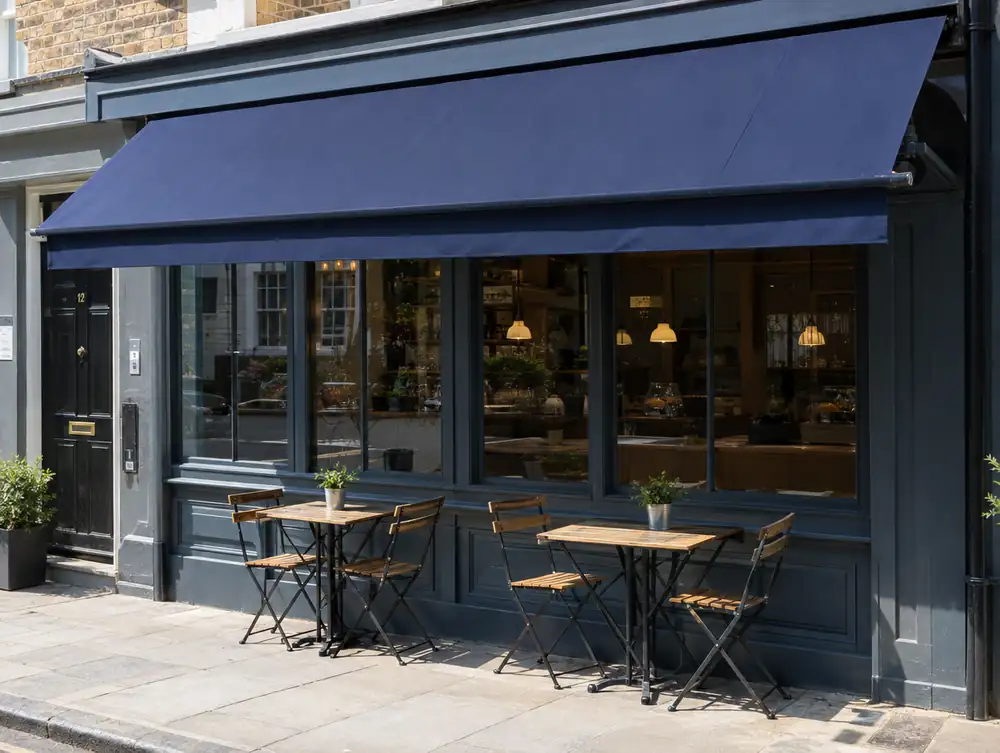
Shade over a window display protects stock as well as customers. For frontages in Cumbernauld that catch the afternoon sun, a folding arm awning or shop blind can slow fading and make the interior easier to see.
Expect us to measure the opening, photograph the existing front and check how materials will reach it on the day, at a time you have agreed.
What goes into getting canopies and awnings right in Cumbernauld?
If the wall is rendered or cavity-built, we check what lies behind it before designing brackets. Long anchors or a spreader plate can take the load where a standard fixing would pull out.
Where the pavement is narrow, a long arm will reach too far, so we would look at a shorter projection or a drop-arm blind. Headroom and the kerb line are measured before we suggest a size.
Where a fascia has crept down over the years, lifting it back to its original line can add real height to the glass. Check what sits behind it first at Cumbernauld premises, since a shutter box or old beam may set the limit.
Which applications might canopies and awnings in Cumbernauld involve?
Scottish guidance says like-for-like windows need no permission, and a true like-for-like frontage replacement usually follows the same logic. Class 7A covers altering or replacing an existing window, but it doesn't mention shopfronts, so ask before relying on it for a display window. For canopies and awnings at premises in the Cumbernauld area, a material effect on the external appearance means planning permission, and the council confirms the position.
The 0.25m projection limit in Class VI means most lit projecting signs in Scotland fall outside it. One at premises in the Cumbernauld area will usually need advertisement consent, so allow for an application in the programme.
Planning and advert applications for Cumbernauld premises normally go to North Lanarkshire Council. We check the position for your address at survey.
How much could canopies and awnings in Cumbernauld cost you?
A sensible starting budget is £1,495 to £9,995 plus VAT per canopy or awning. What shifts the figure is whatever can't be seen yet, such as the condition behind the old frontage or the services running through it.
| Town | Cumbernauld |
|---|---|
| Area | Lanarkshire |
| Postcode districts | G67 |
| Planning authority | North Lanarkshire Council |
| Building approval | Building warrant (Technical Handbook) |
| Distance from Great Barr | About 249 miles |
| Survey | Free for new work |
Does North Lanarkshire Council publish shopfront guidance?
Yes, Shopfronts & Security (2011). It tells applicants what the council expects from new and altered shopfronts. A few of the things it asks for:
- Original stallrisers should be retained or reinstated, and new ones should be 450mm to 700mm high.
- Fascias should be horizontally proportioned and roughly 300mm to 450mm high.
- Demountable grilles are preferred, and externally stored roller shutters carry a high risk of refusal.
Questions about canopies and awnings in Cumbernauld
Do you replace awning fabric in Cumbernauld?
Yes, provided the frame is sound. We measure the frame, check the arms and roller, then make a new cover in your chosen canvas and colour.
Will an awning hide the sign on my Cumbernauld premises?
It should not, if it is designed properly. We place the box and valance so the name reads with the cover out, or we add lettering to the valance.
Which awning suits a cafe in Cumbernauld?
A folding arm awning with a motor usually suits a cafe, because it covers a wide area with no posts. If tables sit close to the kerb or the site is windy, a shorter projection or fixed canopy may suit better.
Does the Equality Act cover a shop entrance in the Cumbernauld area?
Yes. The Equality Act 2010 applies in Scotland as part of Great Britain, and its anticipatory duty expects reasonable steps to remove, alter or avoid physical features that disadvantage disabled people generally. BS 8300-2:2018 is the current British Standard for accessible buildings.
Does a shop sign in the Cumbernauld area need advertisement consent?
Not always. Scotland's 1984 Regulations let an unlit sign within Class IV(1) go up without an application, and Class VI does the same for a lit sign with each character lit from within. Class VI isn't available in conservation areas, and one council says lit signs always need express consent, so ask first.