For an entrance in Cumbernauld that stays busy all day, the sensor set-up matters as much as the door. Done well, it opens for customers and ignores people walking past, which keeps the heat in the shop.
Measuring the opening is the easy part of a survey in Cumbernauld. We also look at the beam above, the pavement fall and any meters or drains nearby.
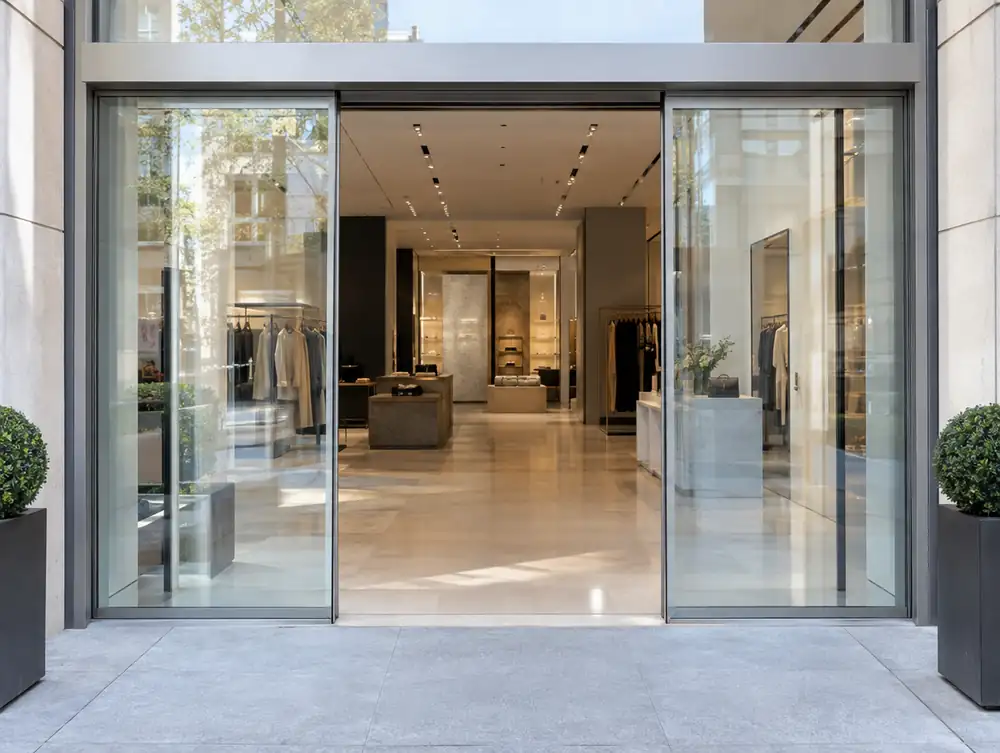
How would we approach automatic sliding doors for your Cumbernauld premises?
For a pharmacy or retail chain with a branch in Cumbernauld, we'd keep the door type, finish and settings the same as the estate standard. Opening width and head detail then adapt to this particular front.
A corner unit in Cumbernauld can often move its entrance to the angle, where two directions of footfall meet. We'd look at a curved or canted door set, and check the wind on both streets before fixing the position.
If your Cumbernauld unit sits in a Victorian parade, the old pilasters usually set the rhythm, so a new front should land on them and not run past them. Keep that line and even a modern frame looks as though it belongs.
What should you budget for automatic sliding doors in Cumbernauld?
Our guide band is £3,895 to £11,995 plus VAT per entrance. Scope is the biggest lever, so a tighter brief for automatic sliding doors brings the figure down faster than any change of detail.
What consents could affect automatic sliding doors in Cumbernauld?
Section 26 of the Town and Country Planning (Scotland) Act 1997 sets the test: work that doesn't materially affect the external appearance isn't development. For automatic sliding doors at premises in the Cumbernauld area, anything that does needs planning permission, and a true like-for-like replacement usually doesn't. The council confirms how that applies to each site.
We confirm the position at survey, because a boundary or a special designation can change who handles the file, but applications from Cumbernauld premises normally go to North Lanarkshire Council.
| Town | Cumbernauld |
|---|---|
| Area | Lanarkshire |
| Postcode districts | G67 |
| Planning authority | North Lanarkshire Council |
| Building approval | Building warrant (Technical Handbook) |
| Distance from Great Barr | About 249 miles |
| Survey | Free for new work |
Does North Lanarkshire Council publish shopfront guidance?
Yes, Shopfronts & Security (2011). It tells applicants what the council expects from new and altered shopfronts. A few of the things it asks for:
- Original stallrisers should be retained or reinstated, and new ones should be 450mm to 700mm high.
- Fascias should be horizontally proportioned and roughly 300mm to 450mm high.
- Demountable grilles are preferred, and externally stored roller shutters carry a high risk of refusal.
Questions about automatic sliding doors in Cumbernauld
Can an automatic door work with my Cumbernauld shop's alarm and locks?
Yes. The door can lock at closing, and it can link to your alarm or access control where the systems allow, with a manual key position as a fallback.
Will an automatic door fit my Cumbernauld shop?
It depends on the width of the front and the depth at the head. A survey shows whether the parked leaves fit and where the operator can hide, and if a slider won't work we'd look at a powered swing door.
What will people on the street see at my Cumbernauld entrance?
Ideally, very little. The drive sits behind the fascia, the leaves line up with the screens beside them, and the frame colour matches the rest of your front.
Do roller shutters need planning permission in the Cumbernauld area?
Usually yes, if they materially affect the external appearance. Class 9A doesn't name shutters, so in Scotland treat them as falling to the appearance test rather than assuming a permitted development route. Ask the council before ordering, as this is a reading of the rules and not an official statement.
Do I need planning permission to alter a shopfront in the Cumbernauld area?
Usually yes, if the work materially affects the external appearance. Class 9A, Scotland's shop permitted development right, doesn't cover work that alters or extends beyond the existing front. A true like-for-like replacement usually needs no permission, and the council confirms the position.