We make timber shopfronts for Kilsyth premises, from plain painted frames to full cornice and console fronts. Every one starts with a measured survey and scale drawings.
Please have keys to any meter cupboards and shutter housings to hand when we survey in Kilsyth, because what sits behind them can change the drawing.
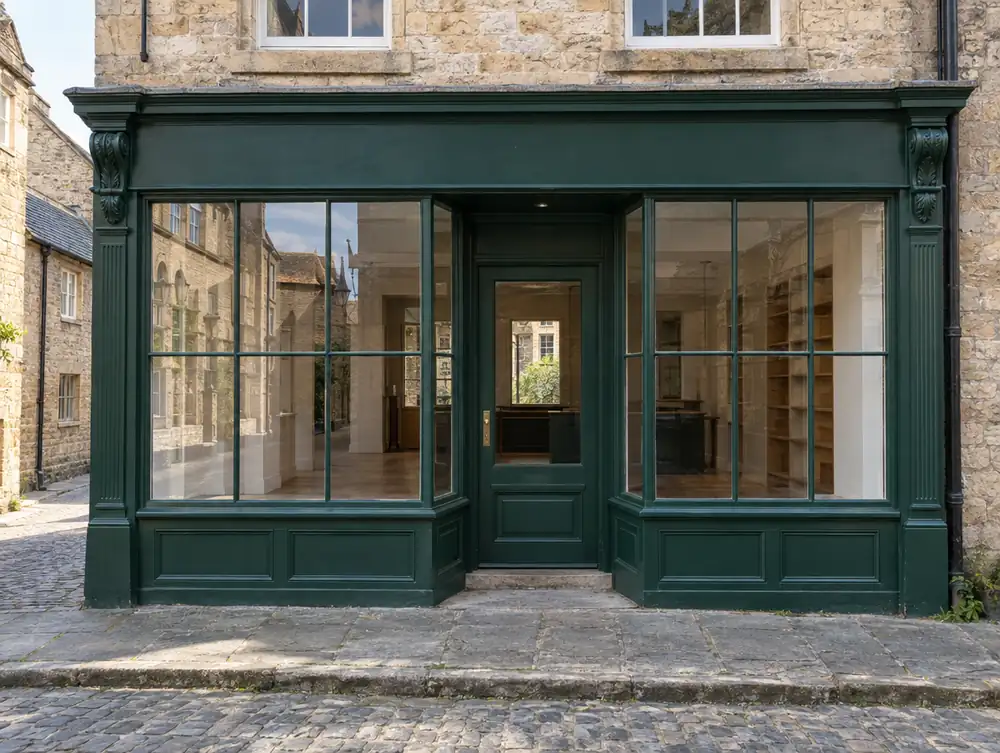
What goes into getting timber shopfronts right in Kilsyth?
Timber fits a night programme better than you'd think, since most of the joinery is made elsewhere. For a unit in Kilsyth that can't close by day, we'd fit the frame in stages at night and leave painting until the end, once the dust has gone.
A south or west-facing Kilsyth frontage is hard on paint. We'd steer you toward a lighter colour or a more stable timber, and if the brand needs a dark finish, we'd plan a shorter repaint interval from the outset.
If the pavement falls across your frontage, let the stallriser take up the slope and keep the glass line dead level. The eye reads the long horizontal, so Kilsyth premises on a slope look settled once that line is true.
How much could timber shopfronts in Kilsyth cost you?
We would budget £3,995 to £13,995 plus VAT for a typical frontage. Scope sets most of the figure, so a clear brief at the start does more for the budget than any later change of detail.
Which applications might timber shopfronts in Kilsyth involve?
Scottish guidance says like-for-like windows need no permission, and a true like-for-like frontage replacement usually follows the same logic. Class 7A covers altering or replacing an existing window, but it doesn't mention shopfronts, so ask before relying on it for a display window. For timber shopfronts at premises in the Kilsyth area, a material effect on the external appearance means planning permission, and the council confirms the position.
Planning and advert applications for Kilsyth premises normally go to North Lanarkshire Council. We check the position for your address at survey.
| Town | Kilsyth |
|---|---|
| Area | Lanarkshire |
| Postcode districts | G65 |
| Planning authority | North Lanarkshire Council |
| Building approval | Building warrant (Technical Handbook) |
| Distance from Great Barr | About 252 miles |
| Survey | Free for new work |
Does North Lanarkshire Council publish shopfront guidance?
Yes, Shopfronts & Security (2011). It tells applicants what the council expects from new and altered shopfronts. A few of the things it asks for:
- Original stallrisers should be retained or reinstated, and new ones should be 450mm to 700mm high.
- Fascias should be horizontally proportioned and roughly 300mm to 450mm high.
- Demountable grilles are preferred, and externally stored roller shutters carry a high risk of refusal.
Questions about timber shopfronts in Kilsyth
Is timber a sensible choice for my Kilsyth frontage?
Usually, if you're happy with a repaint every 5 to 7 years. A survey shows how exposed the front is and whether the structure behind it is sound, and we'll tell you if aluminium would serve you better.
Do you make the joinery for Kilsyth shops to order?
Yes. Every length is made to the signed-off drawings for your opening, then brought to Kilsyth from Great Barr by vetted teams working under S&K Glazing.
Can a timber front take a modern sign in Kilsyth?
Yes. Hand-painted letters suit a timber fascia well, and raised letters or a concealed trough light work too. We draw the sign and the joinery together, so the fixings don't cut through a moulding.
Does the Equality Act cover a shop entrance in the Kilsyth area?
Yes. The Equality Act 2010 applies in Scotland as part of Great Britain, and its anticipatory duty expects reasonable steps to remove, alter or avoid physical features that disadvantage disabled people generally. BS 8300-2:2018 is the current British Standard for accessible buildings.
Which way must a fire exit door open on a shop in the Kilsyth area?
In the direction of escape. Regulation 13(2) of the Fire Safety (Scotland) Regulations 2006 also rules out sliding and revolving doors on a dedicated fire exit and says fire exit doors can't be locked against immediate use. Duties sit with dutyholders under Part 3 of the Fire (Scotland) Act 2005, meaning the employer and any person with control of the premises.