Every enquiry for illuminated signage in Lanarkshire begins with a measured survey at the premises, because a price taken from a photograph is only a guess. That visit gives you real dimensions before anyone draws a line or orders a thing.
Openings are rarely square or level, so the survey for illuminated signage records diagonals, pavement fall and head height at several points. Those few millimetres decide whether the finished front sits true against the building.
What should you settle before committing to illuminated signage in Lanarkshire?
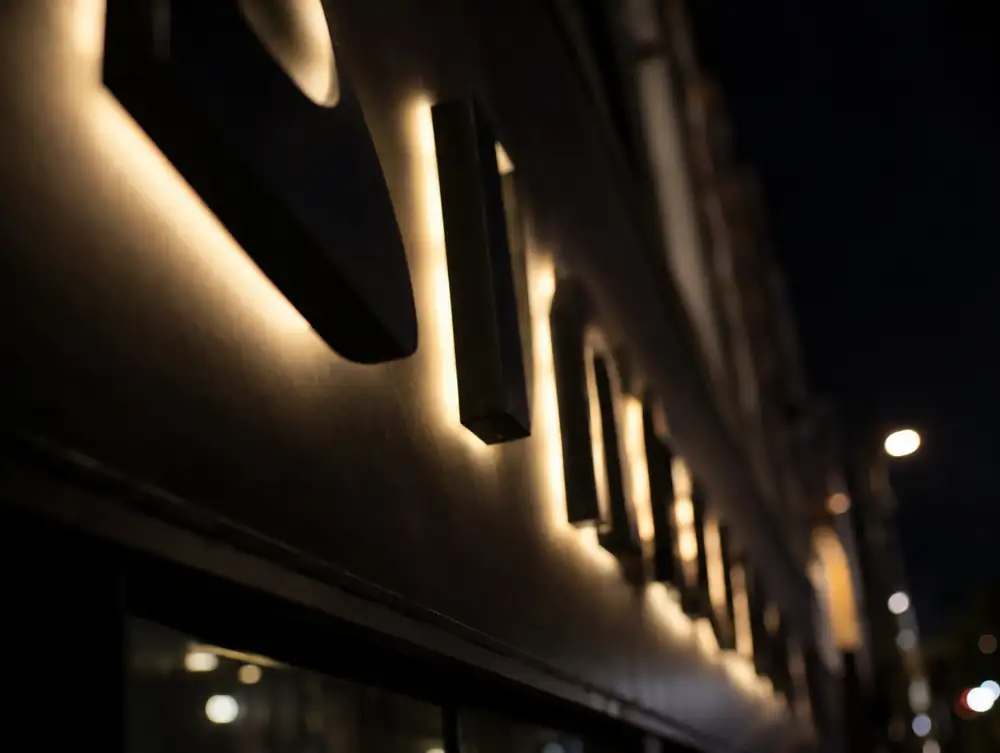
Background decides whether halo lighting works. On premises around Hamilton we test the glow against your actual fascia finish, because brick, painted timber and dark composite each throw the light differently.
Flats or hotel rooms nearby change the brief. Where premises in Lanarkshire have neighbours close by at night, a warmer white, lower output and a late timer keep the sign welcome.
What consents apply to illuminated signage in Lanarkshire?
Section 26 of the Town and Country Planning (Scotland) Act 1997 sets the test: work that doesn't materially affect the external appearance isn't development. For illuminated signage at premises in the Lanarkshire area, anything that does needs planning permission, and a true like-for-like replacement usually doesn't. The council confirms how that applies to each site.
Signs in Scotland come under the 1984 Advertisement Regulations, which have their own class numbers. At premises in the Lanarkshire area, an unlit fascia sign generally needs no application under Class IV(1) of Schedule 4 if it sits on a wall containing a shop window, tops out at 4.6m or first-floor level, and keeps letters to 0.75m high. Anything beyond that needs advertisement consent, and displaying a sign without consent is a criminal offence.
How much does illuminated signage cost in Lanarkshire?
Allow £895 to £3,995 plus VAT per sign. Size and specification set most of that figure for illuminated signage, and the rest depends on what the survey finds on site.
| Area | Lanarkshire |
|---|---|
| Nation | Scotland |
| Towns covered | 17 |
| Main town | Hamilton |
| Planning regime | Scotland: 1997 Planning Act and the 1984 Advertisement Regulations |
| Building approval | Building warrant (Technical Handbook) |
| Survey | Free for new work, from our Great Barr base |
Does North Lanarkshire Council publish shopfront guidance?
Yes, Shopfronts & Security (2011). It tells applicants what the council expects from new and altered shopfronts. A few of the things it asks for:
- Original stallrisers should be retained or reinstated, and new ones should be 450mm to 700mm high.
- Fascias should be horizontally proportioned and roughly 300mm to 450mm high.
- Demountable grilles are preferred, and externally stored roller shutters carry a high risk of refusal.
Questions about illuminated signage in Lanarkshire
How disruptive is fitting a lit sign in Lanarkshire?
Very little, as a rule. Fitting usually takes one to two days from a tower or platform, and any cable work inside the shop can be done outside trading hours.
Can a lit sign in Lanarkshire be set on a timer?
Yes, and we would recommend it. A timer or photocell switches the sign to suit your trading hours, and it can dim or switch off late in the evening.
Can you match the lit signs on my other sites in Lanarkshire?
Usually, yes. We take the letter style, LED colour temperature and output from an existing site, then specify the same again. LED batches vary a little, so we check a sample side by side if the sites are close together.
Do I need a building warrant for a shopfront in the Lanarkshire area?
Usually yes in Scotland, if the work alters a wall or structure. Schedule 3 of the Building (Scotland) Regulations 2004 lists some work that needs no warrant, such as replacing a door or window with its frame, but the standards still apply. Shopfronts aren't named there, so ask the council before relying on it.
Which way must a fire exit door open on a shop in the Lanarkshire area?
In the direction of escape. Regulation 13(2) of the Fire Safety (Scotland) Regulations 2006 also rules out sliding and revolving doors on a dedicated fire exit and says fire exit doors can't be locked against immediate use. Duties sit with dutyholders under Part 3 of the Fire (Scotland) Act 2005, meaning the employer and any person with control of the premises.