One contract covers the frontage when you come to us for structural glazing in Lanarkshire, so glass, frame, sign and shutter aren't separate trades to chase. You also keep one named contact from first visit to handover.
If you're a tenant, your landlord will probably want to see what is proposed. The scale drawings we produce for structural glazing are clear enough to send straight on, which saves a round of explaining.
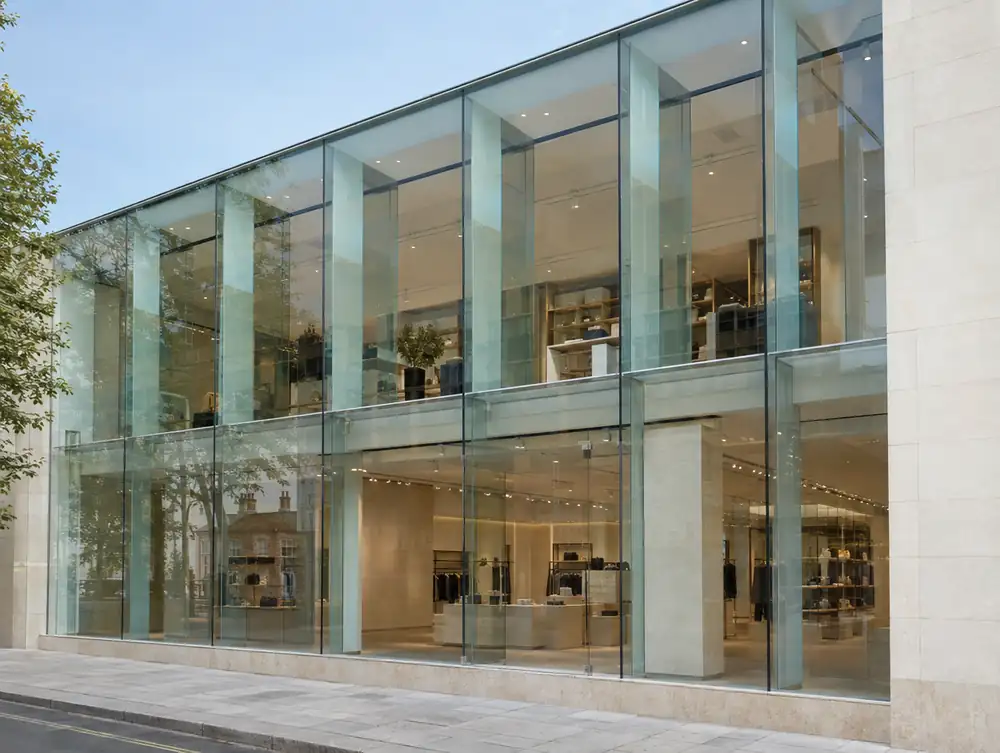
How do we handle structural glazing for premises in Lanarkshire?
Narrow streets call for a different grid. Where premises around Hamilton open onto a tight street, one big pane can become two smaller ones with a fin on the joint, trading a little purity for a lift that can happen safely.
Deflection matters as much as strength if your frontage in Lanarkshire sits beneath a steel or timber head. We check how that head behaves before glass goes under it, since a pane with no frame cannot absorb movement.
What consents apply to structural glazing in Lanarkshire?
Shutters aren't named in Class 9A, so in Scotland they usually fall to the appearance test. The same goes for structural glazing at premises in the Lanarkshire area: building work that materially affects the external appearance needs planning permission, and a true like-for-like usually doesn't. Ask the council to confirm the position for your site.
How much does structural glazing cost in Lanarkshire?
Our guide band is £950 to £1,850 plus VAT per m². Scope is the biggest lever, so a tighter brief for structural glazing brings the figure down faster than any change of detail.
| Area | Lanarkshire |
|---|---|
| Nation | Scotland |
| Towns covered | 17 |
| Main town | Hamilton |
| Planning regime | Scotland: 1997 Planning Act and the 1984 Advertisement Regulations |
| Building approval | Building warrant (Technical Handbook) |
| Survey | Free for new work, from our Great Barr base |
Does North Lanarkshire Council publish shopfront guidance?
Yes, Shopfronts & Security (2011). It tells applicants what the council expects from new and altered shopfronts. A few of the things it asks for:
- Original stallrisers should be retained or reinstated, and new ones should be 450mm to 700mm high.
- Fascias should be horizontally proportioned and roughly 300mm to 450mm high.
- Demountable grilles are preferred, and externally stored roller shutters carry a high risk of refusal.
Questions about structural glazing in Lanarkshire
What happens if a large pane breaks on premises in Lanarkshire?
A laminated pane normally stays in place until it can be replaced. We would make the opening safe, then schedule the new pane and the lift, which typically takes some weeks because large glass is made to order.
Can large glass reach premises on a narrow street in Lanarkshire?
Often, yes, though pane size may need to change. We measure the street, the kerb and any overhead obstructions at survey, then size the glass around what a lifter can reach.
Will my existing floor in Lanarkshire take a concealed channel?
That depends on the depth of the floor build-up. Where it is too shallow, the channel can sit on the slab with the finish cut around it, or a raised detail can be drawn. We open up a small area at survey to find out.
Do I need planning permission to alter a shopfront in the Lanarkshire area?
Usually yes, if the work materially affects the external appearance. Class 9A, Scotland's shop permitted development right, doesn't cover work that alters or extends beyond the existing front. A true like-for-like replacement usually needs no permission, and the council confirms the position.
Which way must a fire exit door open on a shop in the Lanarkshire area?
In the direction of escape. Regulation 13(2) of the Fire Safety (Scotland) Regulations 2006 also rules out sliding and revolving doors on a dedicated fire exit and says fire exit doors can't be locked against immediate use. Duties sit with dutyholders under Part 3 of the Fire (Scotland) Act 2005, meaning the employer and any person with control of the premises.