From Hamilton to the furthest corner of Lanarkshire, the sequence for stallrisers and cladding stays the same: survey, drawings, written price, then work on site. We travel from Great Barr in Birmingham and use vetted teams working under S&K Glazing.
Access gets as much attention as appearance at survey. Where a vehicle can stop, how long sections reach the opening and how the pavement stays safe for the public all shape the programme for stallrisers and cladding in Lanarkshire.
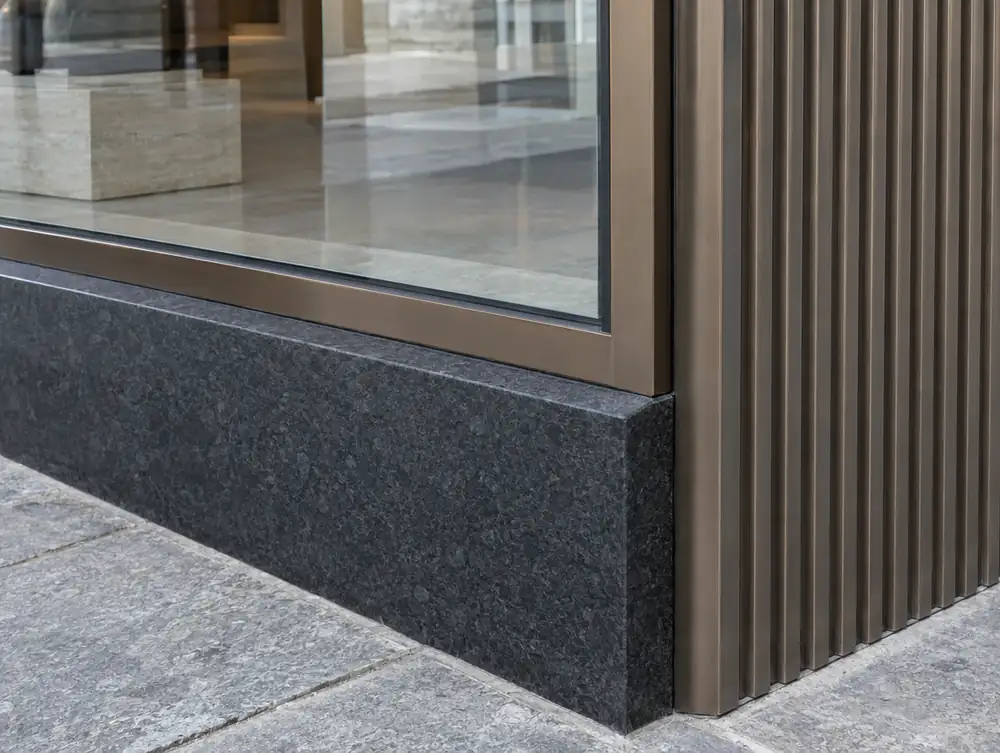
How should you approach stallrisers and cladding in Lanarkshire?
Neighbouring frontages are the first reference for height. At survey near Hamilton we note the sill lines on either side of your unit, then decide whether to match them or make a deliberate break.
A restaurant and a jeweller want very different stallrisers, even side by side. For premises in Lanarkshire we set the height around what people do behind the glass, whether that is sitting, browsing or studying a tray.
What consents apply to stallrisers and cladding in Lanarkshire?
Scottish guidance says like-for-like windows need no permission, and a true like-for-like frontage replacement usually follows the same logic. Class 7A covers altering or replacing an existing window, but it doesn't mention shopfronts, so ask before relying on it for a display window. For stallrisers and cladding at premises in the Lanarkshire area, a material effect on the external appearance means planning permission, and the council confirms the position.
How much do stallrisers and cladding cost in Lanarkshire?
A sensible starting budget is £195 to £495 plus VAT per m². What shifts the figure is whatever can't be seen yet, such as the condition behind the old frontage or the services running through it.
| Area | Lanarkshire |
|---|---|
| Nation | Scotland |
| Towns covered | 17 |
| Main town | Hamilton |
| Planning regime | Scotland: 1997 Planning Act and the 1984 Advertisement Regulations |
| Building approval | Building warrant (Technical Handbook) |
| Survey | Free for new work, from our Great Barr base |
Does North Lanarkshire Council publish shopfront guidance?
Yes, Shopfronts & Security (2011). It tells applicants what the council expects from new and altered shopfronts. A few of the things it asks for:
- Original stallrisers should be retained or reinstated, and new ones should be 450mm to 700mm high.
- Fascias should be horizontally proportioned and roughly 300mm to 450mm high.
- Demountable grilles are preferred, and externally stored roller shutters carry a high risk of refusal.
Questions about stallrisers and cladding in Lanarkshire
Can you match an existing tiled stallriser on premises in Lanarkshire?
Often, yes, though an exact glaze match can be difficult. We take a sample tile, compare it with what is available, and suggest a specialist tile or a change at a natural break if the colour cannot be found.
Can stallriser work on premises around Hamilton be done in a day?
A straightforward composite or painted panel often can, and fitting can be arranged on a closed day. Stone and tile take longer because of fixing and setting time, so we would agree a short phased plan.
Can you reclad only the stallriser on my premises in Lanarkshire?
Yes. It is one of the simplest ways to lift a tired frontage, provided the frame above is sound. We check the sill detail first, because a new facing must not trap water beneath it.
Do I need a building warrant for a shopfront in the Lanarkshire area?
Usually yes in Scotland, if the work alters a wall or structure. Schedule 3 of the Building (Scotland) Regulations 2004 lists some work that needs no warrant, such as replacing a door or window with its frame, but the standards still apply. Shopfronts aren't named there, so ask the council before relying on it.
Does the Equality Act cover a shop entrance in the Lanarkshire area?
Yes. The Equality Act 2010 applies in Scotland as part of Great Britain, and its anticipatory duty expects reasonable steps to remove, alter or avoid physical features that disadvantage disabled people generally. BS 8300-2:2018 is the current British Standard for accessible buildings.