For curved glass shopfronts across Lanarkshire, we draw first and order later. You see a scale drawing with signed-off dimensions before anything is made, so the frontage on paper is the frontage you get.
Finishes behave differently at full size. Any sample we show you for curved glass shopfronts is better judged at the premises in daylight, since a colour that looks quiet on a desk can read much louder across a whole elevation.
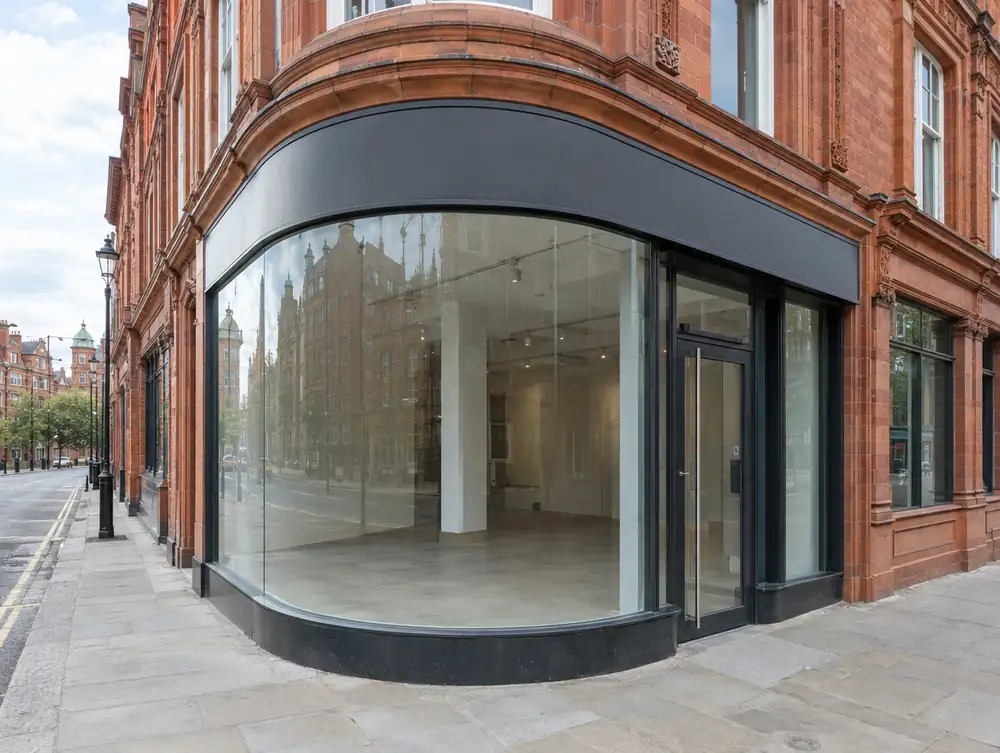
What makes curved glass shopfronts work well for premises in Lanarkshire?
Breakage plans matter more with curved glass. For premises across Lanarkshire, we'd keep the template and glass details on record and talk through how the opening would be protected during the weeks a new pane takes.
A curved pane follows the building instead of a catalogue. For premises across Lanarkshire we template the real corner at floor, waist and head height, because old brickwork often drifts from one radius to another.
What consents apply to curved glass shopfronts in Lanarkshire?
Class 9A, Scotland's shop permitted development right, gives no route for a shopfront change. It covers Class 1A premises, but not work that alters or extends beyond the existing front, and it doesn't apply in conservation areas, National Parks or World Heritage Sites. For curved glass shopfronts at premises in the Lanarkshire area, that generally means a planning application unless the external appearance isn't materially affected.
How much do curved glass shopfronts cost in Lanarkshire?
The guide for curved glass shopfronts is £6,995 to £19,995 plus VAT for a typical frontage. Expect the lower end for simple work with clear access, and the upper end where detail, finish or awkward conditions add hours.
| Area | Lanarkshire |
|---|---|
| Nation | Scotland |
| Towns covered | 17 |
| Main town | Hamilton |
| Planning regime | Scotland: 1997 Planning Act and the 1984 Advertisement Regulations |
| Building approval | Building warrant (Technical Handbook) |
| Survey | Free for new work, from our Great Barr base |
Does North Lanarkshire Council publish shopfront guidance?
Yes, Shopfronts & Security (2011). It tells applicants what the council expects from new and altered shopfronts. A few of the things it asks for:
- Original stallrisers should be retained or reinstated, and new ones should be 450mm to 700mm high.
- Fascias should be horizontally proportioned and roughly 300mm to 450mm high.
- Demountable grilles are preferred, and externally stored roller shutters carry a high risk of refusal.
Questions about curved glass shopfronts in Lanarkshire
What if my corner in Lanarkshire is not a true curve?
Most aren't. We set the glass to the closest arc and absorb the rest in the head and floor channels, or build out the surround where the building drifts too far.
Do you supply curved glass shopfronts across Lanarkshire?
Yes. We travel from Great Barr to template the curve and fit the glass, with the panes made to that template.
Can the old curved pane at my Lanarkshire premises be reused?
Sometimes, if it is sound and can be taken out safely. We'd examine it at survey and tell you honestly whether repairing around it is the safer choice.
Does a shop sign in the Lanarkshire area need advertisement consent?
Not always. Scotland's 1984 Regulations let an unlit sign within Class IV(1) go up without an application, and Class VI does the same for a lit sign with each character lit from within. Class VI isn't available in conservation areas, and one council says lit signs always need express consent, so ask first.
Do roller shutters need planning permission in the Lanarkshire area?
Usually yes, if they materially affect the external appearance. Class 9A doesn't name shutters, so in Scotland treat them as falling to the appearance test rather than assuming a permitted development route. Ask the council before ordering, as this is a reading of the rules and not an official statement.