Our fee for planning and consent support in Lanarkshire is written and itemised before any work starts, which gives you time to take it to a landlord, a partner or a board.
Access gets as much attention as appearance at survey. Where a vehicle can stop, how long sections reach the opening and how the pavement stays safe for the public all shape the programme for planning and consent support in Lanarkshire.
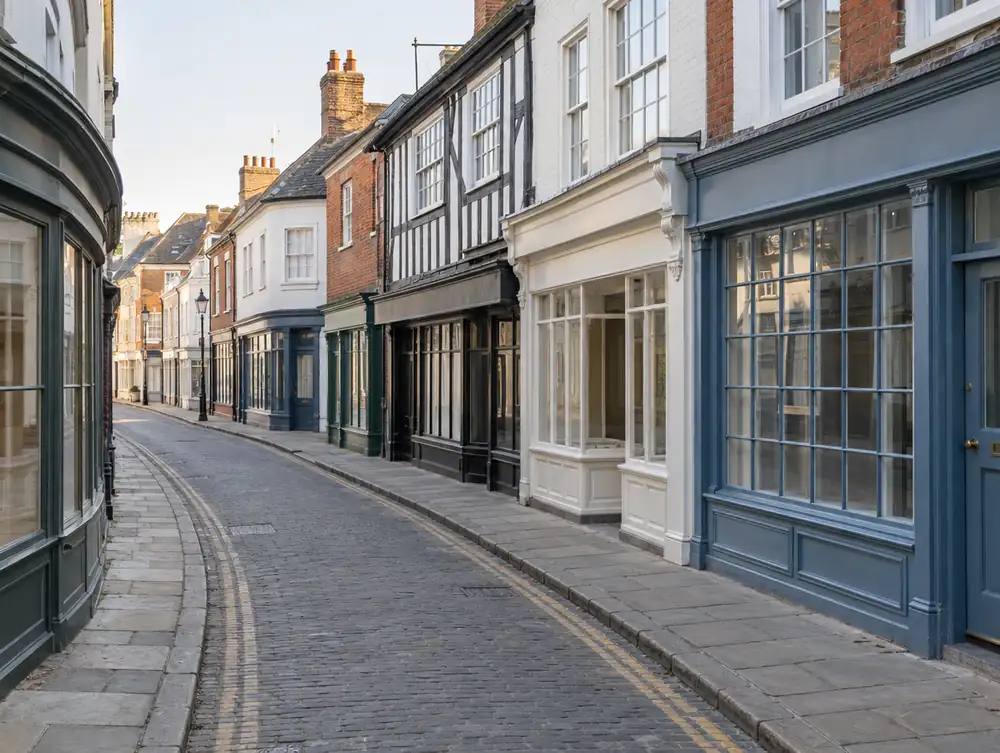
What makes planning and consent support work well for premises in Lanarkshire?
Older buildings need more evidence. If your premises in Lanarkshire have surviving features, we photograph and draw them before the design is fixed, so the submission shows what will be kept.
Good applications start with good photographs. For premises across Lanarkshire we record the frontage, its neighbours and the wider street at survey, so the drawings show your proposal in context.
What consents apply to shopfront work in Lanarkshire?
Class 9A, Scotland's shop permitted development right, gives no route for a shopfront change. It covers Class 1A premises, but not work that alters or extends beyond the existing front, and it doesn't apply in conservation areas, National Parks or World Heritage Sites. For shopfront work at premises in the Lanarkshire area, that generally means a planning application unless the external appearance isn't materially affected.
How much does planning and consent support cost in Lanarkshire?
The guide for planning and consent support is £395 to £1,295 plus VAT per application, plus the council's fee. Expect the lower end for simple work with clear access, and the upper end where detail, finish or awkward conditions add hours.
| Area | Lanarkshire |
|---|---|
| Nation | Scotland |
| Towns covered | 17 |
| Main town | Hamilton |
| Planning regime | Scotland: 1997 Planning Act and the 1984 Advertisement Regulations |
| Building approval | Building warrant (Technical Handbook) |
| Survey | Free for new work, from our Great Barr base |
Does North Lanarkshire Council publish shopfront guidance?
Yes, Shopfronts & Security (2011). It tells applicants what the council expects from new and altered shopfronts. A few of the things it asks for:
- Original stallrisers should be retained or reinstated, and new ones should be 450mm to 700mm high.
- Fascias should be horizontally proportioned and roughly 300mm to 450mm high.
- Demountable grilles are preferred, and externally stored roller shutters carry a high risk of refusal.
Questions about planning and consent support in Lanarkshire
Can you take over an application already started for premises around Hamilton?
Often, yes. Send us the drawings and any correspondence, and we will check them against a measured survey. If the officer has raised points, we would deal with those first.
What photographs help with an application near Hamilton?
Straight-on views of the frontage, views along the street in both directions and close-ups of any older details. We take photographs at survey, and yours can add useful history.
Do you prepare applications for premises across Lanarkshire?
Yes. We measure, draw and prepare the application, then submit it and answer the officer's questions. The decision itself is never ours to make, and we will always be plain about that.
Which way must a fire exit door open on a shop in the Lanarkshire area?
In the direction of escape. Regulation 13(2) of the Fire Safety (Scotland) Regulations 2006 also rules out sliding and revolving doors on a dedicated fire exit and says fire exit doors can't be locked against immediate use. Duties sit with dutyholders under Part 3 of the Fire (Scotland) Act 2005, meaning the employer and any person with control of the premises.
Does a shop sign in the Lanarkshire area need advertisement consent?
Not always. Scotland's 1984 Regulations let an unlit sign within Class IV(1) go up without an application, and Class VI does the same for a lit sign with each character lit from within. Class VI isn't available in conservation areas, and one council says lit signs always need express consent, so ask first.