A shop sign needs express advertisement consent when it falls outside the deemed consent classes for its nation. An unlit fascia sign within the height and letter limits usually needs no application, but lit signs face tighter rules and the lit class is unavailable in conservation areas in all four nations. Displaying an advert without consent is a criminal offence, so ask the council if you are unsure.
When does a shop sign need advertisement consent?
A sign needs express consent when it falls outside the deemed consent classes, which let certain signs go up without an application if they keep to set limits. Each nation has its own regulations and class numbers, although the idea is the same. Getting this wrong is a criminal matter, so check before any letters are ordered.
Most unlit fascia signs sit within deemed consent when the height and letter limits are respected. One trap catches people out: on a shop, unlit-class signs may only go on a wall containing a shop window. A sign on a blank gable or side elevation is a different conversation, even if the brand manual shows one there.
Measure before you design. A sloping street can put one end of a long fascia over the limit while the other end sits comfortably inside it. Buildings with low first-floor cills can also be tighter than the headline figure suggests, because the sign has to stay under the cill where that is lower.
| Limit | England | Wales | Scotland | Northern Ireland |
|---|---|---|---|---|
| Regulations | SI 2007/783 Sch 3 | SI 1992/666 Sch 3 | SI 1984/467 Sch 4 | SR 2015/66 Sch 3 |
| Unlit / lit class | 5 / 4B | 5 / 4B | IV(1) / VI | 5 / 4(2) |
| Top of sign | 4.6m, or first-floor sill if lower | As England | 4.6m or first-floor level | 5m, or first-floor sill if lower |
| Letter height | 0.75m | Ask the council | 0.75m | 0.3m |
| Special control areas | 3.6m top, 0.3m letters | 3.6m top | 3.6m top, 0.3m letters | Term not used |
What are the rules for illuminated shop signs?
A lit sign keeps deemed consent only if the lighting is static, it meets its nation's lighting rule, and its lowest part sits at least 2.5m above ground. England, Wales and Northern Ireland allow halo or character-only lighting. Scotland words it differently: each character lit from within, with a 0.25m projection limit.
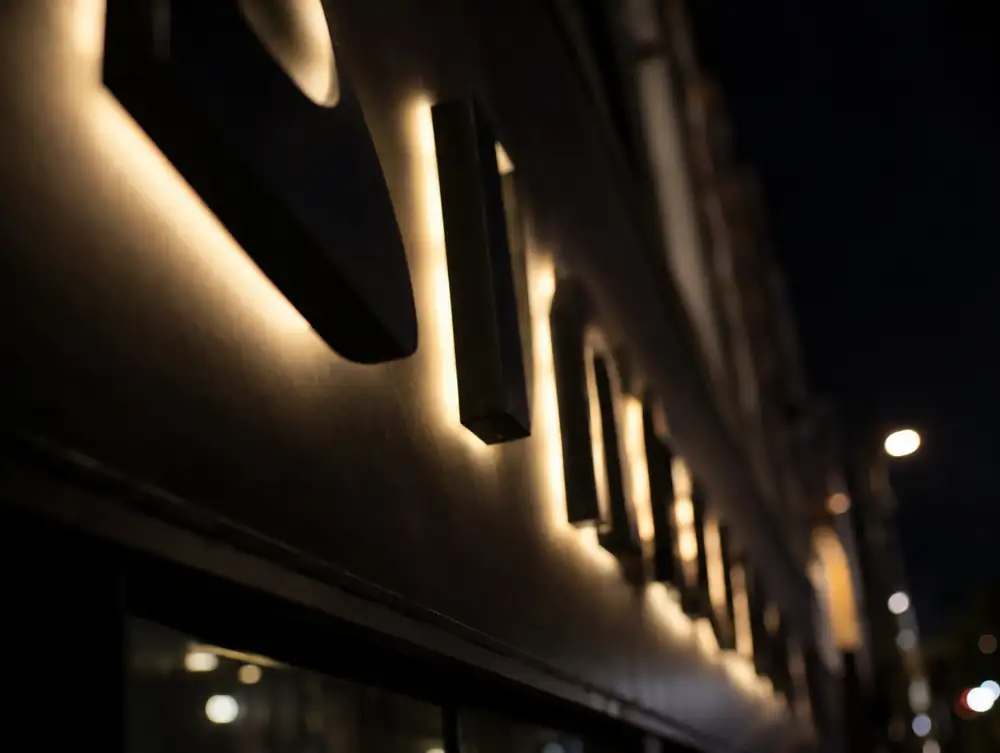
That rules out more than people think. An acrylic box with its whole face glowing isn't character-only, while an opaque metal tray with push-through letters lights just the characters. Halo letters stand off the fascia and wash light onto it, so they need a light or mid-tone background to read at all.
The 2.5m rule catches low fascias on older frontages. Measure to the bottom of the letters or tray, and remember that a fascia set at 2.4m has lost the class whatever the design. If you want a trough light or spotlights washing the fascia, ask the council how it will treat them before ordering.
Brightness has limits too. England sets 600 cd/m² up to 10m² of sign and 300 cd/m² above that, and Northern Ireland uses 1,000, 800, 600 and 400 candela by area. A dimmable driver gives you room to settle the sign once it is up, because a white letter on dark paint looks far stronger at dusk than any drawing suggests.
| Rule | England | Wales | Scotland | Northern Ireland |
|---|---|---|---|---|
| Lighting | Halo or character-only, static | As England | Each character lit from within, static | Halo or character-only, static |
| Lowest part | 2.5m up | 2.5m up | 2.5m up | 2.5m up |
| Lit in conservation areas | Class unavailable | Class unavailable | Class unavailable | Class unavailable |
What if my shop is in a conservation area or special control area?
A lit sign in a conservation area needs express consent in all four nations, because the lit class isn't available there. England extends that to AONBs, National Parks and the Broads, and Northern Ireland to AONBs and National Parks. Lit signs aren't banned in those places, but you must apply and make the case.
Unlit signs offer no way round this. England and Wales allow illumination in Class 5 only for medical-type notices, and Northern Ireland allows none at all in that class.
Special control areas are tighter again. England limits Class 5 to one-tenth of the face up to 3.6m, Wales to 0.1 of the area, and Scotland's Class IV to one-twelfth of the face, with the lit class unavailable in England and Scotland. Northern Ireland's regulations don't use the term.
Scotland has one further wrinkle. At least one council says illuminated signs always need express consent, which doesn't match Class VI as we read it, so ask your own council and follow its answer.
How much does express advertisement consent cost?
The council fee for a sign on business premises runs from £174 in England to £371 in Scotland. These are the current rates we could find, and the council confirms what applies to your application.
A good application is short and exact. Show the sign on the elevation with its letter height, height above ground, projection, lighting method and finish, and add a section so the officer can see how it fixes. A typical range for a decision is 4 to 8 weeks, so sign orders should wait for it. We can prepare and submit the application for you at £395 to £1,295 plus VAT per application, plus the council's fee.
| Nation | Fee | Basis | From |
|---|---|---|---|
| England | £174 | Business premises or advance sign | 1 April 2026 |
| Wales | £248 | Business premises | 1 December 2025 |
| Scotland | £371 | Advertisements | 1 April 2026 |
| Northern Ireland | £231 | Advertisements | 1 April 2025 |
What are the limits for lit projecting signs?
A lit projecting sign may be 0.75m² per surface and 1m high in England and Wales, or 1m² per surface and 1m high in Northern Ireland, projecting up to 1m. England and Northern Ireland reduce that projection to two-thirds of the footway if that is less, and England keeps signs away from the carriageway. Scotland's 0.25m limit means a lit projecting sign of ordinary size will usually need an application.
Clearance below the sign matters as much as its size. The lit classes need 2.5m, and Inclusive Mobility guidance gives 2100mm for suspended signs. Highway authorities can also act on dangerous projections: England and Wales have s.152 of the Highways Act 1980, which names signs, Scotland has s.88 of the Roads (Scotland) Act 1984 with 28 days' notice, and Northern Ireland has Art 55 of the Roads Order 1993.
A 1m bracket puts real leverage on its fixings, so anchor it into masonry and never just into the fascia board. Run the cable inside the bracket where you can, and think about how someone will reach the sign to service it in five years' time.
Common questions
Does replacing an old sign with one the same size need consent?
The same rules apply to a replacement as to a new sign. An old sign being there proves nothing, because it may never have had consent, so check the new one against the limits for your nation.
How soon can a sign go up after consent?
Once consent is in hand, the sign can be made and fitted to the agreed programme, and any conditions on the decision notice must be followed. Check those conditions before signing off artwork, as they can limit brightness or hours of lighting.
Can my landlord refuse a sign the council has approved?
Yes. Many leases control signs separately, so council consent gives you no right to fix anything to the landlord's building, and you need both.
Does a sign need a building warrant in Scotland?
Outdoor signs under the advertisement regulations are listed as needing no warrant, under Schedule 3 type 16 of the 2004 Regulations. The building standards still apply to the work, and the council's building standards team can confirm how they apply to a large or unusual sign.