Built-up or tray-mounted letters suit most premium frontages, hand-painted letters suit traditional fronts, and halo lighting gives the most refined night-time look. Flat panels are the plainest option and the wrong choice on a good building. Fascia signs are £395 to £1,995 plus VAT per sign, and illuminated signs are £895 to £3,995 plus VAT per sign.
Which types of fascia sign are there?
The main types are flat panels, folded tray signs, built-up letters, halo-lit letters, push-through acrylic and hand-painted lettering. They differ in depth more than anything else. A sign with real depth catches the light, throws a shadow and looks like part of the building, whereas a flat one looks like a label.
Each suits a different frontage, and each has a situation where it is simply the wrong choice. Start from the fascia you have, because a sign can't fix a badly proportioned board, and an expensive set of letters on a tired substrate only draws attention to the problem.
| Type | Look | Wrong when |
|---|---|---|
| Flat panel | Plain, printed or vinyl | A good building, or a long life is wanted |
| Folded tray | Crisp, with returned edges | A traditional timber front |
| Built-up letters | Individual, with depth | Thin logos, poor fascia behind |
| Halo-lit letters | Soft glow on the fascia | Very dark backgrounds |
| Push-through acrylic | Bright, sharp characters | Conservation areas, understated brands |
| Hand-painted | Traditional, individual | Short-term branding, metal fascias |
How do flat panels and tray signs compare?
A flat panel is a printed or vinyl-faced sheet fixed to the fascia, while a tray is a folded metal box with returned edges and no visible fixings. Panels are quick and modest in cost, and they suit short leases and temporary premises. Their weakness is the look: visible screws, thin edges and vinyl that fades and lifts over time.
Trays cost more because they are made to measure, and they reward that with a clean shadow line along the top and bottom. A long tray needs joints, so place them between letters and never through one. Allow for movement in long metal runs, and fix to a proper sub-frame rather than straight into old boarding.
Drainage catches people out. A folded tray can trap water at its bottom edge unless small weep holes are included, and rust streaks down a stallriser are a sad end to a clean sign.
When are built-up letters worth it?
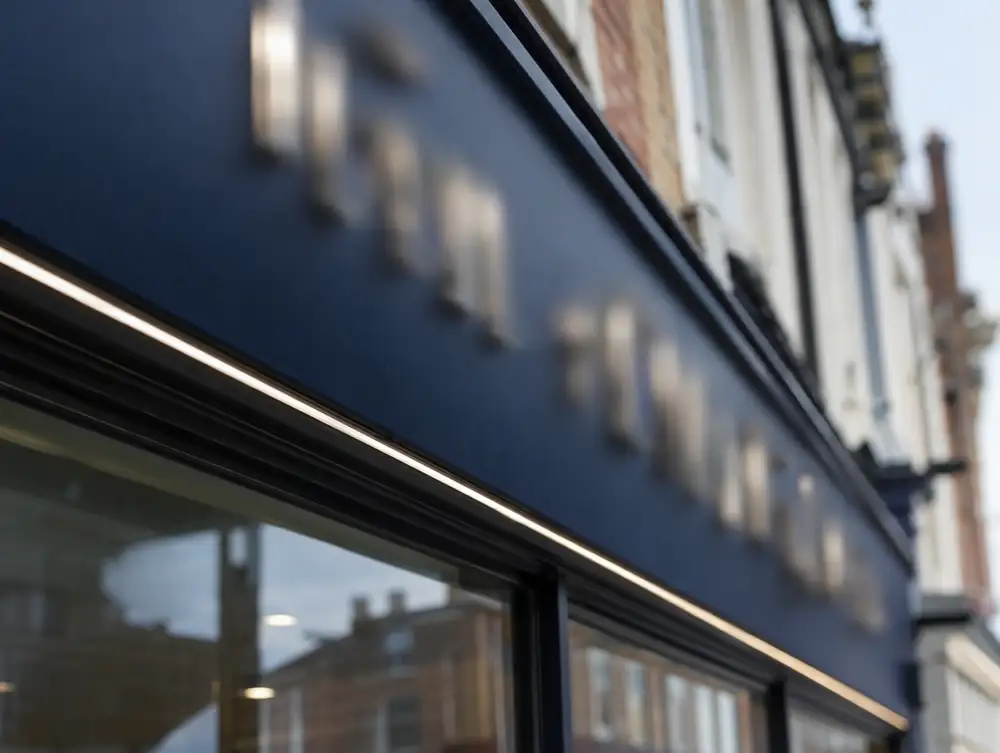
Built-up letters are worth it when you have a sound fascia and a logo with enough weight to stand alone. Individual letters read as crafted, they let the fascia behind them show, and on a premium frontage nothing else does quite the same job in daylight. Brushed stainless, painted metal and solid acrylic all work, and each catches light differently.
Mounting them is exact work. Each letter sits on locator pins, set out with a full-size paper template taped to the fascia, and the pins go into solid backing. Thin serifs and fine script are the problem, as fine strokes can be too narrow to take a fixing, so a logo sometimes needs a small redraw to work at this scale.
Consider who cleans them. Dust and cobwebs gather behind stood-off letters, and a sign that is hard to reach gets dull within a year. Stainless on a busy road will need more attention than people expect.
What is the difference between halo and push-through lighting?
Halo letters are lit from behind and throw light back onto the fascia, while push-through letters are solid acrylic that shines through cut-outs in a tray. The softer effect comes from halo, which suits restaurants, hotels and fashion. Push-through is brighter and more legible at a distance, so it suits a busy road or a retail park.
Each has a physical limit. Halo needs a light or mid-tone surface to reflect from, so it loses most of its effect on black paint or dark brick. Push-through needs enough depth to spread the light, otherwise each LED shows as a bright spot in the letter. Ask for a sample to be lit in a dim room before committing.
Allow for the wiring from the start. Drivers need a dry, reachable home, usually in the fascia void or inside the shop, and every letter needs a route for its cable. Lighting rules also vary: England, Wales and Northern Ireland allow halo or character-only lighting under the lit class, while Scotland's lit class refers to each character being lit from within, so ask the council about halo letters there.
Are hand-painted signs still a good choice?
Yes, on a timber fascia with a period building above it, hand-painted lettering is often exactly right. A good signwriter draws to the fascia, spacing letters by eye, with shading or gold leaf where the budget allows. Nothing else has quite the same warmth.
It is the wrong choice for a brand that changes often, or a front in composite metal. Paint will need attention over the years, though a touch-up is a small job, and a well-kept sign ages gracefully. There is no electrical cost and no consent question around lighting, which is one reason conservation officers tend to favour it.
How much does each sign type cost?
Non-illuminated signs start from £395 plus VAT and illuminated signs from £895 plus VAT, with projecting signs priced separately. Size, letter count, material, height and access all move the figure. A sign is also only as good as what it fixes to, so a fascia repair may need adding to the budget.
| Sign | Guide price |
|---|---|
| Fascia sign | £395 to £1,995 plus VAT per sign |
| Illuminated sign | £895 to £3,995 plus VAT per sign |
| Projecting sign | £395 to £1,295 plus VAT per sign |
How do I choose the right sign for my frontage?
Start with the fascia, the reading distance and the planning position, and only then pick a style. A rough rule says 100mm of letter height reads comfortably from around 12m, so a side street needs far less than a dual carriageway. Then look at the frontage at night, because many signs are chosen by day and judged by evening.
Check the lit class and your lease before you fall in love with a design. Lit signs lose deemed consent in conservation areas, and most leases have something to say about what goes on the fascia. Tape a full-size paper mock-up to the building and walk away from it. If the name reads easily and the fascia still has room to breathe, the size is right.
Common questions
How long does a fascia sign last?
Vinyl on a flat panel typically fades within several years, while metal letters and trays can last much longer with occasional cleaning. Lit signs depend on their drivers, which are usually the first part to need replacing.
Can you reuse my existing fascia?
Often, if the board is sound and the proportions are right. Old fixing holes need filling, and a survey will show whether what sits behind it can take new fixings.
Can I change my sign when a lease ends?
Letters leave holes and a panel usually doesn't, so a tenant on a short lease may prefer a tray fixed to a backing board. Check what the lease says about putting things back.
Who provides the electrics for a lit sign?
A lit sign needs a safe supply with a switch or timer, and the quotation should say who provides it. We can bring that into one contract, so the sign and cable are planned together.