For planning and consent support in Dyfed, you get one named contact who knows the building, the brief and the people who will sign it off.
Finishes behave differently at full size. Any sample we show you for planning and consent support is better judged at the premises in daylight, since a colour that looks quiet on a desk can read much louder across a whole elevation.
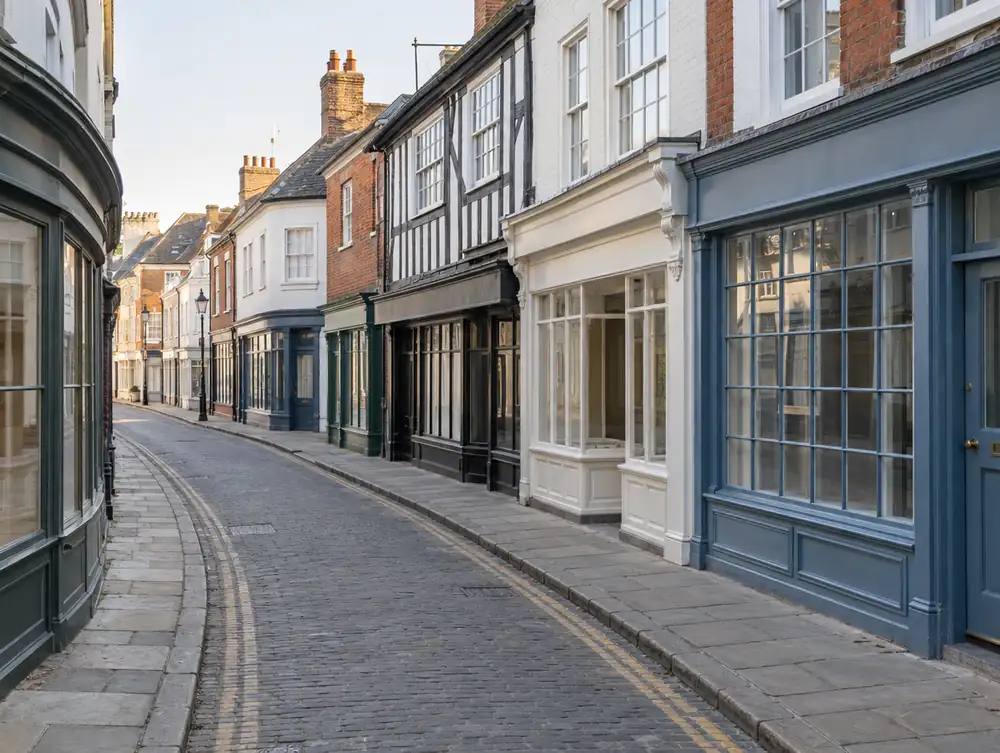
What makes planning and consent support work well for premises in Dyfed?
Several sites at once need a steady system. If you are changing premises in more than one part of Dyfed, each submission, date and document sits in one tracker, with one named contact.
Older buildings need more evidence. If your premises in Dyfed have surviving features, we photograph and draw them before the design is fixed, so the submission shows what will be kept.
What consents apply to shopfront work in Dyfed?
Like-for-like replacement usually needs no planning permission in Wales, because the external appearance isn't materially affected. Matching the existing materials, proportions and glass line is what keeps a job in that position. For shopfront work at premises in the Dyfed area, changing any of those usually means an application, which the council can confirm.
How much does planning and consent support cost in Dyfed?
Until the survey is done, plan on £395 to £1,295 plus VAT per application, plus the council's fee. Unusual sizes, fine detail and phased working push the figure up, while a simple brief and clear access keep it toward the lower end.
| Area | Dyfed |
|---|---|
| Nation | Wales |
| Towns covered | 7 |
| Main town | Carmarthen |
| Planning regime | Wales: TCPA 1990 and the 1992 Advertisement Regulations |
| Building approval | Building Regulations (Approved Documents for Wales) |
| Survey | Free for new work, from our Great Barr base |
Does Carmarthenshire County Council publish shopfront guidance?
Yes, Carmarthenshire Shopfront Design Guide 2022 (2022). It tells applicants what the council expects from new and altered shopfronts. A few of the things it asks for:
- The fascia should be no deeper than the console and sit just below the cornice, and box fascias are not permitted.
- External roller shutters, external grilles and solid metal shutters are not permitted, with internal lattice or brick-bond grilles preferred.
- Internally lit signs are not permitted, and fascias should be lit externally with discreet downward-facing fittings.
Questions about planning and consent support in Dyfed
What photographs help with an application near Carmarthen?
Straight-on views of the frontage, views along the street in both directions and close-ups of any older details. We take photographs at survey, and yours can add useful history.
Can the sign and shopfront be drawn together for premises in Dyfed?
Yes, and that is how we prefer to work. One drawing set shows the frontage as it will really look, which helps everyone reviewing it.
Can you take over an application already started for premises around Carmarthen?
Often, yes. Send us the drawings and any correspondence, and we will check them against a measured survey. If the officer has raised points, we would deal with those first.
When does a shop sign in the Dyfed area need advertisement consent?
A sign needs advertisement consent when it falls outside Class 5 or Class 4B of the 1992 Advertisement Regulations, which still apply in Wales. Within Class 5, an unlit sign sits on a wall containing a shop window and tops out at 4.6m or the first-floor sill if lower. A lit sign in a conservation area needs consent, because Class 4B isn't available there.
What access duty applies to a shop in the Dyfed area?
The Equality Act 2010 applies, in Wales as across Great Britain, and it requires reasonable steps to remove, alter or avoid physical features that disadvantage disabled people. The duty is anticipatory, so it covers disabled people generally. A feature that meets a design standard is generally protected for 10 years.