Seen a frontage you admire? Bring the picture to our first talk about projecting signs in Aberdeen and Aberdeenshire, and we will work out what makes it succeed, from fascia depth to glass line, and what that means for your building.
Daylight is only half the brief for projecting signs, because a frontage keeps working after dark. Think about how the glass, the sign and the view inside will read to someone walking past at six o'clock on a winter evening.
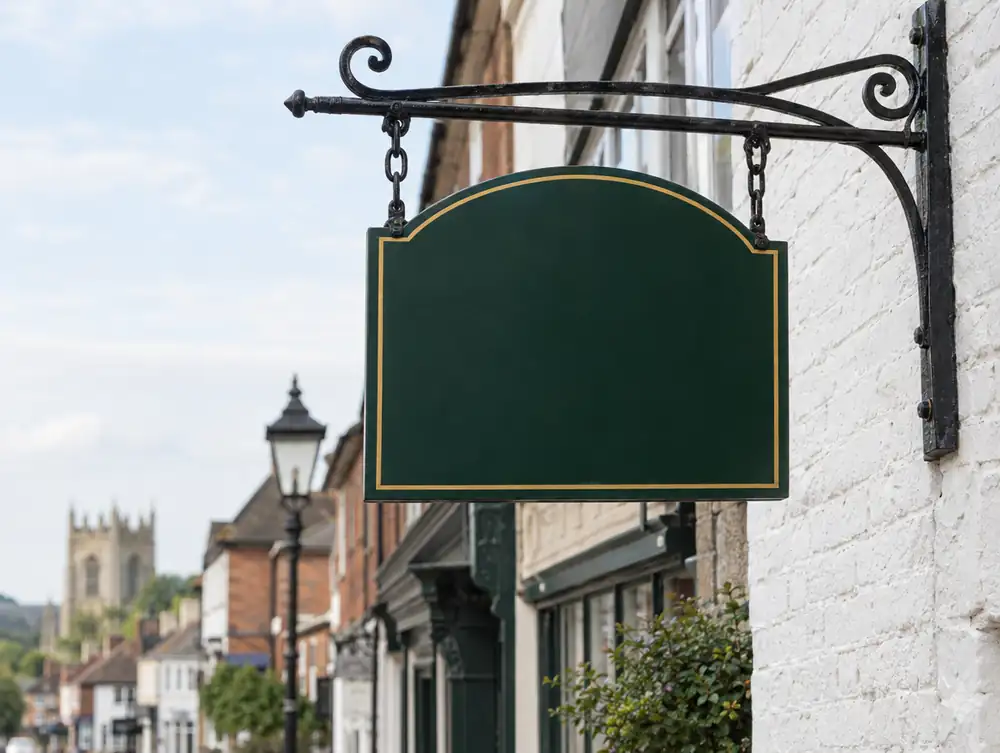
Where do you start with projecting signs in Aberdeen and Aberdeenshire?
Several businesses sharing one building need a plan. If yours sits on an upper floor in Aberdeen and Aberdeenshire, a slim projecting sign at street level may be the only thing that reaches passers-by, so we position it beside your own door.
Exposure can change the bracket design. Where a frontage in Aberdeen and Aberdeenshire faces into the prevailing wind, a fixed blade may be a better choice than a free-swinging panel, as it has no shackles to wear.
What consents apply to projecting signs in Aberdeen and Aberdeenshire?
Shutters aren't named in Class 9A, so in Scotland they usually fall to the appearance test. The same goes for projecting signs at premises in the Aberdeen and Aberdeenshire area: building work that materially affects the external appearance needs planning permission, and a true like-for-like usually doesn't. Ask the council to confirm the position for your site.
Class VI isn't available in Scottish conservation areas, so a lit sign there normally needs advertisement consent. Special control areas are tighter again: no Class VI, and Class IV limited to a 3.6m top height, 0.3m letters and one-twelfth of the building face. The council can say which designations cover premises in the Aberdeen and Aberdeenshire area.
How much do projecting signs cost in Aberdeen and Aberdeenshire?
Until the survey is done, plan on £395 to £1,295 plus VAT per sign. Unusual sizes, fine detail and phased working push the figure up, while a simple brief and clear access keep it toward the lower end.
| Area | Aberdeen and Aberdeenshire |
|---|---|
| Nation | Scotland |
| Towns covered | 7 |
| Main town | Aberdeen |
| Planning regime | Scotland: 1997 Planning Act and the 1984 Advertisement Regulations |
| Building approval | Building warrant (Technical Handbook) |
| Survey | Free for new work, from our Great Barr base |
Does Aberdeen City Council publish shopfront guidance?
Yes, Aberdeen Planning Guidance 2023: Shops and Signs (2023). It tells applicants what the council expects from new and altered shopfronts. A few of the things it asks for:
- Stallrisers typically form no more than 20% of the shopfront height, and original timber ones must be retained and restored.
- Fascia depth should be no greater than 20% of the shop frontage height, with lettering no more than two-thirds of the fascia depth.
- Sub-fascias are not permitted, and existing ones are expected to be removed.
Questions about projecting signs in Aberdeen and Aberdeenshire
Do you make projecting signs to match a fascia in Aberdeen and Aberdeenshire?
Yes. We use the same letter style, colours and finishes, so the two read as one. Both signs appear on the same scale drawing, which also shows how they line up.
Is a hanging sign better than a fixed one for premises around Aberdeen?
It depends on the building and the exposure. Hanging signs suit traditional frontages and give a bit of movement, while fixed signs need less upkeep. On a windy elevation we usually suggest fixed.
How long does fitting take on premises in Aberdeen and Aberdeenshire?
Usually about half a day from a ladder or tower, with a little longer if a cable has to be run for lighting. The shop can normally stay open while we work.
Do I need a building warrant for a shopfront in the Aberdeen and Aberdeenshire area?
Usually yes in Scotland, if the work alters a wall or structure. Schedule 3 of the Building (Scotland) Regulations 2004 lists some work that needs no warrant, such as replacing a door or window with its frame, but the standards still apply. Shopfronts aren't named there, so ask the council before relying on it.
Which way must a fire exit door open on a shop in the Aberdeen and Aberdeenshire area?
In the direction of escape. Regulation 13(2) of the Fire Safety (Scotland) Regulations 2006 also rules out sliding and revolving doors on a dedicated fire exit and says fire exit doors can't be locked against immediate use. Duties sit with dutyholders under Part 3 of the Fire (Scotland) Act 2005, meaning the employer and any person with control of the premises.