What should your premises say from across the road? We open every conversation about timber shopfronts in Aberdeen and Aberdeenshire with that question, then treat sightlines and proportion as seriously as the budget.
Openings are rarely square or level, so the survey for timber shopfronts records diagonals, pavement fall and head height at several points. Those few millimetres decide whether the finished front sits true against the building.
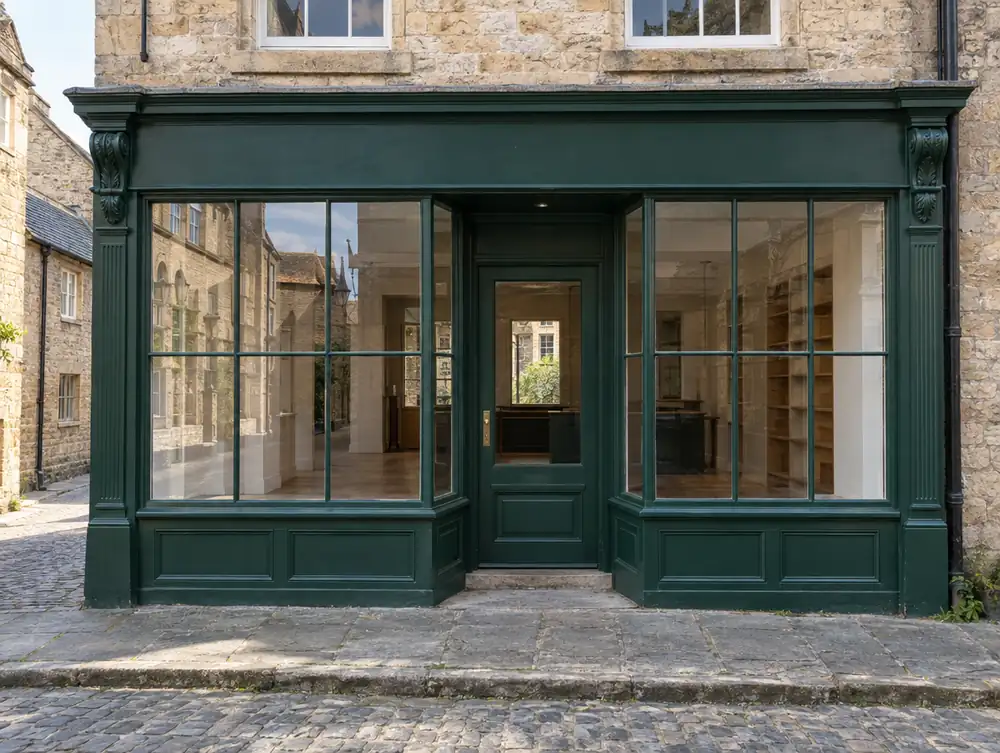
What should you look for from timber shopfronts in Aberdeen and Aberdeenshire?
Colour does a lot of the work on timber. For premises across Aberdeen and Aberdeenshire we test samples on the actual frontage in morning and evening light, because a deep green or navy can read as black at dusk, and the sign then has to carry more contrast.
Timber is a natural fit for food and drink. For a restaurant or bar in Aberdeen, we'd design opening sashes or a serving hatch into the front, so the joinery earns its keep in summer and closes up snugly in winter.
What consents apply to timber shopfronts in Aberdeen and Aberdeenshire?
Scottish guidance says like-for-like windows need no permission, and a true like-for-like frontage replacement usually follows the same logic. Class 7A covers altering or replacing an existing window, but it doesn't mention shopfronts, so ask before relying on it for a display window. For timber shopfronts at premises in the Aberdeen and Aberdeenshire area, a material effect on the external appearance means planning permission, and the council confirms the position.
How much do timber shopfronts cost in Aberdeen and Aberdeenshire?
As a working budget, use £3,995 to £13,995 plus VAT for a typical frontage. Your place inside that range for timber shopfronts depends mostly on how much of the existing frontage can stay and how much has to be put right first.
| Area | Aberdeen and Aberdeenshire |
|---|---|
| Nation | Scotland |
| Towns covered | 7 |
| Main town | Aberdeen |
| Planning regime | Scotland: 1997 Planning Act and the 1984 Advertisement Regulations |
| Building approval | Building warrant (Technical Handbook) |
| Survey | Free for new work, from our Great Barr base |
Does Aberdeen City Council publish shopfront guidance?
Yes, Aberdeen Planning Guidance 2023: Shops and Signs (2023). It tells applicants what the council expects from new and altered shopfronts. A few of the things it asks for:
- Stallrisers typically form no more than 20% of the shopfront height, and original timber ones must be retained and restored.
- Fascia depth should be no greater than 20% of the shop frontage height, with lettering no more than two-thirds of the fascia depth.
- Sub-fascias are not permitted, and existing ones are expected to be removed.
Questions about timber shopfronts in Aberdeen and Aberdeenshire
Can you match other timber shopfronts in Aberdeen?
Yes, if we can see and measure the original. Mouldings can be copied from a surviving piece, and paint colours can be matched from a sample.
Which timber suits the weather in Aberdeen and Aberdeenshire?
Exposure matters more than the place name. A sheltered street can take most durable hardwoods, while a front facing open weather does better with a very stable timber and a stronger paint system.
Can the joinery be painted on site in Aberdeen and Aberdeenshire?
Yes. Fronts are usually primed before they arrive and finished on site, but paint needs dry, mild conditions, so we allow some flexibility in the programme.
Does the Equality Act cover a shop entrance in the Aberdeen and Aberdeenshire area?
Yes. The Equality Act 2010 applies in Scotland as part of Great Britain, and its anticipatory duty expects reasonable steps to remove, alter or avoid physical features that disadvantage disabled people generally. BS 8300-2:2018 is the current British Standard for accessible buildings.
Do I need planning permission to alter a shopfront in the Aberdeen and Aberdeenshire area?
Usually yes, if the work materially affects the external appearance. Class 9A, Scotland's shop permitted development right, doesn't cover work that alters or extends beyond the existing front. A true like-for-like replacement usually needs no permission, and the council confirms the position.