For stallrisers and cladding across Aberdeen and Aberdeenshire, we draw first and order later. You see a scale drawing with signed-off dimensions before anything is made, so the frontage on paper is the frontage you get.
Daylight is only half the brief for stallrisers and cladding, because a frontage keeps working after dark. Think about how the glass, the sign and the view inside will read to someone walking past at six o'clock on a winter evening.
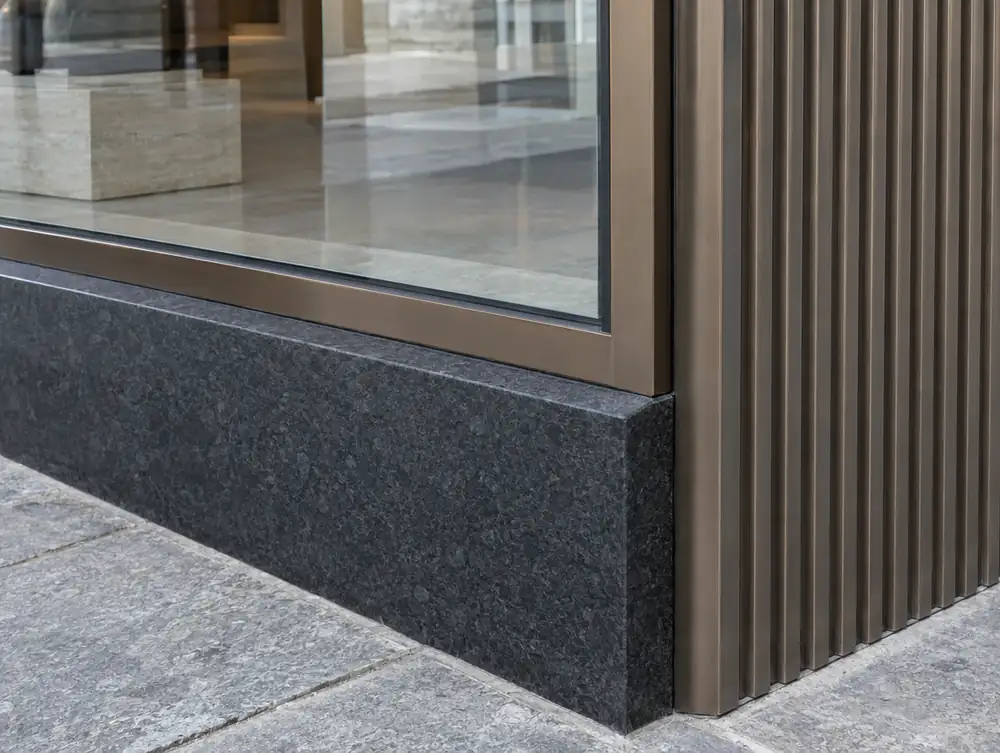
Where do you start with stallrisers and cladding in Aberdeen and Aberdeenshire?
Neighbouring frontages are the first reference for height. At survey near Aberdeen we note the sill lines on either side of your unit, then decide whether to match them or make a deliberate break.
A restaurant and a jeweller want very different stallrisers, even side by side. For premises in Aberdeen and Aberdeenshire we set the height around what people do behind the glass, whether that is sitting, browsing or studying a tray.
What consents apply to stallrisers and cladding in Aberdeen and Aberdeenshire?
Class 9A, Scotland's shop permitted development right, gives no route for a shopfront change. It covers Class 1A premises, but not work that alters or extends beyond the existing front, and it doesn't apply in conservation areas, National Parks or World Heritage Sites. For stallrisers and cladding at premises in the Aberdeen and Aberdeenshire area, that generally means a planning application unless the external appearance isn't materially affected.
How much do stallrisers and cladding cost in Aberdeen and Aberdeenshire?
The guide for stallrisers and cladding is £195 to £495 plus VAT per m². Expect the lower end for simple work with clear access, and the upper end where detail, finish or awkward conditions add hours.
| Area | Aberdeen and Aberdeenshire |
|---|---|
| Nation | Scotland |
| Towns covered | 7 |
| Main town | Aberdeen |
| Planning regime | Scotland: 1997 Planning Act and the 1984 Advertisement Regulations |
| Building approval | Building warrant (Technical Handbook) |
| Survey | Free for new work, from our Great Barr base |
Does Aberdeen City Council publish shopfront guidance?
Yes, Aberdeen Planning Guidance 2023: Shops and Signs (2023). It tells applicants what the council expects from new and altered shopfronts. A few of the things it asks for:
- Stallrisers typically form no more than 20% of the shopfront height, and original timber ones must be retained and restored.
- Fascia depth should be no greater than 20% of the shop frontage height, with lettering no more than two-thirds of the fascia depth.
- Sub-fascias are not permitted, and existing ones are expected to be removed.
Questions about stallrisers and cladding in Aberdeen and Aberdeenshire
Will road salt damage a metal stallriser in Aberdeen and Aberdeenshire?
It will, if cut edges are left exposed. We use folded sheet with hidden edges, keep the base clear of the pavement and fit a replaceable plinth where salt is heavy.
Can you reclad only the stallriser on my premises in Aberdeen and Aberdeenshire?
Yes. It is one of the simplest ways to lift a tired frontage, provided the frame above is sound. We check the sill detail first, because a new facing must not trap water beneath it.
Can stallriser work on premises around Aberdeen be done in a day?
A straightforward composite or painted panel often can, and fitting can be arranged on a closed day. Stone and tile take longer because of fixing and setting time, so we would agree a short phased plan.
Does the Equality Act cover a shop entrance in the Aberdeen and Aberdeenshire area?
Yes. The Equality Act 2010 applies in Scotland as part of Great Britain, and its anticipatory duty expects reasonable steps to remove, alter or avoid physical features that disadvantage disabled people generally. BS 8300-2:2018 is the current British Standard for accessible buildings.
Do roller shutters need planning permission in the Aberdeen and Aberdeenshire area?
Usually yes, if they materially affect the external appearance. Class 9A doesn't name shutters, so in Scotland treat them as falling to the appearance test rather than assuming a permitted development route. Ask the council before ordering, as this is a reading of the rules and not an official statement.