Few businesses can shut for a week, so any time on site for projecting signs in Hampshire is planned around the hours you trade. Closed-day or out-of-hours installation can be arranged.
If you're a tenant, your landlord will probably want to see what is proposed. The scale drawings we produce for projecting signs are clear enough to send straight on, which saves a round of explaining.
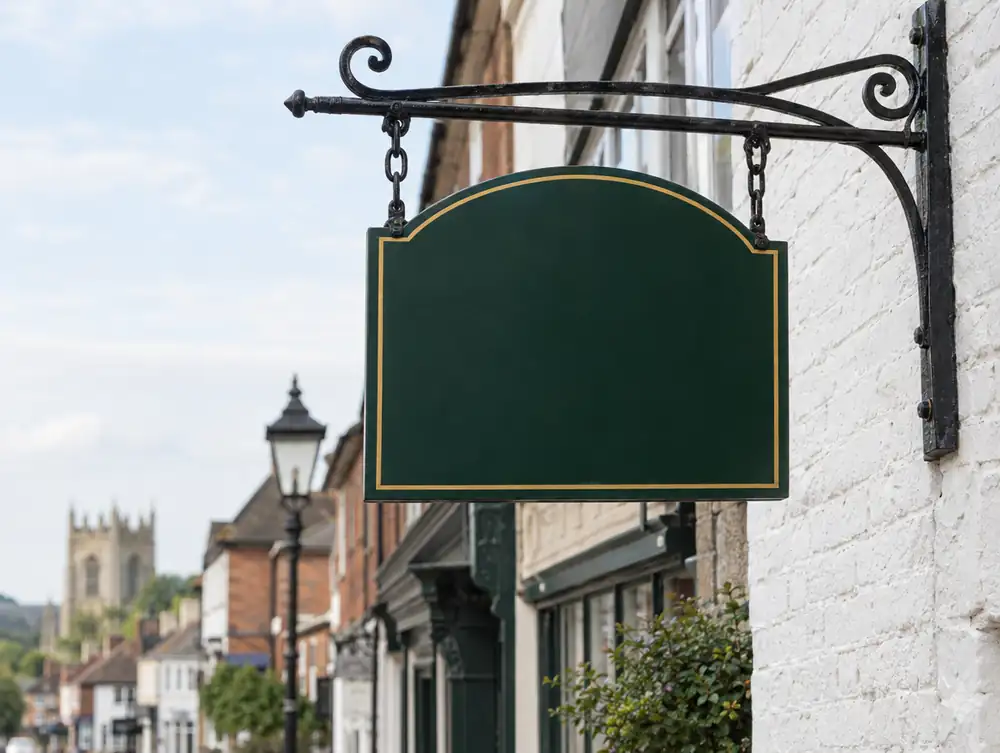
How should you approach projecting signs in Hampshire?
Sightlines along the street decide the position. On premises across Hampshire we walk the pavement from both directions at survey, because a lamp post, tree or neighbouring sign can hide a sign from the side people arrive.
Exposure can change the bracket design. Where a frontage in Hampshire faces into the prevailing wind, a fixed blade may be a better choice than a free-swinging panel, as it has no shackles to wear.
What consents apply to projecting signs in Hampshire?
For projecting signs at premises in the Hampshire area, the deciding question in England is whether the building work materially affects the external appearance. If it does, planning permission is needed, while a true like-for-like replacement usually needs none. The council confirms the position for each site.
A lit projecting sign at premises in the Hampshire area has firm limits under Class 4B in England: 0.75m² per surface and 1m high. It can project 1m, or two-thirds of the footway if that is less, and it can't sit over the carriageway. A larger sign needs advertisement consent, and so does a lit one in a conservation area.
How much do projecting signs cost in Hampshire?
We would budget £395 to £1,295 plus VAT per sign. Scope sets most of the figure, so a clear brief at the start does more for the budget than any later change of detail.
| Area | Hampshire |
|---|---|
| Nation | England |
| Towns covered | 33 |
| Main town | Southampton |
| Planning regime | England: TCPA 1990 and the 2007 Advertisement Regulations |
| Building approval | Building Regulations (Approved Documents) |
| Survey | Free for new work, from our Great Barr base |
Questions about projecting signs in Hampshire
Is a hanging sign better than a fixed one for premises around Southampton?
It depends on the building and the exposure. Hanging signs suit traditional frontages and give a bit of movement, while fixed signs need less upkeep. On a windy elevation we usually suggest fixed.
Can you fit a projecting sign to a stone or brick wall in Hampshire?
Yes. Hard stone and sound brick both take resin anchors well, and soft brick needs a longer, wider fixing. We drill into mortar joints or discreet positions where the wall needs protecting.
Do you make projecting signs to match a fascia in Hampshire?
Yes. We use the same letter style, colours and finishes, so the two read as one. Both signs appear on the same scale drawing, which also shows how they line up.
Do I need planning permission to change a shopfront in the Hampshire area?
Usually yes, if the work materially affects the building's external appearance. England's shop permitted development rights exclude creating, altering or replacing a shopfront, so there is no shortcut. A true like-for-like replacement usually needs no application, and the council confirms the position.
Does the Equality Act apply to a shop entrance in the Hampshire area?
Yes. The Equality Act 2010 applies in England, as across Great Britain, and it requires reasonable steps to remove, alter or avoid physical features that disadvantage disabled people. The duty is anticipatory, so it looks at disabled people generally, and a new Services Code replaced the 2011 Code on 5 August 2026.