One contract covers the frontage when you come to us for projecting signs in South Glamorgan, so glass, frame, sign and shutter aren't separate trades to chase. You also keep one named contact from first visit to handover.
Access gets as much attention as appearance at survey. Where a vehicle can stop, how long sections reach the opening and how the pavement stays safe for the public all shape the programme for projecting signs in South Glamorgan.
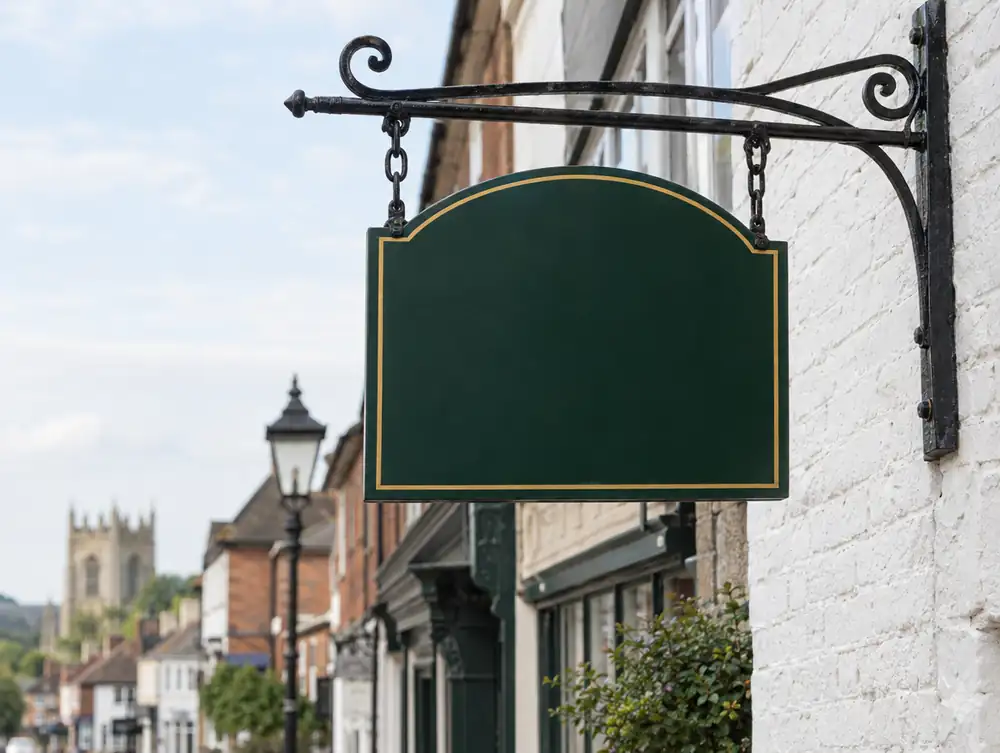
How do we handle projecting signs for premises in South Glamorgan?
Narrow pavements call for a smaller sign. If your premises in South Glamorgan open onto a tight footway, we keep the projection modest and the height generous, so the sign stays clear of people and vehicles.
Exposure can change the bracket design. Where a frontage in South Glamorgan faces into the prevailing wind, a fixed blade may be a better choice than a free-swinging panel, as it has no shackles to wear.
What consents apply to projecting signs in South Glamorgan?
Like-for-like replacement usually needs no planning permission in Wales, because the external appearance isn't materially affected. Matching the existing materials, proportions and glass line is what keeps a job in that position. For projecting signs at premises in the South Glamorgan area, changing any of those usually means an application, which the council can confirm.
Signs in Wales still come under the 1992 Advertisement Regulations, with the classes set out in Schedule 3. At premises in the South Glamorgan area, an unlit fascia sign generally needs no application under Class 5 if it sits on a wall containing a shop window and tops out at 4.6m or the first-floor sill if that is lower. Ask the council about letter sizes, and bear in mind that displaying a sign without consent is a criminal offence.
How much do projecting signs cost in South Glamorgan?
Our guide band is £395 to £1,295 plus VAT per sign. Scope is the biggest lever, so a tighter brief for projecting signs brings the figure down faster than any change of detail.
| Area | South Glamorgan |
|---|---|
| Nation | Wales |
| Towns covered | 6 |
| Main town | Cardiff |
| Planning regime | Wales: TCPA 1990 and the 1992 Advertisement Regulations |
| Building approval | Building Regulations (Approved Documents for Wales) |
| Survey | Free for new work, from our Great Barr base |
Does Vale of Glamorgan Council publish shopfront guidance?
Yes, Shop Fronts, Frontages and Advertisements Good Practice Guidelines. It tells applicants what the council expects from new and altered shopfronts. A few of the things it asks for:
- Fascias should sit within the shop front frame and typically measure about one quarter of the shop front's height.
- Solid or perforated shutters are not acceptable, and open-weave blinds powder-coated in a complementary colour are advised.
- There is a strong presumption against external shutter boxes and blinds in conservation areas.
Questions about projecting signs in South Glamorgan
Do you make projecting signs to match a fascia in South Glamorgan?
Yes. We use the same letter style, colours and finishes, so the two read as one. Both signs appear on the same scale drawing, which also shows how they line up.
Can a new panel go on my existing bracket in South Glamorgan?
Often, yes, once we have checked the bracket and fixings. Old ironwork can be stripped and repainted, and the panel can be made to fit it. A loose or corroded bracket has to come down first.
How long does fitting take on premises in South Glamorgan?
Usually about half a day from a ladder or tower, with a little longer if a cable has to be run for lighting. The shop can normally stay open while we work.
Who decides listed building consent for a shopfront in the South Glamorgan area?
Planning authorities and Welsh Ministers share control of listed building consent in Wales, under the Historic Environment (Wales) Act 2023. Cadw is the national body, and the 1990 Act no longer applies. Ask the council where an application should start.
What access duty applies to a shop in the South Glamorgan area?
The Equality Act 2010 applies, in Wales as across Great Britain, and it requires reasonable steps to remove, alter or avoid physical features that disadvantage disabled people. The duty is anticipatory, so it covers disabled people generally. A feature that meets a design standard is generally protected for 10 years.