What should your premises say from across the road? We open every conversation about projecting signs in Glasgow and Clyde with that question, then treat sightlines and proportion as seriously as the budget.
If you're a tenant, your landlord will probably want to see what is proposed. The scale drawings we produce for projecting signs are clear enough to send straight on, which saves a round of explaining.
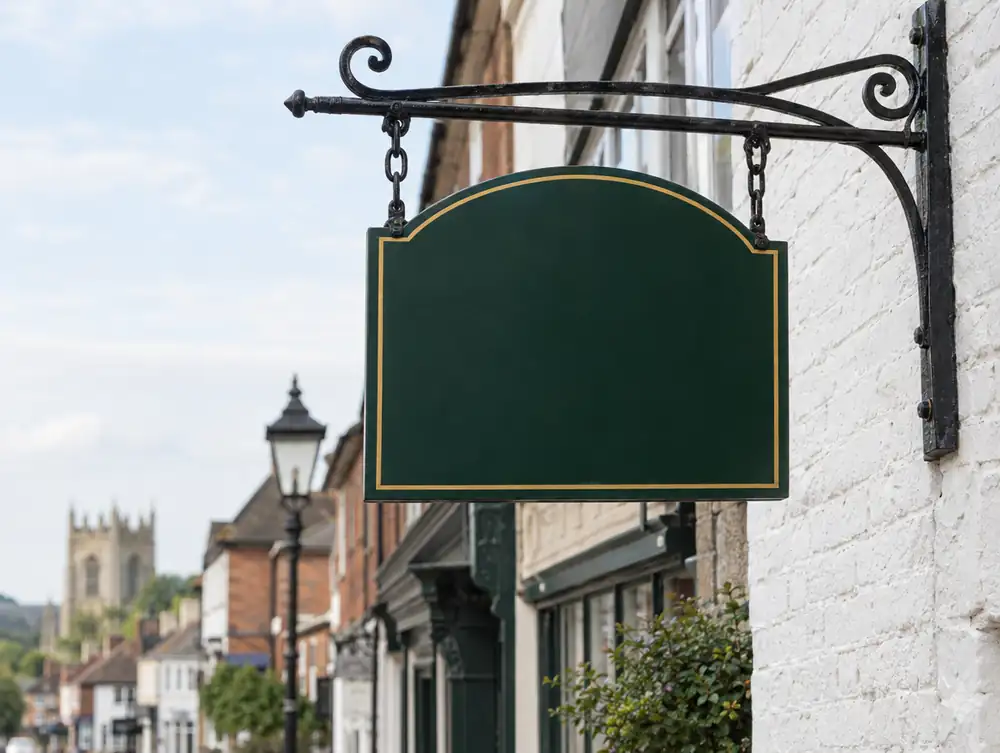
What should you look for from projecting signs in Glasgow and Clyde?
Sightlines along the street decide the position. On premises across Glasgow and Clyde we walk the pavement from both directions at survey, because a lamp post, tree or neighbouring sign can hide a sign from the side people arrive.
Several businesses sharing one building need a plan. If yours sits on an upper floor in Glasgow and Clyde, a slim projecting sign at street level may be the only thing that reaches passers-by, so we position it beside your own door.
What consents apply to projecting signs in Glasgow and Clyde?
Scottish guidance says like-for-like windows need no permission, and a true like-for-like frontage replacement usually follows the same logic. Class 7A covers altering or replacing an existing window, but it doesn't mention shopfronts, so ask before relying on it for a display window. For projecting signs at premises in the Glasgow and Clyde area, a material effect on the external appearance means planning permission, and the council confirms the position.
The 0.25m projection limit in Class VI means most lit projecting signs in Scotland fall outside it. One at premises in the Glasgow and Clyde area will usually need advertisement consent, so allow for an application in the programme.
How much do projecting signs cost in Glasgow and Clyde?
As a working budget, use £395 to £1,295 plus VAT per sign. Your place inside that range for projecting signs depends mostly on how much of the existing frontage can stay and how much has to be put right first.
| Area | Glasgow and Clyde |
|---|---|
| Nation | Scotland |
| Towns covered | 20 |
| Main town | Glasgow |
| Planning regime | Scotland: 1997 Planning Act and the 1984 Advertisement Regulations |
| Building approval | Building warrant (Technical Handbook) |
| Survey | Free for new work, from our Great Barr base |
Questions about projecting signs in Glasgow and Clyde
Can you fit a projecting sign to a stone or brick wall in Glasgow and Clyde?
Yes. Hard stone and sound brick both take resin anchors well, and soft brick needs a longer, wider fixing. We drill into mortar joints or discreet positions where the wall needs protecting.
What artwork works on a small hanging sign around Glasgow?
Bold, simple artwork works, with a logo or a short name. Fine lettering and long strap lines get lost at an angle, so we test the design at full size.
Can a new panel go on my existing bracket in Glasgow and Clyde?
Often, yes, once we have checked the bracket and fixings. Old ironwork can be stripped and repainted, and the panel can be made to fit it. A loose or corroded bracket has to come down first.
Which way must a fire exit door open on a shop in the Glasgow and Clyde area?
In the direction of escape. Regulation 13(2) of the Fire Safety (Scotland) Regulations 2006 also rules out sliding and revolving doors on a dedicated fire exit and says fire exit doors can't be locked against immediate use. Duties sit with dutyholders under Part 3 of the Fire (Scotland) Act 2005, meaning the employer and any person with control of the premises.
Do roller shutters need planning permission in the Glasgow and Clyde area?
Usually yes, if they materially affect the external appearance. Class 9A doesn't name shutters, so in Scotland treat them as falling to the appearance test rather than assuming a permitted development route. Ask the council before ordering, as this is a reading of the rules and not an official statement.