Few businesses can shut for a week, so any time on site for projecting signs in County Antrim is planned around the hours you trade. Closed-day or out-of-hours installation can be arranged.
Access gets as much attention as appearance at survey. Where a vehicle can stop, how long sections reach the opening and how the pavement stays safe for the public all shape the programme for projecting signs in County Antrim.
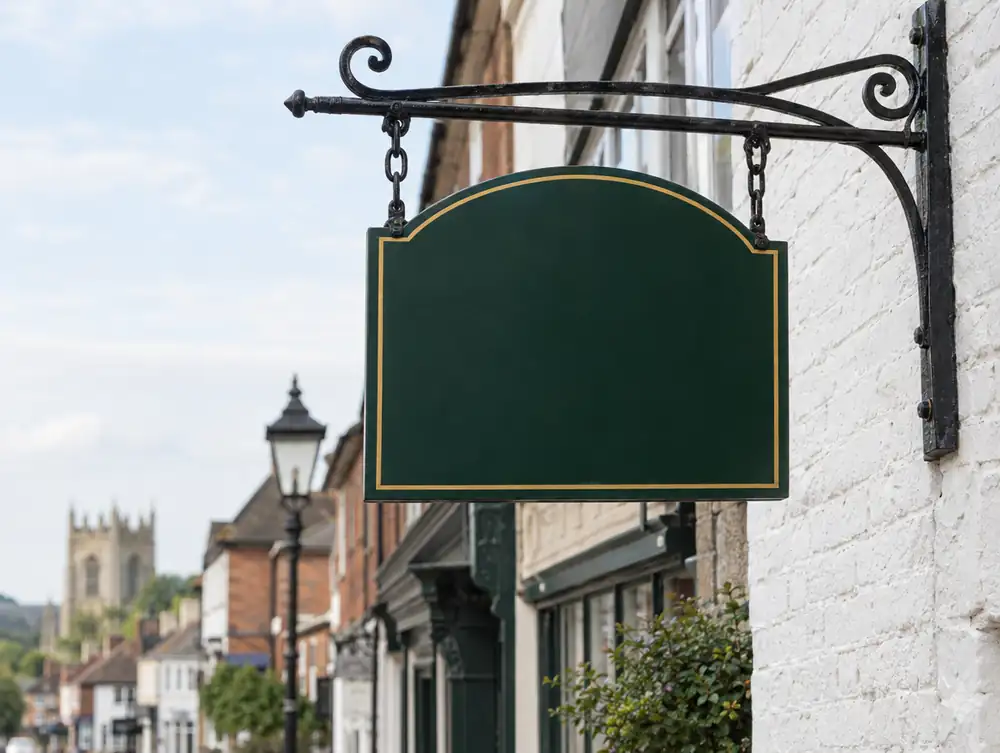
How should you approach projecting signs in County Antrim?
Sightlines along the street decide the position. On premises across County Antrim we walk the pavement from both directions at survey, because a lamp post, tree or neighbouring sign can hide a sign from the side people arrive.
Narrow pavements call for a smaller sign. If your premises in County Antrim open onto a tight footway, we keep the projection modest and the height generous, so the sign stays clear of people and vehicles.
What consents apply to projecting signs in County Antrim?
Section 23 of the Planning Act (Northern Ireland) 2011 sets the test: work that doesn't materially affect the external appearance isn't development. That makes appearance the deciding point for projecting signs at premises in the County Antrim area, so planning permission is needed if it is materially affected and usually not for a true like-for-like replacement. The council confirms the position for the particular premises.
In Northern Ireland, signs come under the 2015 Advertisement Regulations. At premises in the County Antrim area, an unlit fascia sign generally needs no application under Class 5 of Schedule 3 if it sits on a wall containing a shop window, tops out at 5m or the first-floor sill if lower, and keeps letters to 0.3m high. Class 5 allows no illumination at all.
How much do projecting signs cost in County Antrim?
We would budget £395 to £1,295 plus VAT per sign. Scope sets most of the figure, so a clear brief at the start does more for the budget than any later change of detail.
| Area | County Antrim |
|---|---|
| Nation | Northern Ireland |
| Towns covered | 10 |
| Main town | Belfast |
| Planning regime | Northern Ireland: Planning Act 2011 and the 2015 Advertisement Regulations |
| Building approval | Building Control (Technical Booklets) |
| Survey | Free for new work, from our Great Barr base |
Does Belfast City Council publish shopfront guidance?
Yes, Supplementary Planning Guidance: Advertising and Signage (2023). It deals with advertising and signage, not with shopfronts generally. A few of the things it asks for:
- Where an original fascia exists it should be used, with no advertising below fascia level or on pilasters or columns.
- Halo lighting of letters is preferred, and internally lit lightboxes should be avoided.
- Projecting signs should extend about 1m at most including fixings and sit at least 2.25m above ground.
Questions about projecting signs in County Antrim
Is a hanging sign better than a fixed one for premises around Belfast?
It depends on the building and the exposure. Hanging signs suit traditional frontages and give a bit of movement, while fixed signs need less upkeep. On a windy elevation we usually suggest fixed.
What artwork works on a small hanging sign around Belfast?
Bold, simple artwork works, with a logo or a short name. Fine lettering and long strap lines get lost at an angle, so we test the design at full size.
Can you fit a projecting sign to a stone or brick wall in County Antrim?
Yes. Hard stone and sound brick both take resin anchors well, and soft brick needs a longer, wider fixing. We drill into mortar joints or discreet positions where the wall needs protecting.
Does a shop sign in the County Antrim area need advertisement consent?
Not always. Under Northern Ireland's 2015 Regulations, an unlit sign within Class 5 generally needs no application, with a 5m top height and 0.3m letters, and neither does a lit sign within Class 4(2). That lit class isn't available in conservation areas, Areas of Outstanding Natural Beauty or National Parks, so ask first.
What building approval does a shopfront in the County Antrim area need?
Usually a full plans application to Building Control in Northern Ireland, because building notices are for single dwellings. The Technical Booklets set the detail, with Booklet V for glass and Booklet R for access. Only dwelling windows and doors are exempt, so ask Building Control before assuming a like-for-like job falls outside the rules.