One contract covers the frontage when you come to us for accessible entrances in County Antrim, so glass, frame, sign and shutter aren't separate trades to chase. You also keep one named contact from first visit to handover.
If you're a tenant, your landlord will probably want to see what is proposed. The scale drawings we produce for accessible entrances are clear enough to send straight on, which saves a round of explaining.
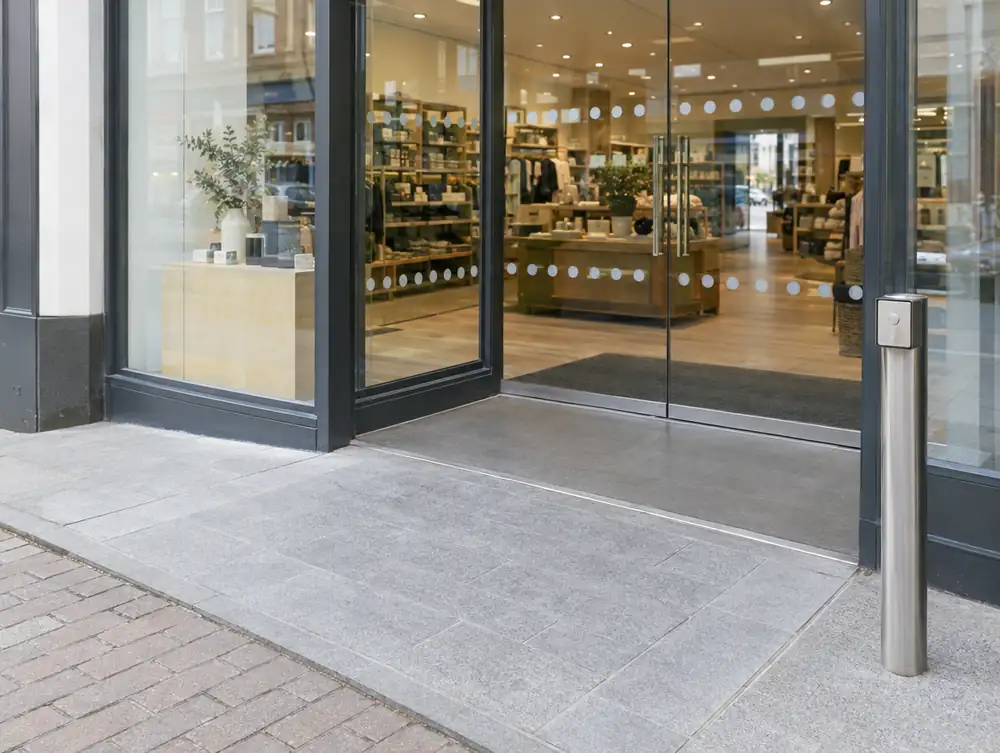
Where do you start with accessible entrances in County Antrim?
A stone step or old threshold can be worth keeping for its character. If your premises in County Antrim have one, we look at ways of working around it, such as a slim ramp within the recess or a second entrance to one side.
Not every improvement is large. For premises across County Antrim, a lighter closer, a contrasting handle and clear markings on the glass can often be done in a day, and they help people straight away.
What consents apply to accessible entrances in County Antrim?
Shutters in Northern Ireland are treated like the rest of the frontage: as no permitted development route appears to exist, they usually fall to the appearance test. Building work that materially affects the external appearance needs planning permission, for accessible entrances at premises in the County Antrim area as for anything else on the frontage, while a true like-for-like usually doesn't. Ask the council where a particular job stands.
How much do accessible entrances cost in County Antrim?
Our guide band is £995 to £6,995 plus VAT depending on the work. Scope is the biggest lever, so a tighter brief for accessible entrances brings the figure down faster than any change of detail.
| Area | County Antrim |
|---|---|
| Nation | Northern Ireland |
| Towns covered | 10 |
| Main town | Belfast |
| Planning regime | Northern Ireland: Planning Act 2011 and the 2015 Advertisement Regulations |
| Building approval | Building Control (Technical Booklets) |
| Survey | Free for new work, from our Great Barr base |
Does Belfast City Council publish shopfront guidance?
Yes, Supplementary Planning Guidance: Advertising and Signage (2023). It deals with advertising and signage, not with shopfronts generally. A few of the things it asks for:
- Where an original fascia exists it should be used, with no advertising below fascia level or on pilasters or columns.
- Halo lighting of letters is preferred, and internally lit lightboxes should be avoided.
- Projecting signs should extend about 1m at most including fixings and sit at least 2.25m above ground.
Questions about accessible entrances in County Antrim
Can work on my County Antrim entrance be done around trading?
Usually. Most threshold and door work can happen out of hours, and we'd keep one route into the shop open wherever we can.
Can I make a small change first at my County Antrim premises?
Yes. Start with what helps most for the least work, such as a lighter closer, better handles or clearer glass markings, and plan the bigger work for your next refit.
Will a powered door suit a small shop in County Antrim?
Often, yes. A low-energy swing operator suits small entrances and quieter footfall, and the door can still be used by hand.
Who decides listed building consent for a shopfront in the County Antrim area?
The council decides, under section 85 of the Planning Act (Northern Ireland) 2011. The Department for Communities' Historic Environment Division is a statutory consultee on applications. Unauthorised works are a criminal offence, so ask before anything is removed.
Does the Disability Discrimination Act apply to a shop entrance in the County Antrim area?
Yes. The Disability Discrimination Act 1995 applies in Northern Ireland, and section 21 deals with physical features that make a service hard for disabled people to use. Regulations made in 2007 (SR 2007/473) add detail on features, third-party consent and design standards.