One contract covers the frontage when you come to us for projecting signs in Fife, so glass, frame, sign and shutter aren't separate trades to chase. You also keep one named contact from first visit to handover.
Most frontages share something with someone, be that a door to the flats above, a meter cupboard or a pilaster on the boundary. We pick those up early on projecting signs in Fife, because they are far easier to design around than to discover on the day.
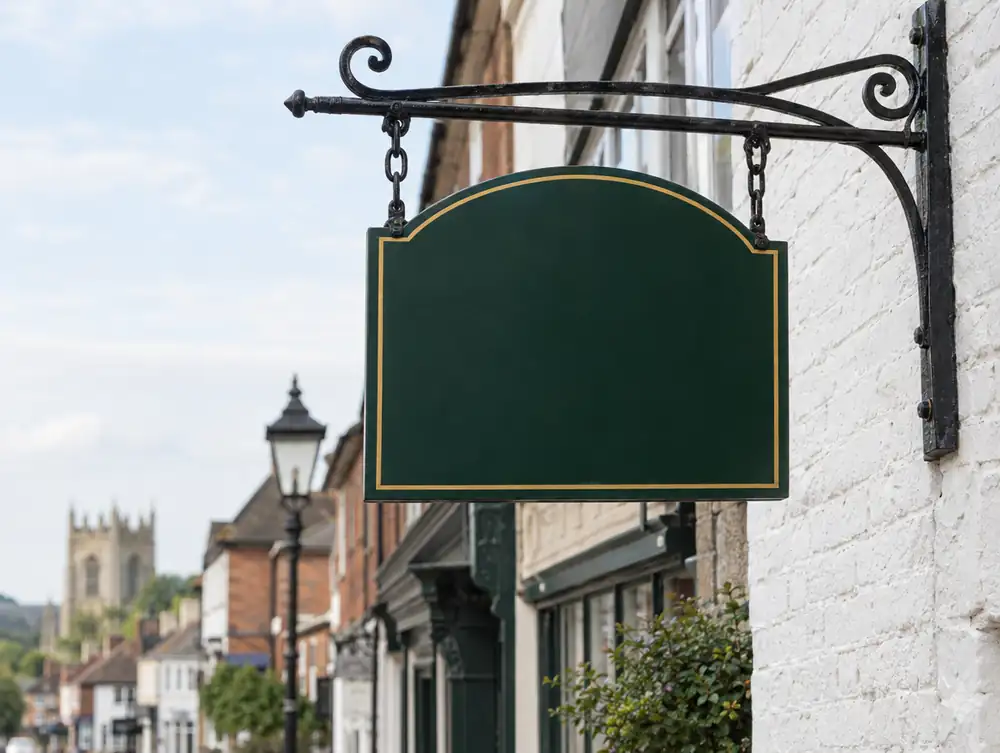
How do we handle projecting signs for premises in Fife?
Wall construction matters more than the sign itself. Around Dunfermline we check what sits behind the paint or render, since a bracket that looks secure on a hollow surface can work loose within a season.
Several businesses sharing one building need a plan. If yours sits on an upper floor in Fife, a slim projecting sign at street level may be the only thing that reaches passers-by, so we position it beside your own door.
What consents apply to projecting signs in Fife?
Shutters aren't named in Class 9A, so in Scotland they usually fall to the appearance test. The same goes for projecting signs at premises in the Fife area: building work that materially affects the external appearance needs planning permission, and a true like-for-like usually doesn't. Ask the council to confirm the position for your site.
Class VI is the class for lit signs in Scotland, and it is tightly drawn: each character lit from within, the sign at least 2.5m up, no more than 0.25m of projection, and static lighting. One Scottish council says illuminated signs always need express consent, which doesn't match Class VI, so ask the council for the Fife area before ordering.
How much do projecting signs cost in Fife?
Our guide band is £395 to £1,295 plus VAT per sign. Scope is the biggest lever, so a tighter brief for projecting signs brings the figure down faster than any change of detail.
| Area | Fife |
|---|---|
| Nation | Scotland |
| Towns covered | 9 |
| Main town | Dunfermline |
| Planning regime | Scotland: 1997 Planning Act and the 1984 Advertisement Regulations |
| Building approval | Building warrant (Technical Handbook) |
| Survey | Free for new work, from our Great Barr base |
Does Fife Council publish shopfront guidance?
Yes, Shop Front Design Guidelines (2016). It tells applicants what the council expects from new and altered shopfronts. A few of the things it asks for:
- Solid security shutters are discouraged, and shutter boxes may not project in front of the shop front.
- Internal lattice shutters and reinforced laminated glass are encouraged in town centres, with demountable mesh grilles preferred on traditional shop fronts.
- Each shop normally gets one fascia sign and one projecting sign, and only one of them may be lit.
Questions about projecting signs in Fife
What artwork works on a small hanging sign around Dunfermline?
Bold, simple artwork works, with a logo or a short name. Fine lettering and long strap lines get lost at an angle, so we test the design at full size.
Can you fit a projecting sign to a stone or brick wall in Fife?
Yes. Hard stone and sound brick both take resin anchors well, and soft brick needs a longer, wider fixing. We drill into mortar joints or discreet positions where the wall needs protecting.
How long does fitting take on premises in Fife?
Usually about half a day from a ladder or tower, with a little longer if a cable has to be run for lighting. The shop can normally stay open while we work.
Which way must a fire exit door open on a shop in the Fife area?
In the direction of escape. Regulation 13(2) of the Fire Safety (Scotland) Regulations 2006 also rules out sliding and revolving doors on a dedicated fire exit and says fire exit doors can't be locked against immediate use. Duties sit with dutyholders under Part 3 of the Fire (Scotland) Act 2005, meaning the employer and any person with control of the premises.
Do I need listed building consent for a shopfront in the Fife area?
Almost certainly, if the building is listed and windows or doors are changing, according to Historic Environment Scotland. The planning authority decides, and Historic Environment Scotland is consulted on some applications. Scottish Ministers are notified if it objects.