Our quotation for frameless glass doors in Fife is written, itemised and valid for 90 days. Nothing is ordered until you accept it, which gives you time to take it to a landlord, a partner or a board.
Daylight is only half the brief for frameless glass doors, because a frontage keeps working after dark. Think about how the glass, the sign and the view inside will read to someone walking past at six o'clock on a winter evening.
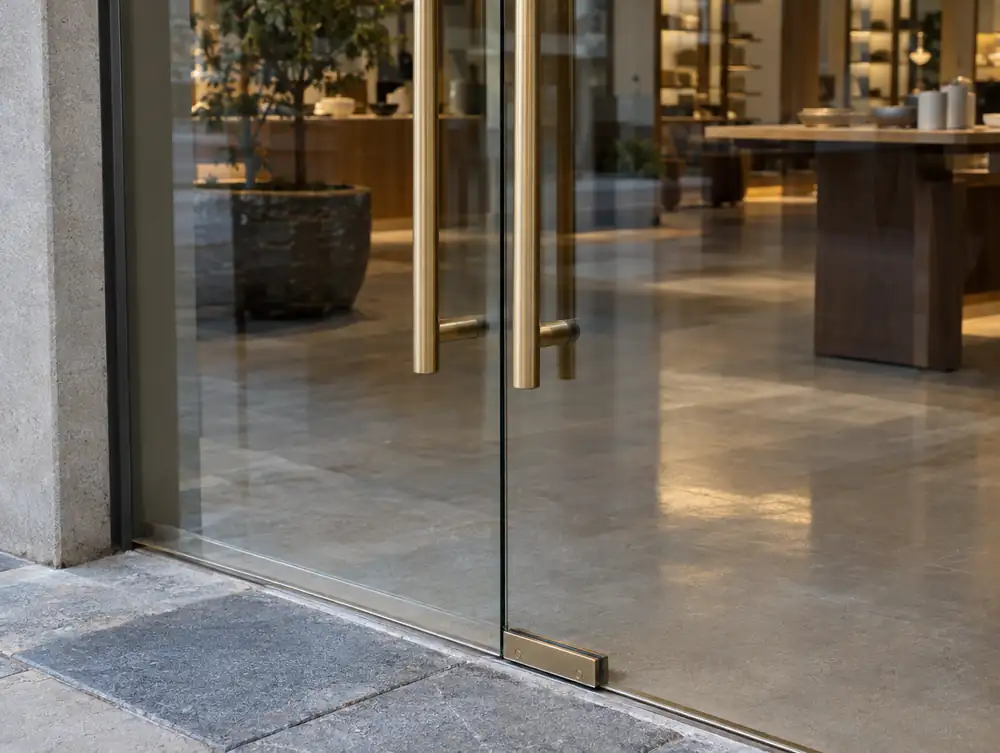
What makes frameless glass doors work well for premises in Fife?
A frameless door doesn't have to match a frameless front. For premises across Fife, it can sit well in a timber or aluminium surround, as long as the head line and the handle finish tie in with what's already there.
Security after hours shapes the hardware. For premises in Fife that close early or sit on a quiet street, we'd look at the lock position, floor socket and any internal shutter together, so the door is secure without looking heavy.
What consents apply to frameless glass doors in Fife?
Class 9A, Scotland's shop permitted development right, gives no route for a shopfront change. It covers Class 1A premises, but not work that alters or extends beyond the existing front, and it doesn't apply in conservation areas, National Parks or World Heritage Sites. For frameless glass doors at premises in the Fife area, that generally means a planning application unless the external appearance isn't materially affected.
How much do frameless glass doors cost in Fife?
Guide price: £1,495 to £4,495 plus VAT per door set. Materials, finish and the amount of drawing and coordination involved all move it, and your itemised quotation shows where the money goes on frameless glass doors.
| Area | Fife |
|---|---|
| Nation | Scotland |
| Towns covered | 9 |
| Main town | Dunfermline |
| Planning regime | Scotland: 1997 Planning Act and the 1984 Advertisement Regulations |
| Building approval | Building warrant (Technical Handbook) |
| Survey | Free for new work, from our Great Barr base |
Does Fife Council publish shopfront guidance?
Yes, Shop Front Design Guidelines (2016). It tells applicants what the council expects from new and altered shopfronts. A few of the things it asks for:
- Solid security shutters are discouraged, and shutter boxes may not project in front of the shop front.
- Internal lattice shutters and reinforced laminated glass are encouraged in town centres, with demountable mesh grilles preferred on traditional shop fronts.
- Each shop normally gets one fascia sign and one projecting sign, and only one of them may be lit.
Questions about frameless glass doors in Fife
What if my floor in Fife can't take a floor spring?
We'd use a concealed closer in a slim transom. It keeps the look almost the same, and suits floors over a cellar or with services beneath.
Do you match door fittings to our other premises in Fife?
Yes. Fittings come in several finishes, and we'd use your existing door as the reference so every entrance feels the same.
Do you fit frameless glass doors across Fife?
Yes. We travel from Great Barr to survey, make a final check measure and fit each door set.
Do I need listed building consent for a shopfront in the Fife area?
Almost certainly, if the building is listed and windows or doors are changing, according to Historic Environment Scotland. The planning authority decides, and Historic Environment Scotland is consulted on some applications. Scottish Ministers are notified if it objects.
Does a shop sign in the Fife area need advertisement consent?
Not always. Scotland's 1984 Regulations let an unlit sign within Class IV(1) go up without an application, and Class VI does the same for a lit sign with each character lit from within. Class VI isn't available in conservation areas, and one council says lit signs always need express consent, so ask first.