Seen a frontage you admire? Bring the picture to our first talk about projecting signs in Staffordshire, and we will work out what makes it succeed, from fascia depth to glass line, and what that means for your building.
Access gets as much attention as appearance at survey. Where a vehicle can stop, how long sections reach the opening and how the pavement stays safe for the public all shape the programme for projecting signs in Staffordshire.
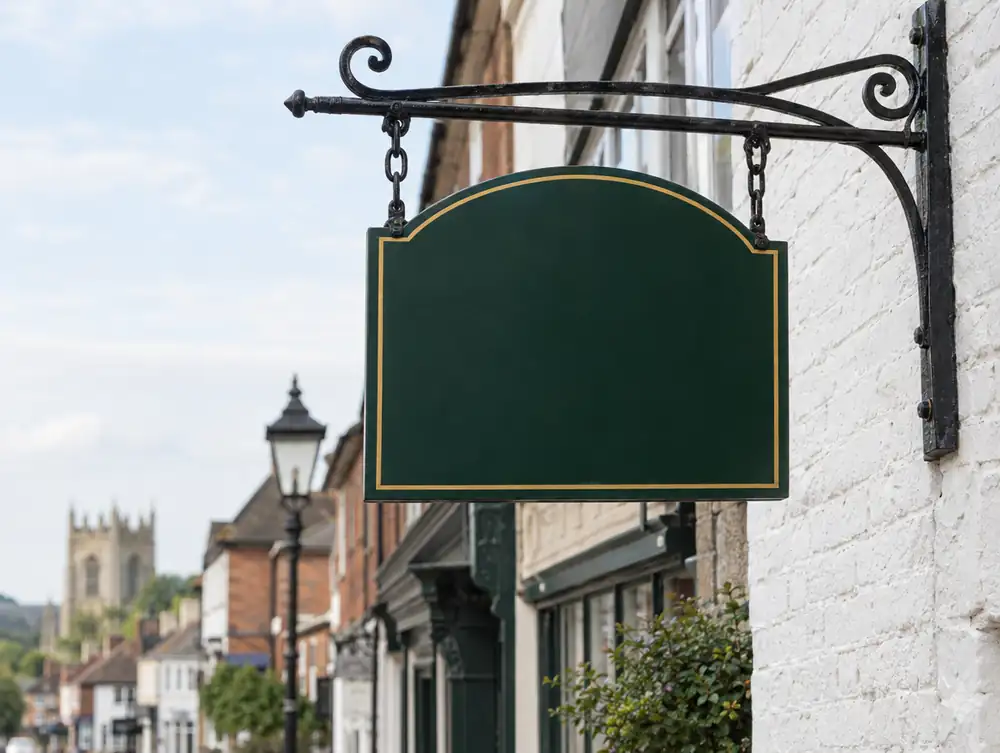
What makes projecting signs work well for premises in Staffordshire?
Narrow pavements call for a smaller sign. If your premises in Staffordshire open onto a tight footway, we keep the projection modest and the height generous, so the sign stays clear of people and vehicles.
Sightlines along the street decide the position. On premises across Staffordshire we walk the pavement from both directions at survey, because a lamp post, tree or neighbouring sign can hide a sign from the side people arrive.
What consents apply to projecting signs in Staffordshire?
Security grilles and shutters are named in England's rules: installing or replacing one on a shopfront sits outside the shop permitted development rights. The frontage itself is treated the same way, so for projecting signs at premises in the Staffordshire area, building work that materially affects the appearance needs planning permission. Confirm the position with the council before anything is ordered.
In England, signs at premises in the Staffordshire area come under the 2007 Advertisement Regulations. An unlit fascia sign generally needs no application under Class 5 of Schedule 3 if it sits on a wall containing a shop window, tops out at 4.6m or the first-floor sill if that is lower, and keeps letters to 0.75m high. Displaying a sign without the consent it needs is a criminal offence, so check before it goes up.
How much do projecting signs cost in Staffordshire?
Until the survey is done, plan on £395 to £1,295 plus VAT per sign. Unusual sizes, fine detail and phased working push the figure up, while a simple brief and clear access keep it toward the lower end.
| Area | Staffordshire |
|---|---|
| Nation | England |
| Towns covered | 21 |
| Main town | Stoke-on-Trent |
| Planning regime | England: TCPA 1990 and the 2007 Advertisement Regulations |
| Building approval | Building Regulations (Approved Documents) |
| Survey | Free for new work, from our Great Barr base |
Questions about projecting signs in Staffordshire
Can you fit a projecting sign to a stone or brick wall in Staffordshire?
Yes. Hard stone and sound brick both take resin anchors well, and soft brick needs a longer, wider fixing. We drill into mortar joints or discreet positions where the wall needs protecting.
Can a new panel go on my existing bracket in Staffordshire?
Often, yes, once we have checked the bracket and fixings. Old ironwork can be stripped and repainted, and the panel can be made to fit it. A loose or corroded bracket has to come down first.
What artwork works on a small hanging sign around Stoke-on-Trent?
Bold, simple artwork works, with a logo or a short name. Fine lettering and long strap lines get lost at an angle, so we test the design at full size.
Does a shop sign in the Staffordshire area need advertisement consent?
Not always. In England, an unlit sign within Class 5 of the 2007 Advertisement Regulations generally needs no application, and neither does a lit sign within Class 4B. Anything outside those classes needs consent, and Class 4B isn't available in conservation areas, so check before ordering.
Does the Equality Act apply to a shop entrance in the Staffordshire area?
Yes. The Equality Act 2010 applies in England, as across Great Britain, and it requires reasonable steps to remove, alter or avoid physical features that disadvantage disabled people. The duty is anticipatory, so it looks at disabled people generally, and a new Services Code replaced the 2011 Code on 5 August 2026.