For projecting signs across the East Riding of Yorkshire, we draw first and order later. You see a scale drawing with signed-off dimensions before anything is made, so the frontage on paper is the frontage you get.
Access gets as much attention as appearance at survey. Where a vehicle can stop, how long sections reach the opening and how the pavement stays safe for the public all shape the programme for projecting signs in the East Riding of Yorkshire.
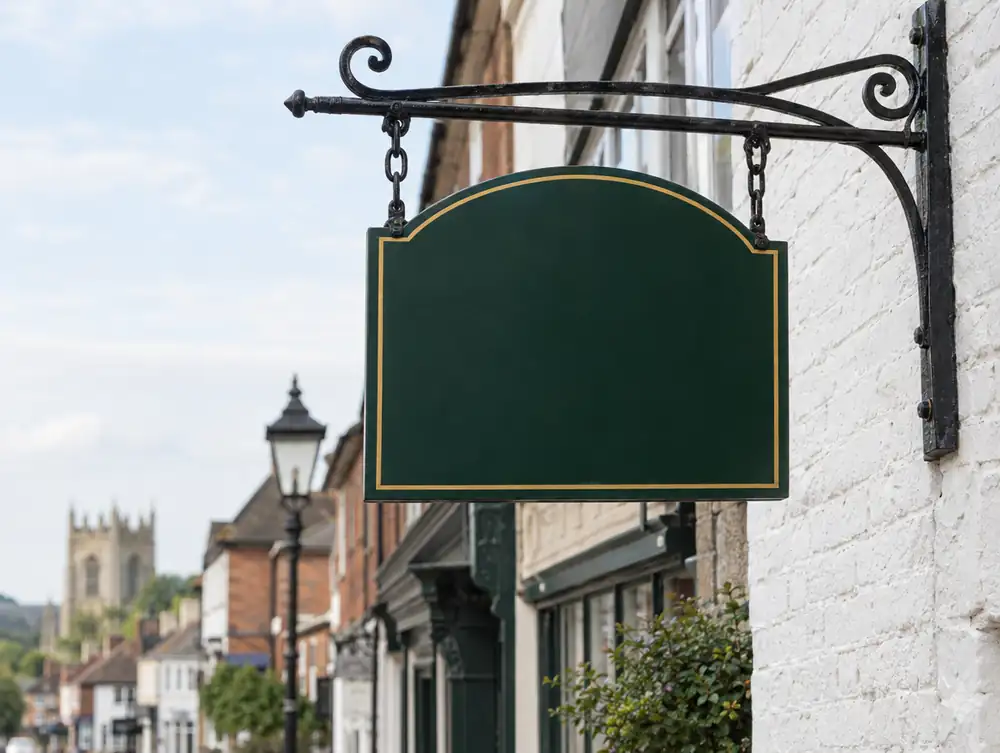
How do we handle projecting signs for premises in the East Riding of Yorkshire?
Sightlines along the street decide the position. On premises across the East Riding of Yorkshire we walk the pavement from both directions at survey, because a lamp post, tree or neighbouring sign can hide a sign from the side people arrive.
Several businesses sharing one building need a plan. If yours sits on an upper floor in the East Riding of Yorkshire, a slim projecting sign at street level may be the only thing that reaches passers-by, so we position it beside your own door.
What consents apply to projecting signs in the East Riding of Yorkshire?
England has no permitted development route for changing a shopfront. Part 7 Class A of the General Permitted Development Order 2015 excludes creating, altering or replacing one, and it allows no alterations at all on article 2(3) land. That leaves two outcomes for projecting signs at premises in the East Riding of Yorkshire area: a planning application, or work that doesn't materially affect the external appearance.
In England, signs at premises in the East Riding of Yorkshire area come under the 2007 Advertisement Regulations. An unlit fascia sign generally needs no application under Class 5 of Schedule 3 if it sits on a wall containing a shop window, tops out at 4.6m or the first-floor sill if that is lower, and keeps letters to 0.75m high. Displaying a sign without the consent it needs is a criminal offence, so check before it goes up.
How much do projecting signs cost in the East Riding of Yorkshire?
The guide for projecting signs is £395 to £1,295 plus VAT per sign. Expect the lower end for simple work with clear access, and the upper end where detail, finish or awkward conditions add hours.
| Area | East Riding of Yorkshire |
|---|---|
| Nation | England |
| Towns covered | 7 |
| Main town | Hull |
| Planning regime | England: TCPA 1990 and the 2007 Advertisement Regulations |
| Building approval | Building Regulations (Approved Documents) |
| Survey | Free for new work, from our Great Barr base |
Questions about projecting signs in the East Riding of Yorkshire
How long does fitting take on premises in the East Riding of Yorkshire?
Usually about half a day from a ladder or tower, with a little longer if a cable has to be run for lighting. The shop can normally stay open while we work.
What artwork works on a small hanging sign around Hull?
Bold, simple artwork works, with a logo or a short name. Fine lettering and long strap lines get lost at an angle, so we test the design at full size.
Can you fit a projecting sign to a stone or brick wall in the East Riding of Yorkshire?
Yes. Hard stone and sound brick both take resin anchors well, and soft brick needs a longer, wider fixing. We drill into mortar joints or discreet positions where the wall needs protecting.
Does the Equality Act apply to a shop entrance in the East Riding of Yorkshire area?
Yes. The Equality Act 2010 applies in England, as across Great Britain, and it requires reasonable steps to remove, alter or avoid physical features that disadvantage disabled people. The duty is anticipatory, so it looks at disabled people generally, and a new Services Code replaced the 2011 Code on 5 August 2026.
What rules apply to a fire exit door through a shopfront in the East Riding of Yorkshire area?
It must open in the direction of escape and can't be locked against immediate use, and a dedicated fire exit can't be a sliding or revolving door. In England that comes from article 14(2) of the Regulatory Reform (Fire Safety) Order 2005, and the duty sits with the responsible person, normally the employer or whoever controls the premises for a business, otherwise the owner. An outward door can clash with section 153 of the Highways Act 1980 where it opens onto the footway, so raise it early.