Our quotation for projecting signs in Argyll and Bute is written, itemised and valid for 90 days. Nothing is ordered until you accept it, which gives you time to take it to a landlord, a partner or a board.
Access gets as much attention as appearance at survey. Where a vehicle can stop, how long sections reach the opening and how the pavement stays safe for the public all shape the programme for projecting signs in Argyll and Bute.
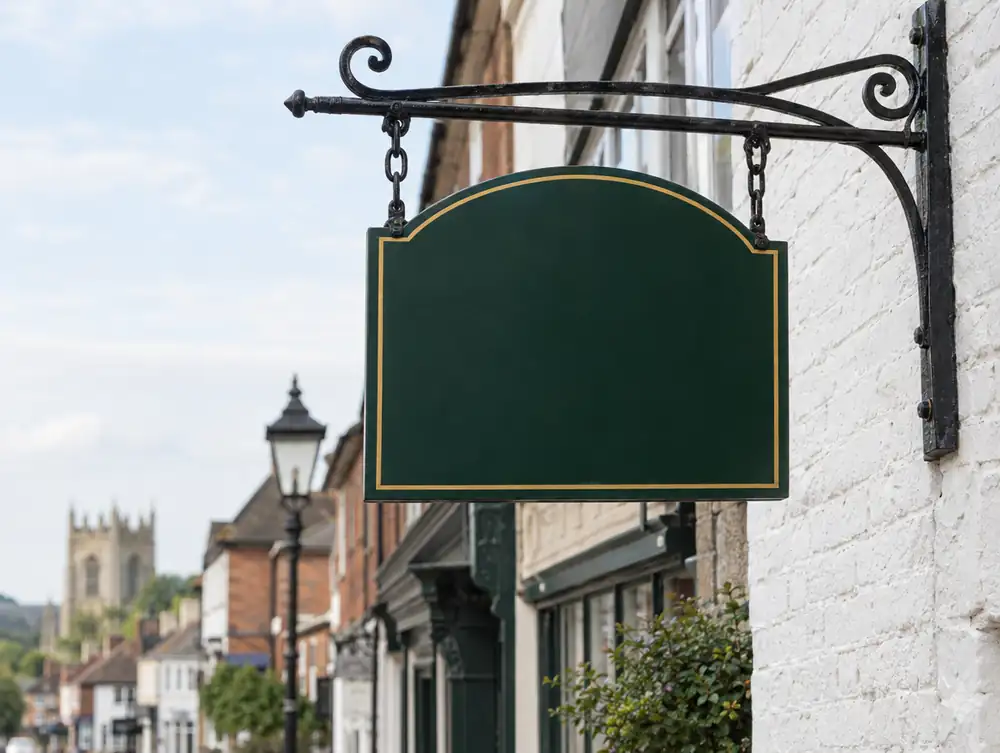
What makes projecting signs work well for premises in Argyll and Bute?
Sightlines along the street decide the position. On premises across Argyll and Bute we walk the pavement from both directions at survey, because a lamp post, tree or neighbouring sign can hide a sign from the side people arrive.
Narrow pavements call for a smaller sign. If your premises in Argyll and Bute open onto a tight footway, we keep the projection modest and the height generous, so the sign stays clear of people and vehicles.
What consents apply to projecting signs in Argyll and Bute?
Class 9A, Scotland's shop permitted development right, gives no route for a shopfront change. It covers Class 1A premises, but not work that alters or extends beyond the existing front, and it doesn't apply in conservation areas, National Parks or World Heritage Sites. For projecting signs at premises in the Argyll and Bute area, that generally means a planning application unless the external appearance isn't materially affected.
Signs in Scotland come under the 1984 Advertisement Regulations, which have their own class numbers. At premises in the Argyll and Bute area, an unlit fascia sign generally needs no application under Class IV(1) of Schedule 4 if it sits on a wall containing a shop window, tops out at 4.6m or first-floor level, and keeps letters to 0.75m high. Anything beyond that needs advertisement consent, and displaying a sign without consent is a criminal offence.
How much do projecting signs cost in Argyll and Bute?
Guide price: £395 to £1,295 plus VAT per sign. Materials, finish and the amount of drawing and coordination involved all move it, and your itemised quotation shows where the money goes on projecting signs.
| Area | Argyll and Bute |
|---|---|
| Nation | Scotland |
| Towns covered | 1 |
| Main town | Helensburgh |
| Planning regime | Scotland: 1997 Planning Act and the 1984 Advertisement Regulations |
| Building approval | Building warrant (Technical Handbook) |
| Survey | By arrangement |
Questions about projecting signs in Argyll and Bute
Can you fit a projecting sign to a stone or brick wall in Argyll and Bute?
Yes. Hard stone and sound brick both take resin anchors well, and soft brick needs a longer, wider fixing. We drill into mortar joints or discreet positions where the wall needs protecting.
Is a hanging sign better than a fixed one for premises around Helensburgh?
It depends on the building and the exposure. Hanging signs suit traditional frontages and give a bit of movement, while fixed signs need less upkeep. On a windy elevation we usually suggest fixed.
Do you make projecting signs to match a fascia in Argyll and Bute?
Yes. We use the same letter style, colours and finishes, so the two read as one. Both signs appear on the same scale drawing, which also shows how they line up.
Do I need a building warrant for a shopfront in the Argyll and Bute area?
Usually yes in Scotland, if the work alters a wall or structure. Schedule 3 of the Building (Scotland) Regulations 2004 lists some work that needs no warrant, such as replacing a door or window with its frame, but the standards still apply. Shopfronts aren't named there, so ask the council before relying on it.
Does a shop sign in the Argyll and Bute area need advertisement consent?
Not always. Scotland's 1984 Regulations let an unlit sign within Class IV(1) go up without an application, and Class VI does the same for a lit sign with each character lit from within. Class VI isn't available in conservation areas, and one council says lit signs always need express consent, so ask first.