Fixed canopies give Reading entrances year-round shelter, in steel, fabric or glass. We design the frame around the structure behind it, so it looks part of the frontage.
Nothing gets ordered off the back of a survey in Reading, because its job is to give us the numbers to draw and price from.
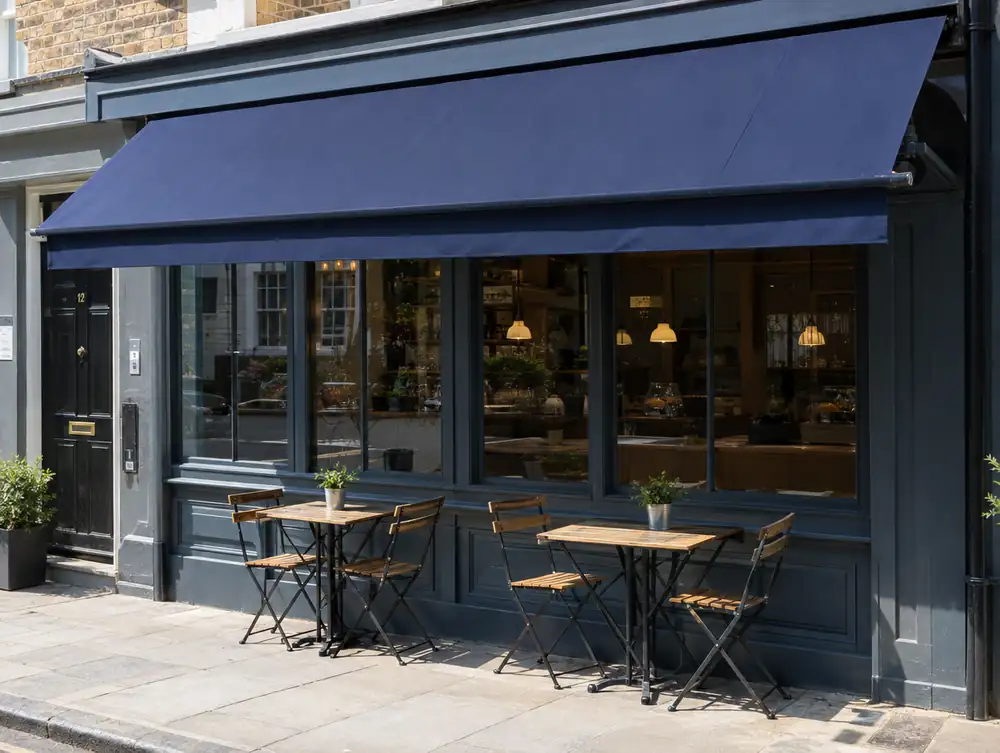
How do you design around the building when planning canopies and awnings in Reading?
If your Reading premises sell food from the front, we would avoid a strong fabric colour that tints the display. Neutral or striped canvas keeps produce looking natural.
Where your sign sits on the fascia, the awning box goes above or below it without covering the name. If that cannot be done, we letter the valance so people can still read who you are.
Where units share one long run of fascia, breaking the height makes you stand out for the wrong reason. If that describes your Reading parade, keep the line and win attention with lettering, lighting and what's in the window.
What permissions should you check for canopies and awnings in Reading?
Security grilles and shutters are named in England's rules: installing or replacing one on a shopfront sits outside the shop permitted development rights. The frontage itself is treated the same way, so for canopies and awnings at premises in the Reading area, building work that materially affects the appearance needs planning permission. Confirm the position with the council before anything is ordered.
Lighting moves a sign out of Class 5 in England, because that class allows illumination only for medical-type notices. Class 4B then applies at premises in the Reading area: halo or character-only lighting, static, with the lowest part at least 2.5m up. Brightness is capped at 600 cd/m² on signs up to 10m² and 300 cd/m² above that, and anything outside these limits needs advertisement consent.
We confirm the position at survey, because a boundary or a special designation can change who handles the file, but applications from Reading premises normally go to Reading Borough Council.
What might canopies and awnings cost in Reading?
The guide for canopies and awnings is £1,495 to £9,995 plus VAT per canopy or awning. Expect the lower end for simple work with clear access, and the upper end where detail, finish or awkward conditions add hours.
| Town | Reading |
|---|---|
| Area | Berkshire |
| Postcode districts | RG1, RG30, RG4, RG6 |
| Planning authority | Reading Borough Council |
| Building approval | Building Regulations (Approved Documents) |
| Distance from Great Barr | About 85 miles |
| Survey | Free for new work |
Does Reading Borough Council publish shopfront guidance?
Yes, Design Guide for Shopfronts (2022). It tells applicants what the council expects from new and altered shopfronts. A few of the things it asks for:
- Stallrisers should be at least 300mm high with 450 to 700mm preferred, and have a moulded projecting cill.
- Fascia text should fill no more than half the fascia's width and height, and the house number should be included.
- Security shutters should be avoided in favour of laminated glass, with internal grilles next and solid shutters generally inappropriate.
Questions about canopies and awnings in Reading
How long will an awning last on Reading premises?
A good frame typically lasts 15 years or more, and acrylic canvas typically lasts 7 to 10 years. Regular cleaning and retracting in high wind make the biggest difference.
Can an awning in Reading be motorised?
Yes, most can. A tubular motor sits inside the roller, with a remote or wall switch, and a wind sensor can be added. You will need a power supply near the box, which we check at survey.
Which awning suits a cafe in Reading?
A folding arm awning with a motor usually suits a cafe, because it covers a wide area with no posts. If tables sit close to the kerb or the site is windy, a shorter projection or fixed canopy may suit better.
Does a shop sign in the Reading area need advertisement consent?
Not always. In England, an unlit sign within Class 5 of the 2007 Advertisement Regulations generally needs no application, and neither does a lit sign within Class 4B. Anything outside those classes needs consent, and Class 4B isn't available in conservation areas, so check before ordering.
Does the Equality Act apply to a shop entrance in the Reading area?
Yes. The Equality Act 2010 applies in England, as across Great Britain, and it requires reasonable steps to remove, alter or avoid physical features that disadvantage disabled people. The duty is anticipatory, so it looks at disabled people generally, and a new Services Code replaced the 2011 Code on 5 August 2026.