From Reading to the furthest corner of Berkshire, the sequence for canopies and awnings stays the same: survey, drawings, written price, then work on site. We travel from Great Barr in Birmingham and use vetted teams working under S&K Glazing.
Most frontages share something with someone, be that a door to the flats above, a meter cupboard or a pilaster on the boundary. We pick those up early on canopies and awnings in Berkshire, because they are far easier to design around than to discover on the day.
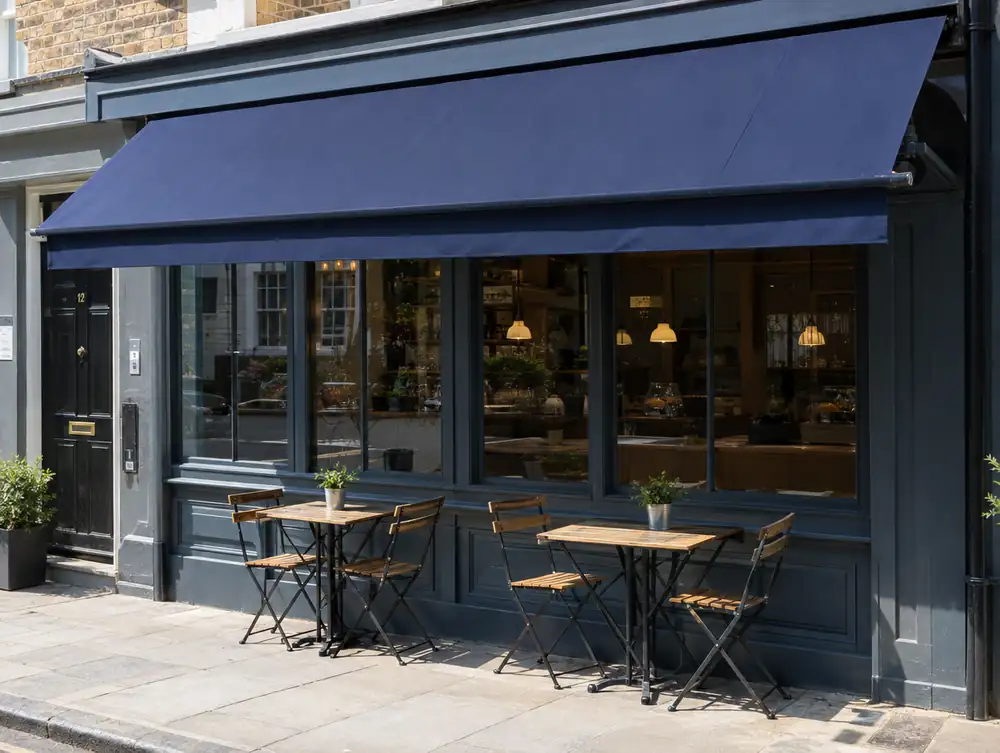
How should you approach canopies and awnings in Berkshire?
Fabric colour changes the light beneath it. A red cover can turn a food display pink, so for premises across Berkshire we choose canvas with the interior and the stock in mind.
Pavement width sets the upper limit. For a frontage in Berkshire we measure the footway, the kerb line and any street furniture, so the arms stop where people and vehicles are safe.
What consents apply to canopies and awnings in Berkshire?
A true like-for-like replacement usually needs no planning permission in England, because the external appearance isn't materially affected. New materials, a different glass line or altered proportions usually do count as material, so for canopies and awnings at premises in the Berkshire area, an application is then likely. The council confirms which side of that line a job falls on.
Lighting moves a sign out of Class 5 in England, because that class allows illumination only for medical-type notices. Class 4B then applies at premises in the Berkshire area: halo or character-only lighting, static, with the lowest part at least 2.5m up. Brightness is capped at 600 cd/m² on signs up to 10m² and 300 cd/m² above that, and anything outside these limits needs advertisement consent.
How much do canopies and awnings cost in Berkshire?
A sensible starting budget is £1,495 to £9,995 plus VAT per canopy or awning. What shifts the figure is whatever can't be seen yet, such as the condition behind the old frontage or the services running through it.
| Area | Berkshire |
|---|---|
| Nation | England |
| Towns covered | 14 |
| Main town | Reading |
| Planning regime | England: TCPA 1990 and the 2007 Advertisement Regulations |
| Building approval | Building Regulations (Approved Documents) |
| Survey | Free for new work, from our Great Barr base |
Does Reading Borough Council publish shopfront guidance?
Yes, Design Guide for Shopfronts (2022). It tells applicants what the council expects from new and altered shopfronts. A few of the things it asks for:
- Stallrisers should be at least 300mm high with 450 to 700mm preferred, and have a moulded projecting cill.
- Fascia text should fill no more than half the fascia's width and height, and the house number should be included.
- Security shutters should be avoided in favour of laminated glass, with internal grilles next and solid shutters generally inappropriate.
Questions about canopies and awnings in Berkshire
Motorised or manual for a unit near Reading?
Motorised makes sense if the awning goes in and out every day, because people use it properly. A hand crank suits small covers and occasional use, and it avoids a power supply.
Can you fit an awning without closing my premises in Berkshire?
Usually, yes. Most awnings go up in a day from a tower or platform, and we keep a safe zone around the door. Closed-day or out-of-hours fitting can be arranged where the entrance is tight.
Will an awning make my premises in Berkshire cooler?
Yes, external shade stops sun before it reaches the glass. It can make a clear difference on south and west-facing frontages, and it also slows fading of stock in the window.
Does a new shopfront in the Berkshire area need Building Regulations approval?
Assume yes until building control says otherwise. England has no like-for-like exemption, though registered installers can self-certify replacement windows and doors in non-dwellings. That route doesn't cover structural glass, curtain walling or revolving doors.
What rules apply to a fire exit door through a shopfront in the Berkshire area?
It must open in the direction of escape and can't be locked against immediate use, and a dedicated fire exit can't be a sliding or revolving door. In England that comes from article 14(2) of the Regulatory Reform (Fire Safety) Order 2005, and the duty sits with the responsible person, normally the employer or whoever controls the premises for a business, otherwise the owner. An outward door can clash with section 153 of the Highways Act 1980 where it opens onto the footway, so raise it early.