If your Reading frontage has good glass and a tired door, a new frameless set could lift the whole entrance. We'd line it up with the panes beside it and match the fittings to your brand.
Measuring the opening is the easy part of a survey in Reading. We also look at the beam above, the pavement fall and any meters or drains nearby.
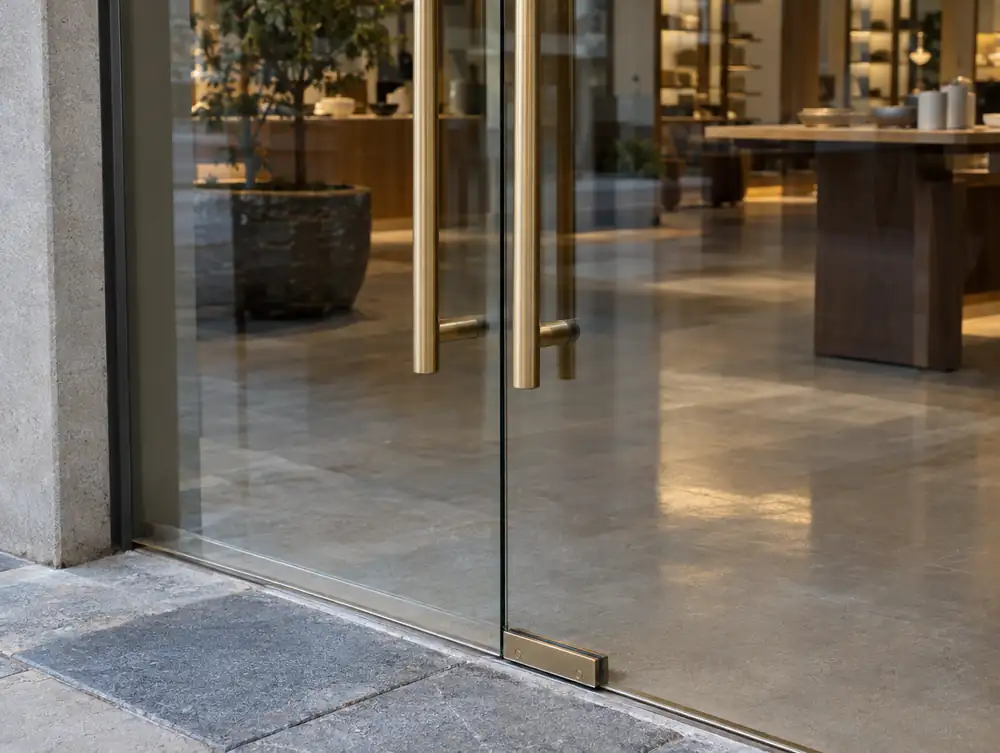
How do you design around the building when planning frameless glass doors in Reading?
If a landlord in Reading controls the frontage, a glass door is often an easy approval because so little changes visually. We'd supply a drawing showing the door, the fittings and any markings on the glass.
In a deep recess, a frameless door gets natural shelter and can sit back from the street. At Reading premises with that layout, we'd choose glass side returns so the recess stays bright and the door stays obvious.
On a north-facing frontage the glass stays free of glare, but the interior can look dim from the street, so lighting needs to sit closer to the window. If your Reading premises face south, the problem flips to reflections by day and fading stock.
What might frameless glass doors cost in Reading?
Guide price: £1,495 to £4,495 plus VAT per door set. Materials, finish and the amount of drawing and coordination involved all move it, and your itemised quotation shows where the money goes on frameless glass doors.
What permissions should you check for frameless glass doors in Reading?
England has no permitted development route for changing a shopfront. Part 7 Class A of the General Permitted Development Order 2015 excludes creating, altering or replacing one, and it allows no alterations at all on article 2(3) land. That leaves two outcomes for frameless glass doors at premises in the Reading area: a planning application, or work that doesn't materially affect the external appearance.
At survey we check how things stand for your building, although applications for planning permission or advertisement consent here normally go to Reading Borough Council.
| Town | Reading |
|---|---|
| Area | Berkshire |
| Postcode districts | RG1, RG30, RG4, RG6 |
| Planning authority | Reading Borough Council |
| Building approval | Building Regulations (Approved Documents) |
| Distance from Great Barr | About 85 miles |
| Survey | Free for new work |
Does Reading Borough Council publish shopfront guidance?
Yes, Design Guide for Shopfronts (2022). It tells applicants what the council expects from new and altered shopfronts. A few of the things it asks for:
- Stallrisers should be at least 300mm high with 450 to 700mm preferred, and have a moulded projecting cill.
- Fascia text should fill no more than half the fascia's width and height, and the house number should be included.
- Security shutters should be avoided in favour of laminated glass, with internal grilles next and solid shutters generally inappropriate.
Questions about frameless glass doors in Reading
Can my Reading premises take a frameless glass door?
Most can, once the floor and opening have been checked. The survey shows whether a floor spring will fit, and if not, a concealed closer in a transom does the same job.
How long will my Reading entrance be out of use?
Usually only a few hours, if the floor needs no work. Doors are often fitted outside trading hours, so you can open as normal.
Can you reuse my existing floor spring in Reading?
Sometimes, if it is sound and suits the new leaf. We'd test it at survey, because an old spring under a heavier door tends to fail early.
Does a shop sign in the Reading area need advertisement consent?
Not always. In England, an unlit sign within Class 5 of the 2007 Advertisement Regulations generally needs no application, and neither does a lit sign within Class 4B. Anything outside those classes needs consent, and Class 4B isn't available in conservation areas, so check before ordering.
Does a new shopfront in the Reading area need Building Regulations approval?
Assume yes until building control says otherwise. England has no like-for-like exemption, though registered installers can self-certify replacement windows and doors in non-dwellings. That route doesn't cover structural glass, curtain walling or revolving doors.