Few businesses can shut for a week, so any time on site for canopies and awnings in Oxfordshire is planned around the hours you trade. Closed-day or out-of-hours installation can be arranged.
Daylight is only half the brief for canopies and awnings, because a frontage keeps working after dark. Think about how the glass, the sign and the view inside will read to someone walking past at six o'clock on a winter evening.
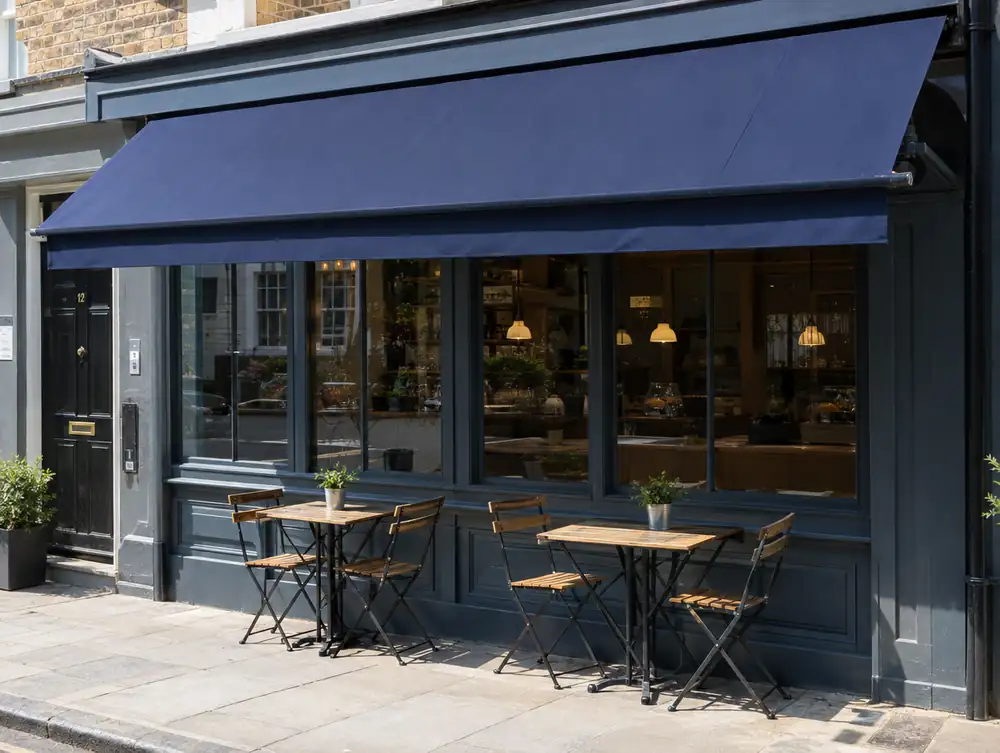
What should you look for from canopies and awnings in Oxfordshire?
Fabric colour changes the light beneath it. A red cover can turn a food display pink, so for premises across Oxfordshire we choose canvas with the interior and the stock in mind.
Tables outside need a different cover from a window display. If you serve customers at the front of premises near Oxford, we size the shade for seated guests and allow for the low sun of an evening.
What consents apply to canopies and awnings in Oxfordshire?
For canopies and awnings at premises in the Oxfordshire area, the deciding question in England is whether the building work materially affects the external appearance. If it does, planning permission is needed, while a true like-for-like replacement usually needs none. The council confirms the position for each site.
Class 4B, England's class for lit signs, isn't available in conservation areas, Areas of Outstanding Natural Beauty, National Parks or the Broads, so a lit sign there normally needs advertisement consent. In an area of special control it is unavailable too, and Class 5 drops to a 3.6m top height, 0.3m letters and one-tenth of the building face up to 3.6m. Ask the council which designations cover premises in the Oxfordshire area.
How much do canopies and awnings cost in Oxfordshire?
We would budget £1,495 to £9,995 plus VAT per canopy or awning. Scope sets most of the figure, so a clear brief at the start does more for the budget than any later change of detail.
| Area | Oxfordshire |
|---|---|
| Nation | England |
| Towns covered | 13 |
| Main town | Oxford |
| Planning regime | England: TCPA 1990 and the 2007 Advertisement Regulations |
| Building approval | Building Regulations (Approved Documents) |
| Survey | Free for new work, from our Great Barr base |
Does Oxford City Council publish shopfront guidance?
Yes, Technical Advice Note 10: Shopfronts and Signage (2021). It tells applicants what the council expects from new and altered shopfronts. A few of the things it asks for:
- The fascia is expected to be roughly 10% of the shopfront height, with lettering that does not dominate it.
- Permanently fixed external grilles will not be permitted in public places, with toughened glass and internal grilles preferred.
- Painted timber should be the basis for new shopfronts in conservation areas and on listed buildings.
Questions about canopies and awnings in Oxfordshire
Will an awning make my premises in Oxfordshire cooler?
Yes, external shade stops sun before it reaches the glass. It can make a clear difference on south and west-facing frontages, and it also slows fading of stock in the window.
Can a new cover go on the awning frame on my premises in Oxfordshire?
Often, yes. If the arms, roller and gear are sound, we measure the frame and make a new cover to fit. Frames that have started to bend or seize are usually better replaced.
Motorised or manual for a unit near Oxford?
Motorised makes sense if the awning goes in and out every day, because people use it properly. A hand crank suits small covers and occasional use, and it avoids a power supply.
Does a shop sign in the Oxfordshire area need advertisement consent?
Not always. In England, an unlit sign within Class 5 of the 2007 Advertisement Regulations generally needs no application, and neither does a lit sign within Class 4B. Anything outside those classes needs consent, and Class 4B isn't available in conservation areas, so check before ordering.
Does the Equality Act apply to a shop entrance in the Oxfordshire area?
Yes. The Equality Act 2010 applies in England, as across Great Britain, and it requires reasonable steps to remove, alter or avoid physical features that disadvantage disabled people. The duty is anticipatory, so it looks at disabled people generally, and a new Services Code replaced the 2011 Code on 5 August 2026.