People choose where to sit partly by what is overhead. Tables under a good awning in Oxford can gain useful trading hours in spring and autumn.
It helps if you can be there when we visit Oxford, since five minutes walking the frontage together answers more than a long email.
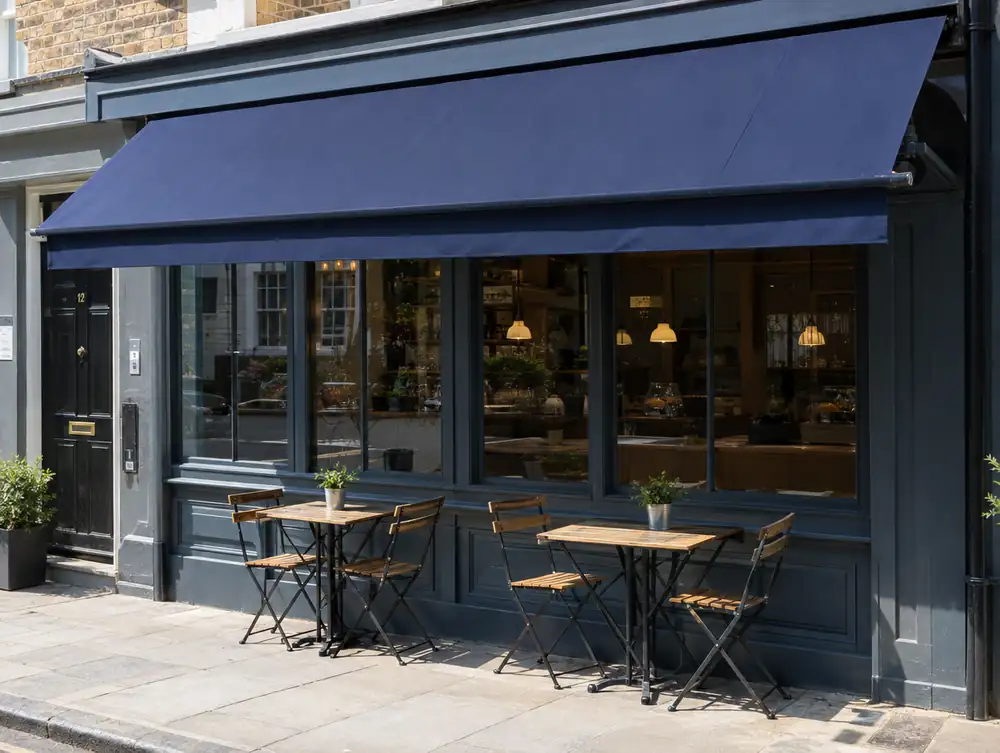
What goes into getting canopies and awnings right in Oxford?
Where the pavement is narrow, a long arm will reach too far, so we would look at a shorter projection or a drop-arm blind. Headroom and the kerb line are measured before we suggest a size.
Where your sign sits on the fascia, the awning box goes above or below it without covering the name. If that cannot be done, we letter the valance so people can still read who you are.
A corner unit has two fronts to think about, and the return elevation often does as much selling as the main one. If that is your layout in Oxford, carry the fascia and glass line round the corner and treat both faces as one composition.
How much could canopies and awnings in Oxford cost you?
As a working budget, use £1,495 to £9,995 plus VAT per canopy or awning. Your place inside that range for canopies and awnings depends mostly on how much of the existing frontage can stay and how much has to be put right first.
Which applications might canopies and awnings in Oxford involve?
For canopies and awnings at premises in the Oxford area, the deciding question in England is whether the building work materially affects the external appearance. If it does, planning permission is needed, while a true like-for-like replacement usually needs none. The council confirms the position for each site.
A lit projecting sign at premises in the Oxford area has firm limits under Class 4B in England: 0.75m² per surface and 1m high. It can project 1m, or two-thirds of the footway if that is less, and it can't sit over the carriageway. A larger sign needs advertisement consent, and so does a lit one in a conservation area.
Expect planning and advert applications here to go to Oxford City Council in the normal way. We check what that means for your building when we survey it in Oxford.
| Town | Oxford |
|---|---|
| Area | Oxfordshire |
| Postcode districts | OX1, OX2, OX3, OX4 |
| Planning authority | Oxford City Council |
| Building approval | Building Regulations (Approved Documents) |
| Distance from Great Barr | About 62 miles |
| Survey | Free for new work |
Does Oxford City Council publish shopfront guidance?
Yes, Technical Advice Note 10: Shopfronts and Signage (2021). It tells applicants what the council expects from new and altered shopfronts. A few of the things it asks for:
- The fascia is expected to be roughly 10% of the shopfront height, with lettering that does not dominate it.
- Permanently fixed external grilles will not be permitted in public places, with toughened glass and internal grilles preferred.
- Painted timber should be the basis for new shopfronts in conservation areas and on listed buildings.
Questions about canopies and awnings in Oxford
Will an awning hide the sign on my Oxford premises?
It should not, if it is designed properly. We place the box and valance so the name reads with the cover out, or we add lettering to the valance.
Will an awning or canopy be measured before I get a price in Oxford?
Yes. Every price comes from a measure-up, because wall construction and pavement width affect the design. You then receive an itemised quotation, valid for 90 days.
Do you replace awning fabric in Oxford?
Yes, provided the frame is sound. We measure the frame, check the arms and roller, then make a new cover in your chosen canvas and colour.
Does the Equality Act apply to a shop entrance in the Oxford area?
Yes. The Equality Act 2010 applies in England, as across Great Britain, and it requires reasonable steps to remove, alter or avoid physical features that disadvantage disabled people. The duty is anticipatory, so it looks at disabled people generally, and a new Services Code replaced the 2011 Code on 5 August 2026.
Do I need listed building consent for a shopfront in the Oxford area?
Usually yes, if the building is listed. In England the local planning authority decides, and Historic England is notified of Grade I and II* works and specified Grade II works. Like-for-like repair may not need consent, so ask the council before work starts.