Shopfront refurbishment gives Oxford premises a better frontage without starting from scratch. We survey what is sound, note what has failed and price the difference.
Your survey is where the price gets real, because widths, heights, levels and access are all taken on site in Oxford.
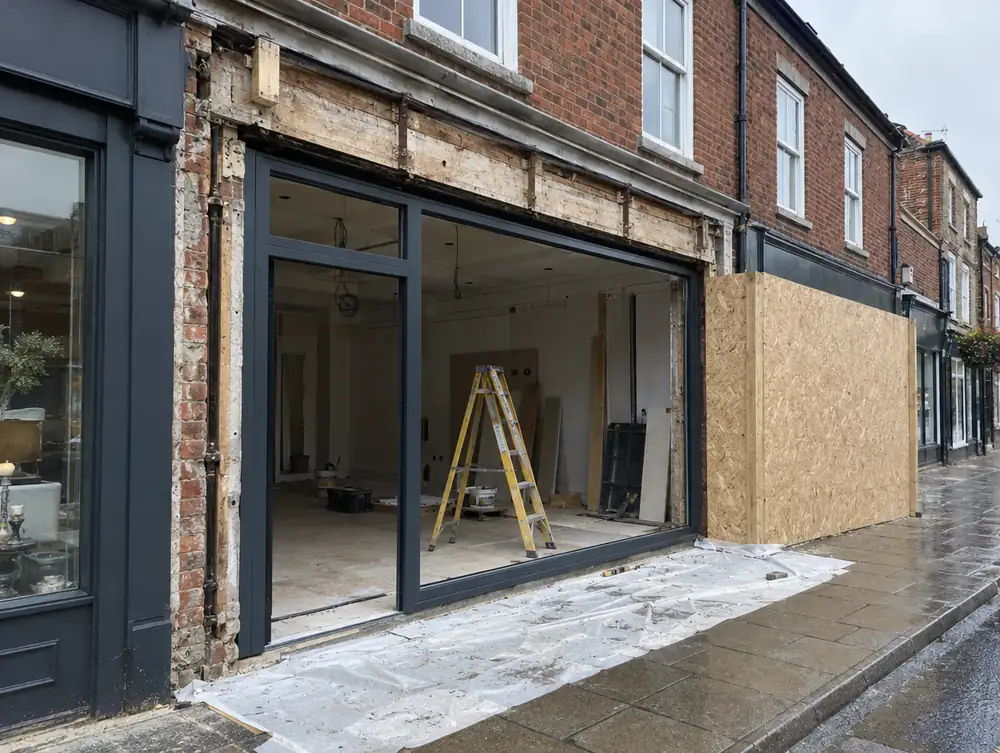
What goes into getting shopfront refurbishment right in Oxford?
Where budget is the limit, we rank the work by what people see first. The fascia, the door and the lower part of the frontage usually matter most, and the rest can follow as a second stage.
Where the sign is the first thing that looks tired, we would start there and work down. A slimmer fascia and better letters can carry a modest frame very well.
If the pavement falls across your frontage, let the stallriser take up the slope and keep the glass line dead level. The eye reads the long horizontal, so Oxford premises on a slope look settled once that line is true.
Which applications might shopfront refurbishment in Oxford involve?
For shopfront refurbishment at premises in the Oxford area, the deciding question in England is whether the building work materially affects the external appearance. If it does, planning permission is needed, while a true like-for-like replacement usually needs none. The council confirms the position for each site.
We confirm the position at survey, because a boundary or a special designation can change who handles the file, but applications from Oxford premises normally go to Oxford City Council.
How much could shopfront refurbishment in Oxford cost you?
Guide price: £1,995 to £8,995 plus VAT depending on what is kept. Materials, finish and the amount of drawing and coordination involved all move it, and your itemised quotation shows where the money goes on shopfront refurbishment.
| Town | Oxford |
|---|---|
| Area | Oxfordshire |
| Postcode districts | OX1, OX2, OX3, OX4 |
| Planning authority | Oxford City Council |
| Building approval | Building Regulations (Approved Documents) |
| Distance from Great Barr | About 62 miles |
| Survey | Free for new work |
Does Oxford City Council publish shopfront guidance?
Yes, Technical Advice Note 10: Shopfronts and Signage (2021). It tells applicants what the council expects from new and altered shopfronts. A few of the things it asks for:
- The fascia is expected to be roughly 10% of the shopfront height, with lettering that does not dominate it.
- Permanently fixed external grilles will not be permitted in public places, with toughened glass and internal grilles preferred.
- Painted timber should be the basis for new shopfronts in conservation areas and on listed buildings.
Questions about shopfront refurbishment in Oxford
Can a refurbishment make my Oxford premises easier to enter?
Often, yes. Lighter door closers, better handles and a lower threshold can all be added without replacing the frontage. We check the door width and the step at survey.
Can my Oxford shopfront be refurbished without closing?
Usually, yes. Work is split into stages around your trading hours, and closed-day or out-of-hours work can be arranged for anything that affects the door.
How do I know if my Oxford shopfront needs replacing?
A measured survey will show you. We check the frame, joints, door and glass, then tell you plainly whether refurbishment will last or whether a new shopfront would be better value.
Does a shop sign in the Oxford area need advertisement consent?
Not always. In England, an unlit sign within Class 5 of the 2007 Advertisement Regulations generally needs no application, and neither does a lit sign within Class 4B. Anything outside those classes needs consent, and Class 4B isn't available in conservation areas, so check before ordering.
What rules apply to a fire exit door through a shopfront in the Oxford area?
It must open in the direction of escape and can't be locked against immediate use, and a dedicated fire exit can't be a sliding or revolving door. In England that comes from article 14(2) of the Regulatory Reform (Fire Safety) Order 2005, and the duty sits with the responsible person, normally the employer or whoever controls the premises for a business, otherwise the owner. An outward door can clash with section 153 of the Highways Act 1980 where it opens onto the footway, so raise it early.