Panels that fold away should still look right when closed, since that is how a front in Oxford spends most of the year. We keep the widths even, the rails aligned and the frames slim, so the set reads as a shopfront.
Surveys for Oxford are booked with you directly. Tell us your quieter days and we'll work around them.
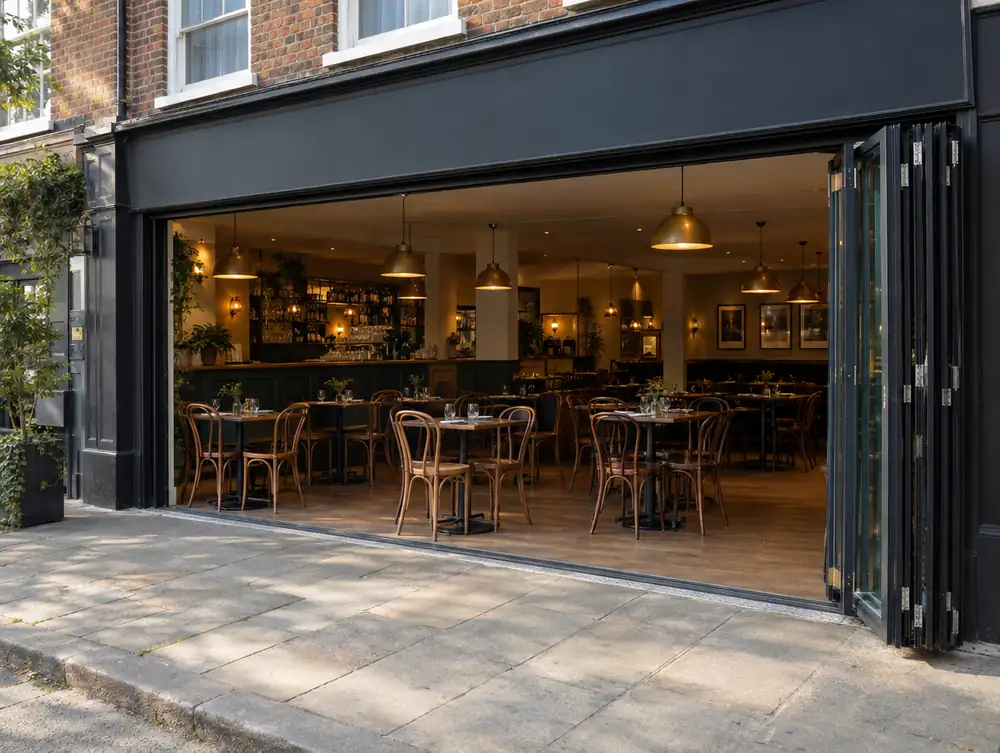
How would we approach bi-folding shopfronts for your Oxford premises?
A corner plot offers something rare: a front that can open on two sides. For Oxford corner premises, we'd look at two sets meeting with no fixed post, provided the structure above can span it.
Landlords often worry about what a bi-fold does to the structure and the weather line. For a unit in Oxford we'd prepare a drawing of the head, threshold and reinstatement route, so the conversation is about detail rather than doubt.
If your premises were once two shops, decide early whether the front should read as one or as two. One continuous fascia with a repeated bay width usually settles the elevation better than two mismatched halves, which is worth testing on any Oxford unit of that kind.
What should you budget for bi-folding shopfronts in Oxford?
The guide for bi-folding shopfronts is £5,195 to £13,995 plus VAT for a typical opening. Expect the lower end for simple work with clear access, and the upper end where detail, finish or awkward conditions add hours.
What consents could affect bi-folding shopfronts in Oxford?
A true like-for-like replacement usually needs no planning permission in England, because the external appearance isn't materially affected. New materials, a different glass line or altered proportions usually do count as material, so for bi-folding shopfronts at premises in the Oxford area, an application is then likely. The council confirms which side of that line a job falls on.
At survey we check how things stand for your building, although applications for planning permission or advertisement consent here normally go to Oxford City Council.
| Town | Oxford |
|---|---|
| Area | Oxfordshire |
| Postcode districts | OX1, OX2, OX3, OX4 |
| Planning authority | Oxford City Council |
| Building approval | Building Regulations (Approved Documents) |
| Distance from Great Barr | About 62 miles |
| Survey | Free for new work |
Does Oxford City Council publish shopfront guidance?
Yes, Technical Advice Note 10: Shopfronts and Signage (2021). It tells applicants what the council expects from new and altered shopfronts. A few of the things it asks for:
- The fascia is expected to be roughly 10% of the shopfront height, with lettering that does not dominate it.
- Permanently fixed external grilles will not be permitted in public places, with toughened glass and internal grilles preferred.
- Painted timber should be the basis for new shopfronts in conservation areas and on listed buildings.
Questions about bi-folding shopfronts in Oxford
Which way should the panels fold at my Oxford premises?
Inward is the usual answer, since panels folded into the room stay clear of people on the pavement. We'd draw the options where the room allows, and you choose against your seating plan.
Who do I speak to about a bi-fold in Oxford?
Your named contact stays the same from the first visit to the final adjustment. Fitting is carried out by vetted teams working under S&K Glazing, travelling from Great Barr.
How many panels would my Oxford opening need?
It depends on the width and how you want the set to open. Most openings divide into leaves under 1m wide, and an odd number gives you a daily door, so we draw the options after the measure-up.
Does a new shopfront in the Oxford area need Building Regulations approval?
Assume yes until building control says otherwise. England has no like-for-like exemption, though registered installers can self-certify replacement windows and doors in non-dwellings. That route doesn't cover structural glass, curtain walling or revolving doors.
Do roller shutters need planning permission in the Oxford area?
Usually yes. Installing or replacing a security grill or shutter on a shopfront is expressly outside England's shop permitted development rights, so the only way to avoid an application is work that doesn't materially affect the appearance. Ask the council before ordering.