Seen a frontage you admire? Bring the picture to our first talk about canopies and awnings in Dyfed, and we will work out what makes it succeed, from fascia depth to glass line, and what that means for your building.
If you're a tenant, your landlord will probably want to see what is proposed. The scale drawings we produce for canopies and awnings are clear enough to send straight on, which saves a round of explaining.
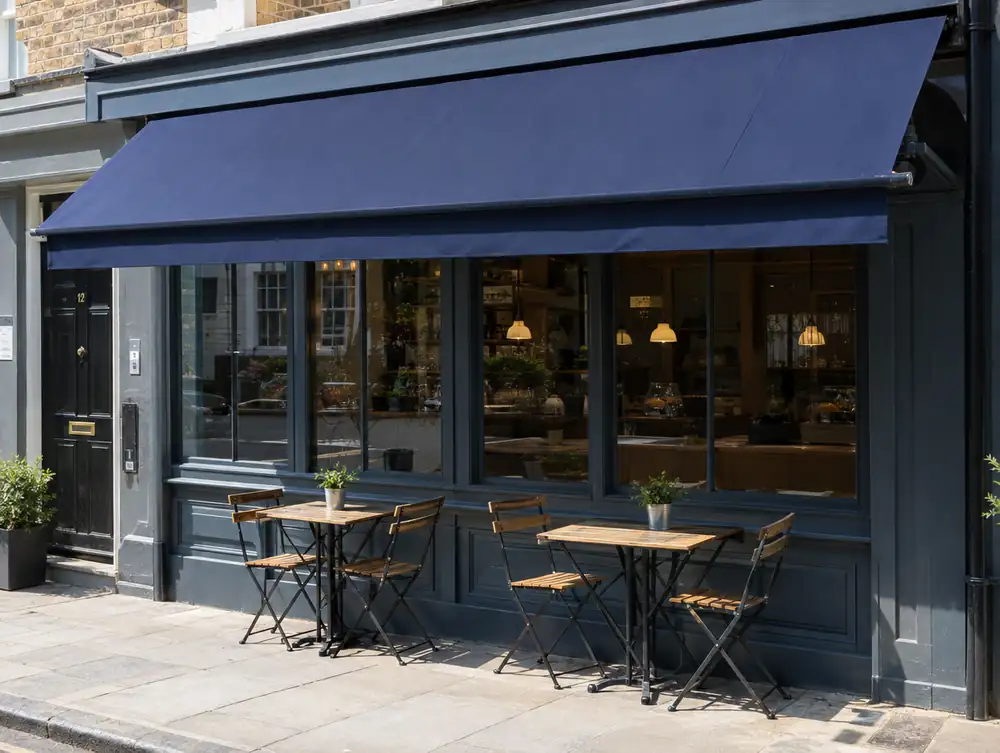
What makes canopies and awnings work well for premises in Dyfed?
Fabric colour changes the light beneath it. A red cover can turn a food display pink, so for premises across Dyfed we choose canvas with the interior and the stock in mind.
Orientation decides whether an awning earns its keep. For premises across Dyfed we look at where the sun falls during your trading hours, then size the projection for the hours that matter.
What consents apply to canopies and awnings in Dyfed?
Like-for-like replacement usually needs no planning permission in Wales, because the external appearance isn't materially affected. Matching the existing materials, proportions and glass line is what keeps a job in that position. For canopies and awnings at premises in the Dyfed area, changing any of those usually means an application, which the council can confirm.
Class 4B in Wales limits a lit projecting sign to 0.75m², 1m high and a 1m projection. A sign beyond those figures at premises in the Dyfed area needs advertisement consent, and the same goes for a lit sign in a conservation area.
How much do canopies and awnings cost in Dyfed?
Until the survey is done, plan on £1,495 to £9,995 plus VAT per canopy or awning. Unusual sizes, fine detail and phased working push the figure up, while a simple brief and clear access keep it toward the lower end.
| Area | Dyfed |
|---|---|
| Nation | Wales |
| Towns covered | 7 |
| Main town | Carmarthen |
| Planning regime | Wales: TCPA 1990 and the 1992 Advertisement Regulations |
| Building approval | Building Regulations (Approved Documents for Wales) |
| Survey | Free for new work, from our Great Barr base |
Does Carmarthenshire County Council publish shopfront guidance?
Yes, Carmarthenshire Shopfront Design Guide 2022 (2022). It tells applicants what the council expects from new and altered shopfronts. A few of the things it asks for:
- The fascia should be no deeper than the console and sit just below the cornice, and box fascias are not permitted.
- External roller shutters, external grilles and solid metal shutters are not permitted, with internal lattice or brick-bond grilles preferred.
- Internally lit signs are not permitted, and fascias should be lit externally with discreet downward-facing fittings.
Questions about canopies and awnings in Dyfed
Motorised or manual for a unit near Carmarthen?
Motorised makes sense if the awning goes in and out every day, because people use it properly. A hand crank suits small covers and occasional use, and it avoids a power supply.
Will an awning make my premises in Dyfed cooler?
Yes, external shade stops sun before it reaches the glass. It can make a clear difference on south and west-facing frontages, and it also slows fading of stock in the window.
Do you repair old blind boxes around Carmarthen?
Where they can be saved, yes. An original timber box can often be repaired and fitted with a new roller and cover, keeping the frontage's character. We open it up at survey to see the condition.
Can a roller shutter go on a shop in the Dyfed area without planning permission?
Usually not in Wales. Part 42 of the 1995 Order, as inserted in 2014, excludes installing or replacing a security grill or shutter on a shopfront, so the rights for shops don't help. The only way to avoid an application is work that doesn't materially affect the appearance, and the council confirms that.
What access duty applies to a shop in the Dyfed area?
The Equality Act 2010 applies, in Wales as across Great Britain, and it requires reasonable steps to remove, alter or avoid physical features that disadvantage disabled people. The duty is anticipatory, so it covers disabled people generally. A feature that meets a design standard is generally protected for 10 years.