Seen a frontage you admire? Bring the picture to our first talk about stallrisers and cladding in Dyfed, and we will work out what makes it succeed, from fascia depth to glass line, and what that means for your building.
Access gets as much attention as appearance at survey. Where a vehicle can stop, how long sections reach the opening and how the pavement stays safe for the public all shape the programme for stallrisers and cladding in Dyfed.
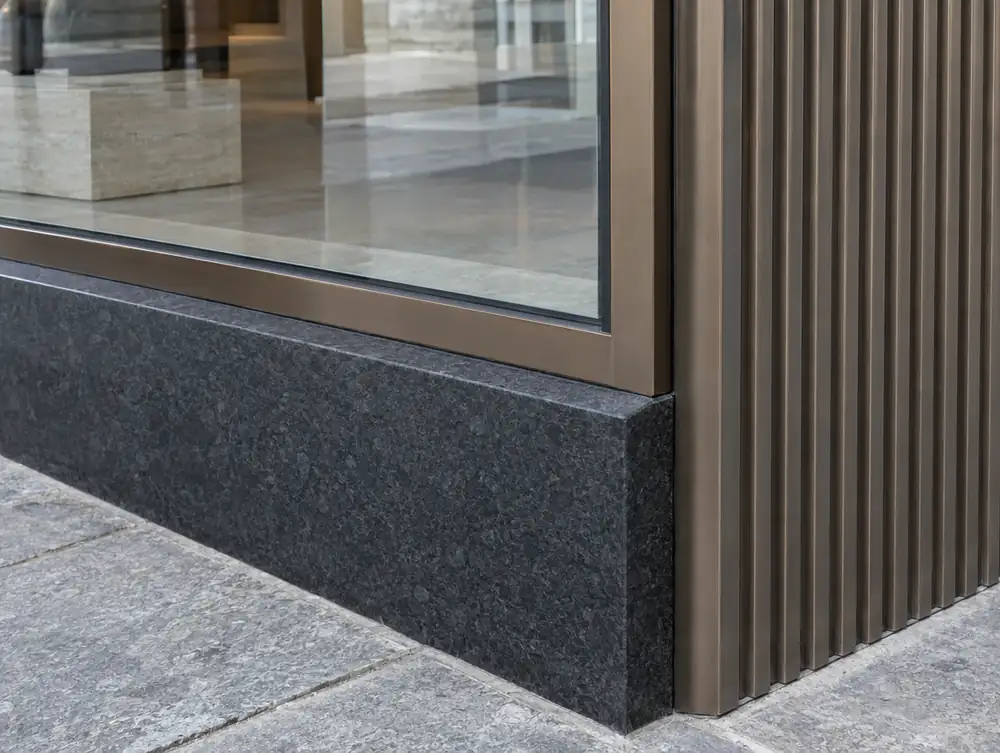
Where do you start with stallrisers and cladding in Dyfed?
Stripping an old facing can reveal what the building had first. If original tile or timber turns up on your premises in Dyfed, we stop and talk to you, since repairing it may cost less than cladding over it.
Stone and tile need a clean, dry surface and time to set. If your unit around Carmarthen opens straight onto the pavement, we cut off site and keep the working area small so the entrance stays usable.
What consents apply to stallrisers and cladding in Dyfed?
Like-for-like replacement usually needs no planning permission in Wales, because the external appearance isn't materially affected. Matching the existing materials, proportions and glass line is what keeps a job in that position. For stallrisers and cladding at premises in the Dyfed area, changing any of those usually means an application, which the council can confirm.
How much do stallrisers and cladding cost in Dyfed?
Until the survey is done, plan on £195 to £495 plus VAT per m². Unusual sizes, fine detail and phased working push the figure up, while a simple brief and clear access keep it toward the lower end.
| Area | Dyfed |
|---|---|
| Nation | Wales |
| Towns covered | 7 |
| Main town | Carmarthen |
| Planning regime | Wales: TCPA 1990 and the 1992 Advertisement Regulations |
| Building approval | Building Regulations (Approved Documents for Wales) |
| Survey | Free for new work, from our Great Barr base |
Does Carmarthenshire County Council publish shopfront guidance?
Yes, Carmarthenshire Shopfront Design Guide 2022 (2022). It tells applicants what the council expects from new and altered shopfronts. A few of the things it asks for:
- The fascia should be no deeper than the console and sit just below the cornice, and box fascias are not permitted.
- External roller shutters, external grilles and solid metal shutters are not permitted, with internal lattice or brick-bond grilles preferred.
- Internally lit signs are not permitted, and fascias should be lit externally with discreet downward-facing fittings.
Questions about stallrisers and cladding in Dyfed
Can you match an existing tiled stallriser on premises in Dyfed?
Often, yes, though an exact glaze match can be difficult. We take a sample tile, compare it with what is available, and suggest a specialist tile or a change at a natural break if the colour cannot be found.
Can stallriser work on premises around Carmarthen be done in a day?
A straightforward composite or painted panel often can, and fitting can be arranged on a closed day. Stone and tile take longer because of fixing and setting time, so we would agree a short phased plan.
How do I pick a stallriser finish for a unit in Dyfed?
Start with the brick, stone or render above the shop, then bring in the brand colour. Samples held against the building in daylight will tell you more than a screen, so try them in the morning and the evening.
When does a shop sign in the Dyfed area need advertisement consent?
A sign needs advertisement consent when it falls outside Class 5 or Class 4B of the 1992 Advertisement Regulations, which still apply in Wales. Within Class 5, an unlit sign sits on a wall containing a shop window and tops out at 4.6m or the first-floor sill if lower. A lit sign in a conservation area needs consent, because Class 4B isn't available there.
Can a shop fire exit in the Dyfed area use a sliding door?
No, a dedicated fire exit can't be a sliding or revolving door. In Wales, article 14(2) of the Regulatory Reform (Fire Safety) Order 2005 also says fire exit doors must open in the direction of escape and can't be locked against immediate use. The responsible person holds that duty, normally the employer or whoever controls the premises for a business, otherwise the owner.