Seen a frontage you admire? Bring the picture to our first talk about fascia signage in Dyfed, and we will work out what makes it succeed, from fascia depth to glass line, and what that means for your building.
Most frontages share something with someone, be that a door to the flats above, a meter cupboard or a pilaster on the boundary. We pick those up early on fascia signage in Dyfed, because they are far easier to design around than to discover on the day.
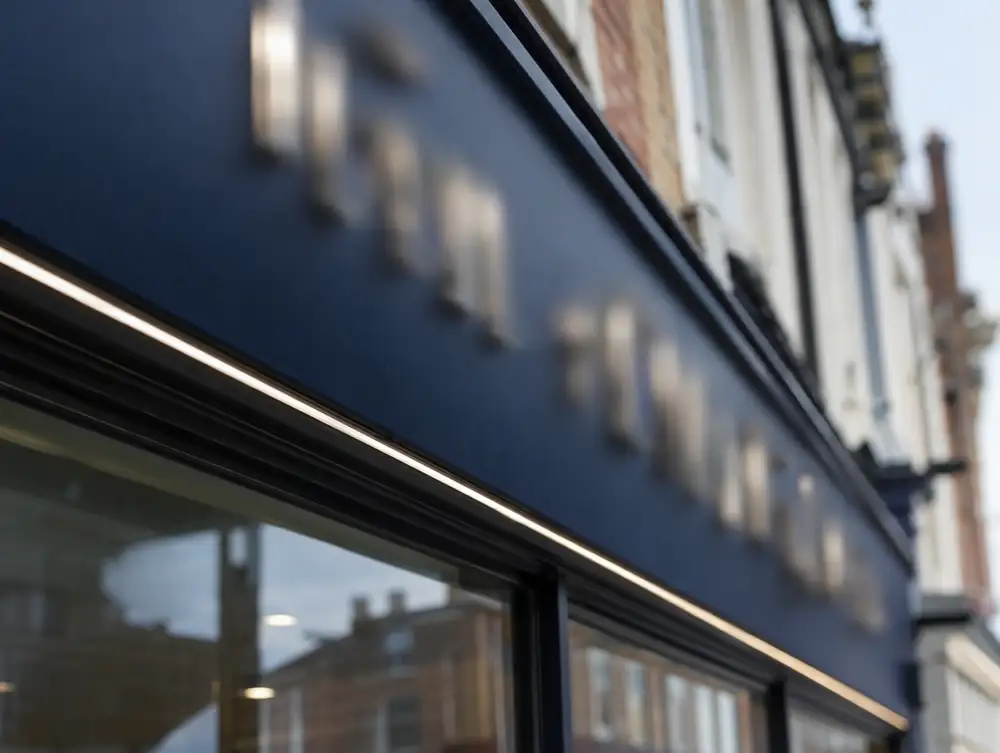
How do we handle fascia signage for premises in Dyfed?
Neighbouring signs set the visual noise your name has to sit against. If the units beside your premises in Dyfed use bright panels, a quieter dark fascia with well-spaced letters will usually stand out more.
Fascia depths rarely match from site to site. If your brand has several premises in Dyfed, we keep the logo proportions and spacing rules and adjust the size, so a shallow fascia near Carmarthen still looks related to a deep one elsewhere.
What consents apply to fascia signage in Dyfed?
Like-for-like replacement usually needs no planning permission in Wales, because the external appearance isn't materially affected. Matching the existing materials, proportions and glass line is what keeps a job in that position. For fascia signage at premises in the Dyfed area, changing any of those usually means an application, which the council can confirm.
In Wales, adding light takes a sign out of Class 5, which allows illumination only for medical-type notices, and into Class 4B. For premises in the Dyfed area, that generally means halo or character-only lighting, static, with the lowest part at least 2.5m up. Any other lighting needs advertisement consent.
How much does fascia signage cost in Dyfed?
Until the survey is done, plan on £395 to £1,995 plus VAT per sign. Unusual sizes, fine detail and phased working push the figure up, while a simple brief and clear access keep it toward the lower end.
| Area | Dyfed |
|---|---|
| Nation | Wales |
| Towns covered | 7 |
| Main town | Carmarthen |
| Planning regime | Wales: TCPA 1990 and the 1992 Advertisement Regulations |
| Building approval | Building Regulations (Approved Documents for Wales) |
| Survey | Free for new work, from our Great Barr base |
Does Carmarthenshire County Council publish shopfront guidance?
Yes, Carmarthenshire Shopfront Design Guide 2022 (2022). It tells applicants what the council expects from new and altered shopfronts. A few of the things it asks for:
- The fascia should be no deeper than the console and sit just below the cornice, and box fascias are not permitted.
- External roller shutters, external grilles and solid metal shutters are not permitted, with internal lattice or brick-bond grilles preferred.
- Internally lit signs are not permitted, and fascias should be lit externally with discreet downward-facing fittings.
Questions about fascia signage in Dyfed
How are letters sized for a fascia in Dyfed?
We start with the fascia depth, then check the reading distance from where people approach. Letters usually fill around 60% of the depth, with spacing adjusted by eye on the drawing.
Can a sign go up out of hours on premises around Carmarthen?
Yes, closed-day or out-of-hours installation can be arranged. Most fascia signs take about a day, so the shop rarely needs to close for long.
Can you replace a fascia sign in Dyfed without touching the shopfront?
Yes. Most signs can be changed on their own, and we check the subframe once the old panel is off. If the shopfront will be replaced within a few years, we would tell you, so the sign can be sized for it.
Can a roller shutter go on a shop in the Dyfed area without planning permission?
Usually not in Wales. Part 42 of the 1995 Order, as inserted in 2014, excludes installing or replacing a security grill or shutter on a shopfront, so the rights for shops don't help. The only way to avoid an application is work that doesn't materially affect the appearance, and the council confirms that.
Does a replacement shopfront in the Dyfed area need Building Regulations approval?
Assume yes until building control says otherwise, because Wales has no like-for-like exemption. Glazing is judged against Approved Document N, as Wales keeps Part N. A registered installer can self-certify replacement windows and doors in non-dwellings, but not structural glass, curtain walling or revolving doors.