What should your premises say from across the road? We open every conversation about illuminated signage in Dyfed with that question, then treat sightlines and proportion as seriously as the budget.
Finishes behave differently at full size. Any sample we show you for illuminated signage is better judged at the premises in daylight, since a colour that looks quiet on a desk can read much louder across a whole elevation.
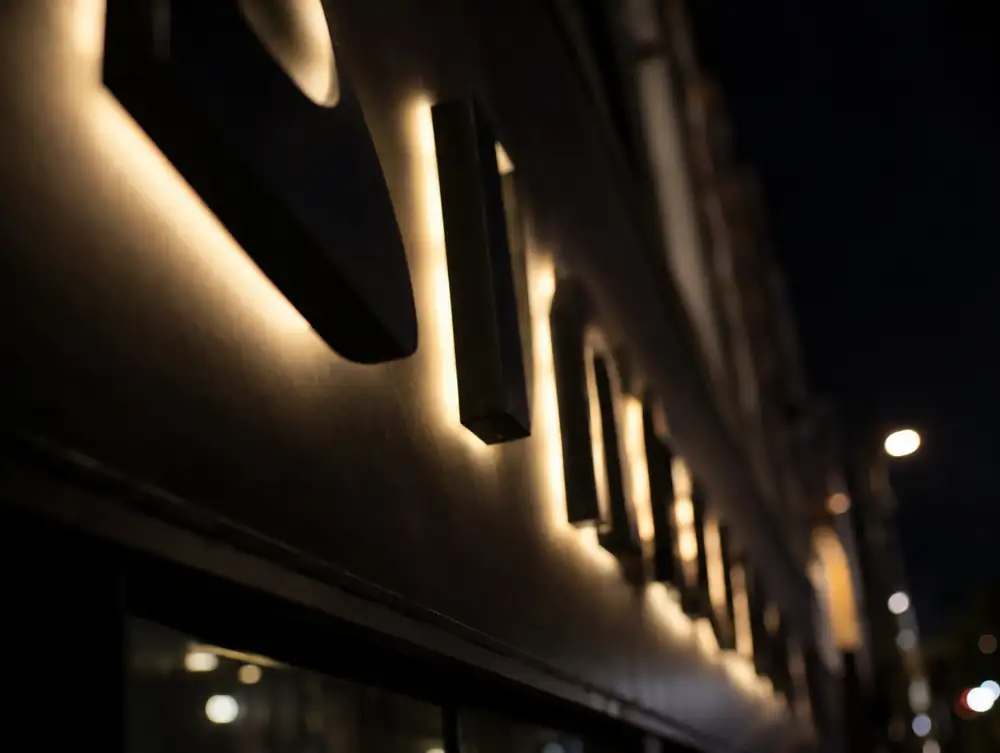
How should you approach illuminated signage in Dyfed?
Power often sets the layout. On a frontage near Carmarthen we trace where a supply can reach the sign without surface trunking, and we leave the drivers where they can be changed.
Think first about when your customers arrive. For premises across Dyfed that trade into the evening, we design from the dusk view, since that is when the letters do their real work.
What consents apply to illuminated signage in Dyfed?
Going by Part 42 of the 1995 Order as inserted in 2014, Wales has no permitted development route for changing a shopfront. The right covers A1 and A2 premises, but it excludes creating, altering or replacing a shopfront, or fitting or replacing a security grill or shutter on one, and it doesn't apply on Article 1(5) land. For illuminated signage at premises in the Dyfed area, that leaves a planning application, or work that leaves the appearance materially unchanged.
Class 4B isn't available in Welsh conservation areas, so a lit sign there normally needs advertisement consent. In an area of special control, Class 5 tightens to a 3.6m top height and a one-tenth area limit. Ask the council whether either applies to premises in the Dyfed area.
How much does illuminated signage cost in Dyfed?
As a working budget, use £895 to £3,995 plus VAT per sign. Your place inside that range for illuminated signage depends mostly on how much of the existing frontage can stay and how much has to be put right first.
| Area | Dyfed |
|---|---|
| Nation | Wales |
| Towns covered | 7 |
| Main town | Carmarthen |
| Planning regime | Wales: TCPA 1990 and the 1992 Advertisement Regulations |
| Building approval | Building Regulations (Approved Documents for Wales) |
| Survey | Free for new work, from our Great Barr base |
Does Carmarthenshire County Council publish shopfront guidance?
Yes, Carmarthenshire Shopfront Design Guide 2022 (2022). It tells applicants what the council expects from new and altered shopfronts. A few of the things it asks for:
- The fascia should be no deeper than the console and sit just below the cornice, and box fascias are not permitted.
- External roller shutters, external grilles and solid metal shutters are not permitted, with internal lattice or brick-bond grilles preferred.
- Internally lit signs are not permitted, and fascias should be lit externally with discreet downward-facing fittings.
Questions about illuminated signage in Dyfed
How disruptive is fitting a lit sign in Dyfed?
Very little, as a rule. Fitting usually takes one to two days from a tower or platform, and any cable work inside the shop can be done outside trading hours.
Can you test a lit letter on my premises in Dyfed before ordering?
Yes, where the job warrants it. A sample letter held against your fascia at dusk tells you more than a visual, particularly for halo lighting on a dark finish.
Do you arrange the electrics for signs around Carmarthen?
Yes. Low-voltage wiring and testing are part of the installation, with the final connection made by a qualified electrician. Any supply work needed is shown on the itemised quotation.
Can a roller shutter go on a shop in the Dyfed area without planning permission?
Usually not in Wales. Part 42 of the 1995 Order, as inserted in 2014, excludes installing or replacing a security grill or shutter on a shopfront, so the rights for shops don't help. The only way to avoid an application is work that doesn't materially affect the appearance, and the council confirms that.
Is planning permission needed for a new shopfront in the Dyfed area?
Usually yes, if the work materially affects the external appearance, because Wales has no permitted development route for changing a shopfront. Most of the Planning (Wales) Act 2026 hasn't been commenced yet, so the existing rules apply. A true like-for-like replacement usually avoids an application, and the council confirms the position.