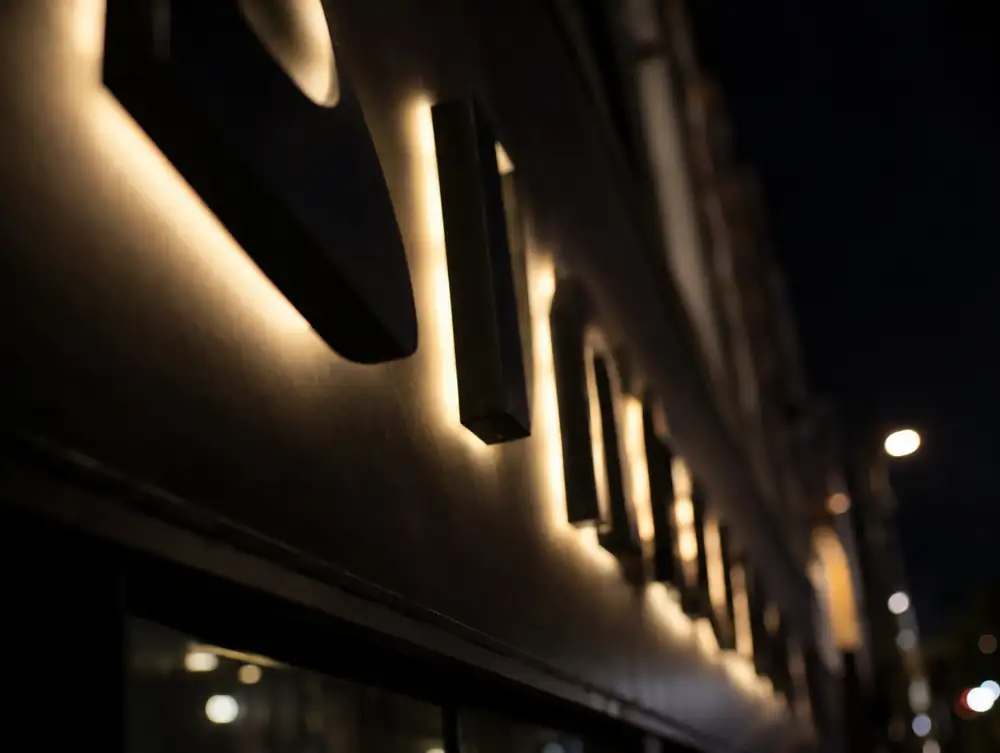
Illuminated signs for Pembroke Dock premises are designed from the evening view, because that is when the choice of light shows. We draw the letters, the glow and the power route together, so the sign looks planned from the first night.
We measure your Pembroke Dock opening in person, at a time agreed with you first, so the visit fits around your trading.
What should you think about before commissioning illuminated signage in Pembroke Dock?
On a timber frontage, a slim trough light usually keeps more of the daytime character than lit letters. We colour-match the bar to the fascia, so it almost disappears by day.
If letters will sit close to a window head or canopy, we check how the light falls across it. A small change in stand-off or letter position can prevent a hard shadow line.
On a north-facing frontage the glass stays free of glare, but the interior can look dim from the street, so lighting needs to sit closer to the window. If your Pembroke Dock premises face south, the problem flips to reflections by day and fading stock.
Who approves illuminated signage in Pembroke Dock?
The existing rules still apply in Wales, because most of the Planning (Wales) Act 2026 is waiting for a commencement order. For illuminated signage at premises in the Pembroke Dock area, building work that materially affects the external appearance needs planning permission, while a true like-for-like replacement usually doesn't. The council confirms the current position.
Signs in Wales still come under the 1992 Advertisement Regulations, with the classes set out in Schedule 3. At premises in the Pembroke Dock area, an unlit fascia sign generally needs no application under Class 5 if it sits on a wall containing a shop window and tops out at 4.6m or the first-floor sill if that is lower. Ask the council about letter sizes, and bear in mind that displaying a sign without consent is a criminal offence.
Expect planning and advert applications here to go to Pembrokeshire County Council in the normal way. We check what that means for your building when we survey it in Pembroke Dock.
What is a realistic budget for illuminated signage in Pembroke Dock?
We would budget £895 to £3,995 plus VAT per sign. Scope sets most of the figure, so a clear brief at the start does more for the budget than any later change of detail.
| Town | Pembroke Dock |
|---|---|
| Area | Dyfed |
| Postcode districts | SA72 |
| Planning authority | Pembrokeshire County Council |
| Building approval | Building Regulations (Approved Documents for Wales) |
| Distance from Great Barr | About 141 miles |
| Survey | Free for new work |
Questions about illuminated signage in Pembroke Dock
Will a lit sign in Pembroke Dock cost much to run?
Very little. A typical LED sign uses about the same power as a few domestic lamps, and a timer trims that further. Occasional driver changes are the larger long-term cost.
Which illuminated sign suits a restaurant in Pembroke Dock?
Halo-lit letters in a warm white usually suit restaurants, as they feel calm and considered. A trough light over a painted sign is a good alternative for a more traditional room.
Do you supply lit signs for premises across Dyfed?
Yes. We travel from Great Barr, with vetted teams working under S&K Glazing and one named contact for the job. The same scale drawing and sign-off process applies wherever your premises are.
When does a shop sign in the Pembroke Dock area need advertisement consent?
A sign needs advertisement consent when it falls outside Class 5 or Class 4B of the 1992 Advertisement Regulations, which still apply in Wales. Within Class 5, an unlit sign sits on a wall containing a shop window and tops out at 4.6m or the first-floor sill if lower. A lit sign in a conservation area needs consent, because Class 4B isn't available there.
Can a roller shutter go on a shop in the Pembroke Dock area without planning permission?
Usually not in Wales. Part 42 of the 1995 Order, as inserted in 2014, excludes installing or replacing a security grill or shutter on a shopfront, so the rights for shops don't help. The only way to avoid an application is work that doesn't materially affect the appearance, and the council confirms that.