We found no specific permitted development class for canopies or awnings, so treat one as needing planning permission if it materially affects appearance. An awning carrying your name is an advertisement in England and Wales, and anything over the highway usually needs the highway authority's agreement. There is no statutory footway clearance we could find, but guidance gives 2300mm generally.
What rules apply to canopies and awnings?
Three sets of rules usually apply: planning, advertisement control if it carries your name, and highway law if it projects over the footway. Listed building consent joins them on a listed building, and a conservation area will raise the bar on all three.
Highway rules differ by nation, as the table shows. In England and Wales, s.177 of the Highways Act 1980 requires a licence for a structure over the road, with "building" taken to include any structure, and the licence sets the headway. Northern Ireland has a similar licence under Art 75 of the Roads Order 1993. We couldn't confirm a Scottish equivalent, so ask the roads authority there.
A retractable blind and a fixed steel canopy may be treated differently, and small domestic-style awnings often get overlooked until someone complains. Ask the highway authority early, because a licence can take longer to get than the planning decision.
| Item | England and Wales | Scotland | Northern Ireland |
|---|---|---|---|
| Structure over road | s.177 licence, sets headway | Ask the roads authority | Art 75 licence, headway |
| Beams, cables | s.178 consent | s.90 consent | Art 73 |
| Dangerous projections | s.152 notice | s.88, 28 days' notice | Art 55 notice |
Do canopies and awnings need planning permission?
They usually do if they materially affect the appearance of the building, because we found no specific permitted development class for them in any nation. Small, retractable and well-matched blinds have the strongest case for no real effect, though the council decides.
Fixed canopies are a clearer change. A rigid frame projecting over the footway alters how the frontage looks all year round, and that is hard to describe as immaterial. In conservation areas, councils often dislike curved Dutch canopies, which hide the fascia and pilasters and bring in a shape foreign to most older streets.
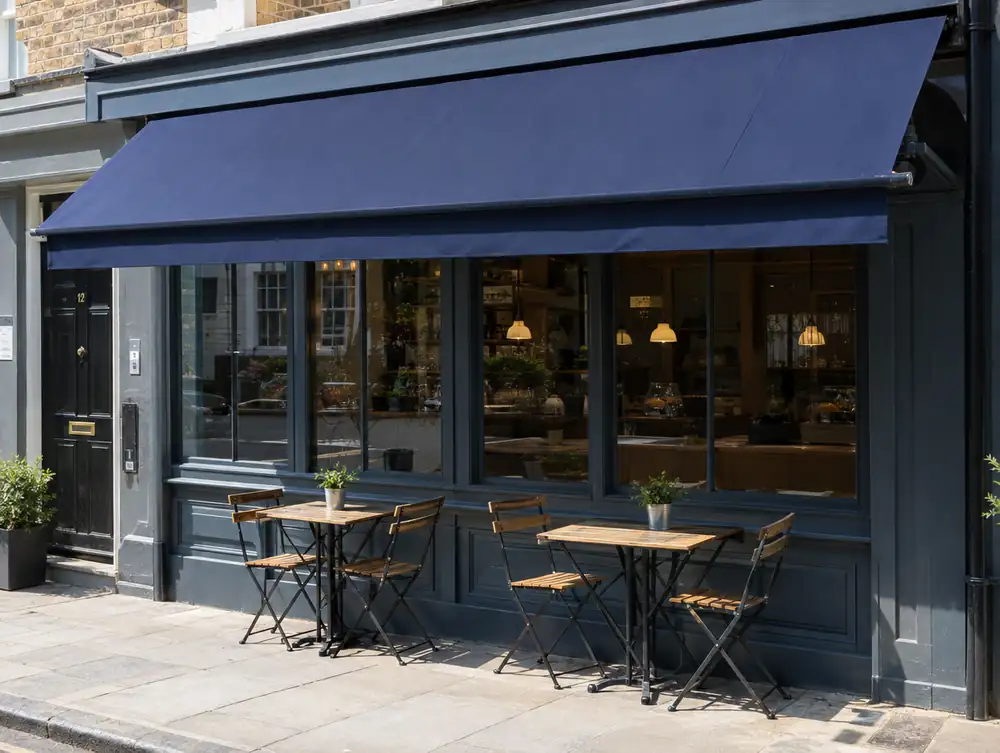
A traditional retractable blind tends to get a warmer reception. It folds away into a blind box, leaves the frontage visible when closed and has a history on many period shops, so a surviving box can be good evidence in your favour. Applications go through the same process as other shopfront works, and our planning guide lists the fee by nation.
Is an awning with my name on it an advertisement?
Yes, in England and Wales an advertising awning or blind counts as an advertisement. The Town and Country Planning Act 1990 defines the term widely enough to include it, so lettering on the valance brings advertisement control into the picture. Elsewhere, ask the council how it would treat one.
That doesn't always mean an application, but you should check the deemed consent limits before you print anything. Plain, unlit lettering of modest height has a better chance of fitting the rules than a large logo across the slope. A lit awning is a separate matter, as the lit classes have their own rules and no lit class is available in a conservation area.
Keep lettering to the valance where you can. Writing across the sloping face is seen from a distance but reads poorly up close, and it tends to look like an advert stuck onto the building. A clean valance with a short name is usually enough.
How high and how far can a canopy project?
We found no statutory footway minimum, so the working figures come from guidance and from your licence. Inclusive Mobility gives 2300mm generally and 2100mm for suspended signs and scaffolding, and the lit-sign classes need 2.5m. Where a licence applies, it will set the headway itself.
Measure from the pavement to the lowest point of the valance, with the awning fully open. A sloping street can lose you 100mm from one end to the other, and a soft valance can sag or blow lower than its rail. Keep well back from the kerb, since high-sided vehicles clip anything near the edge of the road, and watch out for lamp posts, bus stops and trees.
We found no set national figure for projection, so draw it and ask. The guide to go by is that people should be able to walk under it and pass each other without ducking.
Which canopy type suits a shop?
A traditional retractable blind suits most period frontages, a folding-arm awning suits cafes and terraces, a Dutch canopy suits only a few settings, and a fixed canopy suits modern entrances. Prices are £1,495 to £9,995 plus VAT per canopy or awning, depending on width, projection, fabric and mechanism.
Being honest about each one helps. Fixed canopies are permanent commitments and the hardest to get through planning on an older street. Dutch canopies are often the wrong choice anywhere the fascia is worth seeing.
| Type | Suits | Wrong when |
|---|---|---|
| Traditional blind | Period shops, delis, food halls | Exposed, windy positions |
| Folding-arm awning | Cafes, restaurants, terraces | Low fascias, narrow footways |
| Dutch canopy | Some modern retail | Conservation areas, good older fronts |
| Fixed glass or metal | Hotels, offices, modern entrances | Older streets, limited headway |
How is a canopy fixed safely to a building?
Fix it into solid structure, and design for wind uplift as well as weight. A canopy behaves like a sail, so a gust underneath it puts real force on the fixings, and they have to go into sound masonry or steel. Fascia boards have no place in that load path.
Retractable blinds and awnings should have a wind sensor if motorised, or a clear rule for staff if not. Most fabric damage comes from being left out in a storm. A pitched fabric needs enough slope to shed rain, as water pooling on a flat cover stretches it and overloads the arms.
If a projection is dangerous, the highway authority can act: s.152 in England and Wales, s.88 in Scotland and Art 55 in Northern Ireland. Inspect the fixings once a year, clean the fabric as the maker advises, and retract it before any planned street works or storms.
Common questions
Can a canopy be added to a listed building?
Possibly, but it will need listed building consent, and the fixings will be examined closely. Reinstating a blind where a historic box survives is much easier to argue than adding something new.
Do canopies need building regulations approval?
We couldn't confirm a clear rule for small canopies, so ask building control or building standards. A large fixed structure carrying load onto the building is much more likely to involve them.
Can a canopy cover a fire exit?
It can, provided the door still opens freely and the headroom stays clear. Avoid fabric close to heaters, and include it in your fire risk assessment if the exit route runs beneath it.
How long does awning fabric last?
Acrylic fabrics typically keep their colour for several years, with position and care making the main difference. Cleaning it and keeping it dry when stored does more than anything else to extend its life.