Does your Bingley shop need a hands-free entrance? A well-set sliding door gives customers, pushchairs and wheelchairs a clear way in, without anything swinging into the street.
It helps if you can be there when we visit Bingley, since five minutes walking the frontage together answers more than a long email.
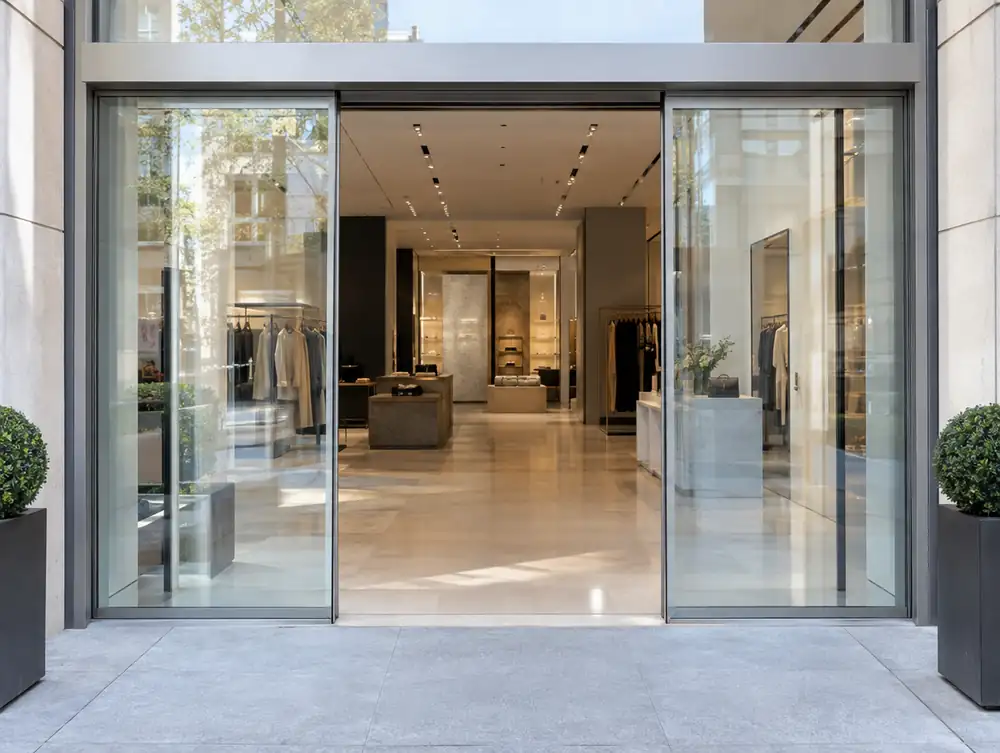
Where should you begin with automatic sliding doors in Bingley?
Automatic doors suit a night fit in Bingley, because most of the work is at the head and the opening stays usable in stages. We'd fit the track and leaves out of hours, then commission the door before you open.
Where a landlord in Bingley wants the frontage kept looking the same, a slim slider can sit behind the existing line. We'd draw the operator inside the fascia and give the landlord a clear elevation to approve.
If there are storeys above the shop, the frontage should feel like the base of the building and not a sign stuck on it. Lining up mullions with the windows overhead is a small move that settles the whole elevation at Bingley premises.
What sign-off might you need for automatic sliding doors in Bingley?
England has no permitted development route for changing a shopfront. Part 7 Class A of the General Permitted Development Order 2015 excludes creating, altering or replacing one, and it allows no alterations at all on article 2(3) land. That leaves two outcomes for automatic sliding doors at premises in the Bingley area: a planning application, or work that doesn't materially affect the external appearance.
Planning and advert applications for Bingley premises normally go to City of Bradford Metropolitan District Council. We check the position for your address at survey.
What price should you expect for automatic sliding doors in Bingley?
Allow £3,895 to £11,995 plus VAT per entrance. Size and specification set most of that figure for automatic sliding doors, and the rest depends on what the survey finds on site.
| Town | Bingley |
|---|---|
| Area | West Yorkshire |
| Postcode districts | BD16 |
| Planning authority | City of Bradford Metropolitan District Council |
| Building approval | Building Regulations (Approved Documents) |
| Distance from Great Barr | About 90 miles |
| Survey | Free for new work |
Does City of Bradford Metropolitan District Council publish shopfront guidance?
Yes, Bradford Shopfront Design Guide Supplementary Planning Document (2026). It tells applicants what the council expects from new and altered shopfronts. A few of the things it asks for:
- Stallrisers should ideally be no more than 20% of total shopfront height, and plastic is never acceptable for them.
- Cornice, fascia and architrave together should be no more than 20% of total height, with lettering no more than two-thirds of the fascia height.
- Solid and perforated roller shutters are strongly discouraged, and internal grilles, ideally set back at least 1m from the window, are the council's preferred approach.
Questions about automatic sliding doors in Bingley
What will people on the street see at my Bingley entrance?
Ideally, very little. The drive sits behind the fascia, the leaves line up with the screens beside them, and the frame colour matches the rest of your front.
Will an automatic door fit my Bingley shop?
It depends on the width of the front and the depth at the head. A survey shows whether the parked leaves fit and where the operator can hide, and if a slider won't work we'd look at a powered swing door.
Will the door keep opening for passers-by in Bingley?
Not if it is set up properly. We narrow the sensor field on site and test it against real footfall, so only people heading for the door trigger it.
Do roller shutters need planning permission in the Bingley area?
Usually yes. Installing or replacing a security grill or shutter on a shopfront is expressly outside England's shop permitted development rights, so the only way to avoid an application is work that doesn't materially affect the appearance. Ask the council before ordering.
Do I need listed building consent for a shopfront in the Bingley area?
Usually yes, if the building is listed. In England the local planning authority decides, and Historic England is notified of Grade I and II* works and specified Grade II works. Like-for-like repair may not need consent, so ask the council before work starts.