For an entrance in Whitstable that stays busy all day, the sensor set-up matters as much as the door. Done well, it opens for customers and ignores people walking past, which keeps the heat in the shop.
Bring whatever you have to the survey in Whitstable: brand guidelines, lease plans, old drawings or a photo of a frontage you admire.
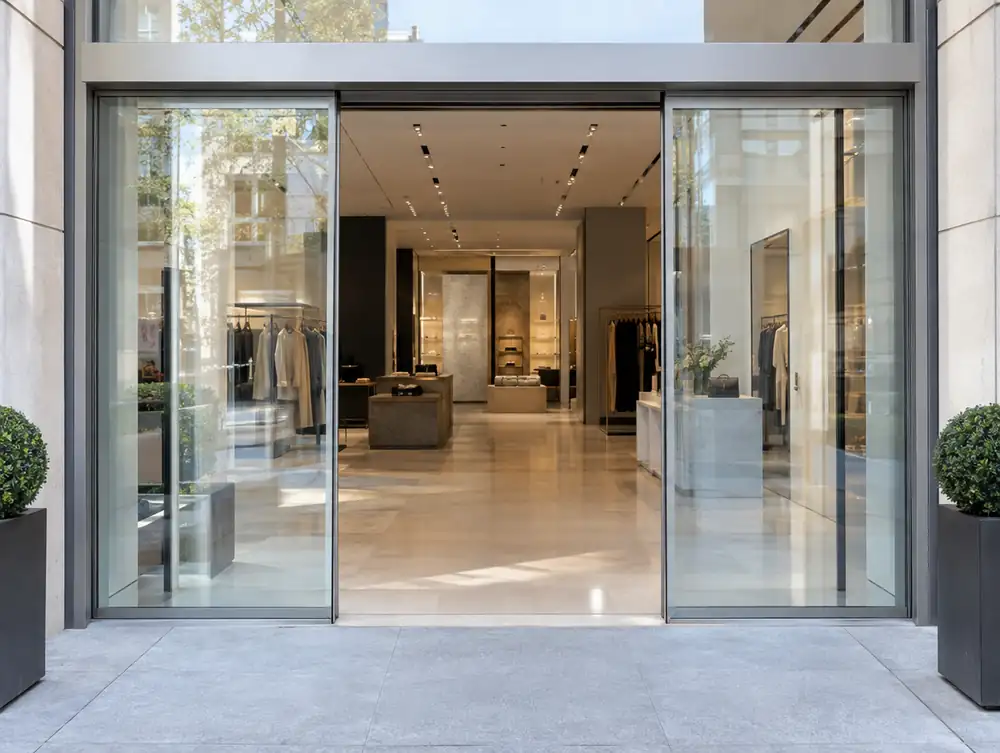
What should you think about before commissioning automatic sliding doors in Whitstable?
A corner unit in Whitstable can often move its entrance to the angle, where two directions of footfall meet. We'd look at a curved or canted door set, and check the wind on both streets before fixing the position.
On a narrow Whitstable frontage, parked leaves can leave too little opening. We'd look at a telescopic or single-slide set, and consider moving the door to one side to free up the display.
Where the footway outside your Whitstable premises is narrow, a recessed entrance earns its keep. It gives people a dry place to pause out of the walkway, and it adds a longer run of display glass either side of the door.
Who approves automatic sliding doors in Whitstable?
For automatic sliding doors at premises in the Whitstable area, the deciding question in England is whether the building work materially affects the external appearance. If it does, planning permission is needed, while a true like-for-like replacement usually needs none. The council confirms the position for each site.
Whitstable applications for planning permission or advertisement consent are normally handled by Canterbury City Council. Our survey includes a check of the position for your address.
What is a realistic budget for automatic sliding doors in Whitstable?
Our guide band is £3,895 to £11,995 plus VAT per entrance. Scope is the biggest lever, so a tighter brief for automatic sliding doors brings the figure down faster than any change of detail.
| Town | Whitstable |
|---|---|
| Area | Kent |
| Postcode districts | CT5 |
| Planning authority | Canterbury City Council |
| Building approval | Building Regulations (Approved Documents) |
| Distance from Great Barr | About 150 miles |
| Survey | Free for new work |
Does Canterbury City Council publish shopfront guidance?
Yes, Shopfront design Supplementary Planning Document (2020). It tells applicants what the council expects from new and altered shopfronts. A few of the things it asks for:
- Fascia depth must not exceed the depth of the console, or one-fifth of the distance from console to pavement.
- External solid roller shutters are not normally supported in conservation areas or main shopping streets and are unacceptable on listed buildings.
- Internally lit box signs, illuminated letters and window neon are unsuitable in conservation areas, with external lighting only for premises open at night.
Questions about automatic sliding doors in Whitstable
Can you match the door to my existing front in Kent?
Yes. Frames come in any RAL colour, and we'd line up the leaves with your existing mullions so the door doesn't look like an add-on.
Will the door keep opening for passers-by in Whitstable?
Not if it is set up properly. We narrow the sensor field on site and test it against real footfall, so only people heading for the door trigger it.
Who installs automatic doors in Whitstable?
Vetted door teams working under S&K Glazing handle the fit and set-up, travelling from Great Barr. Your agreement is with S&K Glazing Limited, and one person stays your point of call.
Does a shop sign in the Whitstable area need advertisement consent?
Not always. In England, an unlit sign within Class 5 of the 2007 Advertisement Regulations generally needs no application, and neither does a lit sign within Class 4B. Anything outside those classes needs consent, and Class 4B isn't available in conservation areas, so check before ordering.
Do I need planning permission to change a shopfront in the Whitstable area?
Usually yes, if the work materially affects the building's external appearance. England's shop permitted development rights exclude creating, altering or replacing a shopfront, so there is no shortcut. A true like-for-like replacement usually needs no application, and the council confirms the position.