The brief for a bi-fold is simple: an open front in summer and a warm room in winter. For Belfast premises in County Antrim, that comes down to panel count, thermal section and a threshold that drains properly.
Please have keys to any meter cupboards and shutter housings to hand when we survey in Belfast, because what sits behind them can change the drawing.
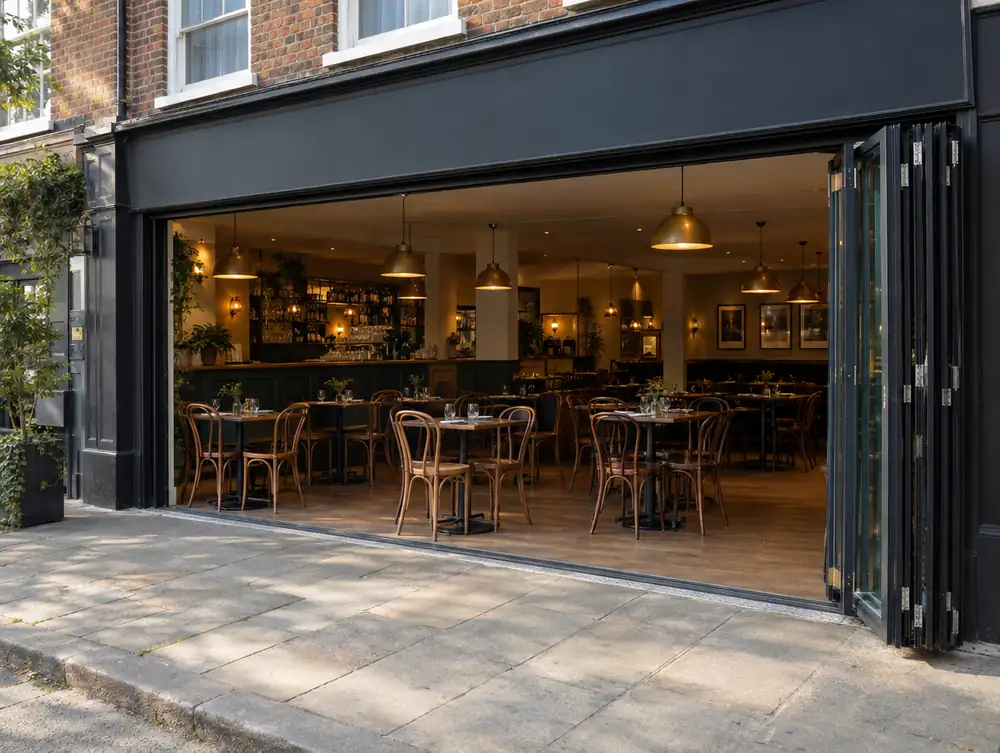
What makes bi-folding shopfronts work well on Belfast premises?
If your Belfast frontage faces the sun, a bi-fold doubles as ventilation. We'd pair it with an awning so the room stays usable at midday, and look at solar control glass for the days the set stays closed.
For a restaurant group opening in Belfast, a bi-fold can carry the brand's look from site to site. We'd standardise the panel section, colour and hardware, then vary the panel count and stack side to suit each opening.
On a north-facing frontage the glass stays free of glare, but the interior can look dim from the street, so lighting needs to sit closer to the window. If your Belfast premises face south, the problem flips to reflections by day and fading stock.
Could bi-folding shopfronts in Belfast need planning permission?
Northern Ireland appears to have no permitted development route for a shopfront, as its 2015 Order mentions shops only in the Part 4 changes of use. For bi-folding shopfronts at premises in the Belfast area, expect a planning application unless the external appearance isn't materially affected. Ask the council to confirm the position.
Expect planning and advert applications here to go to Belfast City Council in the normal way. We check what that means for your building when we survey it in Belfast.
How much should you set aside for bi-folding shopfronts in Belfast?
Allow £5,195 to £13,995 plus VAT for a typical opening. Size and specification set most of that figure for bi-folding shopfronts, and the rest depends on what the survey finds on site.
| Town | Belfast |
|---|---|
| Area | County Antrim |
| Postcode districts | BT1, BT12, BT2, BT7 |
| Planning authority | Belfast City Council |
| Building approval | Building Control (Technical Booklets) |
| Survey | Free for new work |
Does Belfast City Council publish shopfront guidance?
Yes, Supplementary Planning Guidance: Advertising and Signage (2023). It deals with advertising and signage, not with shopfronts generally. A few of the things it asks for:
- Where an original fascia exists it should be used, with no advertising below fascia level or on pilasters or columns.
- Halo lighting of letters is preferred, and internally lit lightboxes should be avoided.
- Projecting signs should extend about 1m at most including fixings and sit at least 2.25m above ground.
Questions about bi-folding shopfronts in Belfast
Will I lose a table to the stack in my Belfast restaurant?
Possibly one, but careful layout usually avoids it. We draw the folded panels on your floor plan, then look at moving the stack to a quieter corner or splitting the set in two.
How many panels would my Belfast opening need?
It depends on the width and how you want the set to open. Most openings divide into leaves under 1m wide, and an odd number gives you a daily door, so we draw the options after the measure-up.
Can I have a timber bi-fold on my Belfast frontage?
Yes. Painted hardwood sets suit older premises across County Antrim, though the panels are heavier and need a stiffer head than aluminium.
What building approval does a shopfront in the Belfast area need?
Usually a full plans application to Building Control in Northern Ireland, because building notices are for single dwellings. The Technical Booklets set the detail, with Booklet V for glass and Booklet R for access. Only dwelling windows and doors are exempt, so ask Building Control before assuming a like-for-like job falls outside the rules.
Do roller shutters need planning permission in the Belfast area?
Usually yes, when they materially affect the external appearance. No permitted development route for shutters appears in Northern Ireland's 2015 Order, so treat them as falling to the appearance test. Check with the council before ordering.