The brief for a bi-fold is simple: an open front in summer and a warm room in winter. For Enniskillen premises in County Fermanagh, that comes down to panel count, thermal section and a threshold that drains properly.
It helps if you can be there when we visit Enniskillen, since five minutes walking the frontage together answers more than a long email.
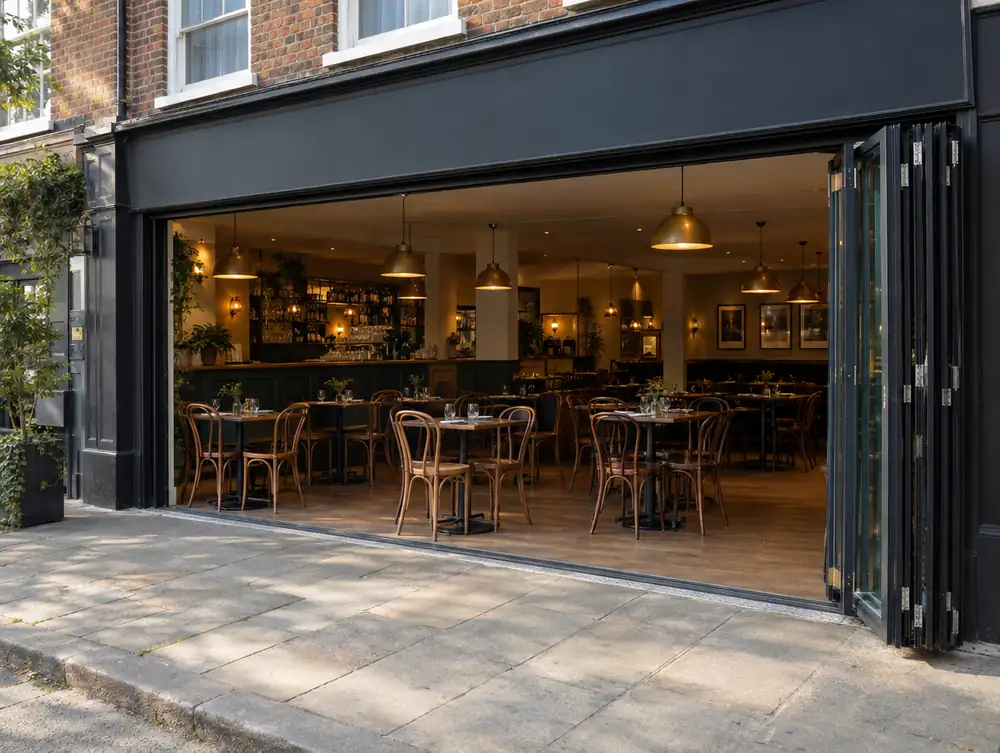
How do you design around the building when planning bi-folding shopfronts in Enniskillen?
Bi-folds suit a two-stage fit at Enniskillen premises that trade late. We'd take the old front out and fix the frame during closed hours, then hang and adjust the panels the following night, with temporary boarding in between.
For a restaurant group opening in Enniskillen, a bi-fold can carry the brand's look from site to site. We'd standardise the panel section, colour and hardware, then vary the panel count and stack side to suit each opening.
If your premises were once two shops, decide early whether the front should read as one or as two. One continuous fascia with a repeated bay width usually settles the elevation better than two mismatched halves, which is worth testing on any Enniskillen unit of that kind.
What permissions should you check for bi-folding shopfronts in Enniskillen?
Northern Ireland appears to have no permitted development route for a shopfront, as its 2015 Order mentions shops only in the Part 4 changes of use. For bi-folding shopfronts at premises in the Enniskillen area, expect a planning application unless the external appearance isn't materially affected. Ask the council to confirm the position.
Planning and advert applications for Enniskillen premises normally go to Fermanagh and Omagh District Council. We check the position for your address at survey.
What might bi-folding shopfronts cost in Enniskillen?
We would budget £5,195 to £13,995 plus VAT for a typical opening. Scope sets most of the figure, so a clear brief at the start does more for the budget than any later change of detail.
| Town | Enniskillen |
|---|---|
| Area | County Fermanagh |
| Postcode districts | BT74 |
| Planning authority | Fermanagh and Omagh District Council |
| Building approval | Building Control (Technical Booklets) |
| Survey | Free for new work |
Does Fermanagh and Omagh District Council publish shopfront guidance?
Yes, Shop Front Design, Supplementary Planning Guidance. It tells applicants what the council expects from new and altered shopfronts. A few of the things it asks for:
- Stallrisers should not exceed the pilaster base or fascia depth, whichever is less, with depths up to 600mm generally acceptable.
- Fascia depths up to 600mm are generally acceptable, one fascia should not span two buildings, and box fascia signs should be avoided.
- External solid roller shutters are not acceptable, with security glass, internal lattice shutters or demountable mesh grilles preferred.
Questions about bi-folding shopfronts in Enniskillen
How secure is a folding front in Enniskillen overnight?
Very, if it is specified for the job. Each leaf locks top and bottom with concealed bolts, and laminated glass adds a second line of defence.
How many panels would my Enniskillen opening need?
It depends on the width and how you want the set to open. Most openings divide into leaves under 1m wide, and an odd number gives you a daily door, so we draw the options after the measure-up.
Who do I speak to about a bi-fold in Enniskillen?
Your named contact stays the same from the first visit to the final adjustment. Fitting is carried out by vetted teams working under S&K Glazing, travelling from Great Barr.
Who decides listed building consent for a shopfront in the Enniskillen area?
The council decides, under section 85 of the Planning Act (Northern Ireland) 2011. The Department for Communities' Historic Environment Division is a statutory consultee on applications. Unauthorised works are a criminal offence, so ask before anything is removed.
Does the Disability Discrimination Act apply to a shop entrance in the Enniskillen area?
Yes. The Disability Discrimination Act 1995 applies in Northern Ireland, and section 21 deals with physical features that make a service hard for disabled people to use. Regulations made in 2007 (SR 2007/473) add detail on features, third-party consent and design standards.