On a warm evening, an open front does more for a cafe or bar in Morley than any sign. We design the folding set around your seating, so the panels park where they don't cost you a table.
Your survey is where the price gets real, because widths, heights, levels and access are all taken on site in Morley.
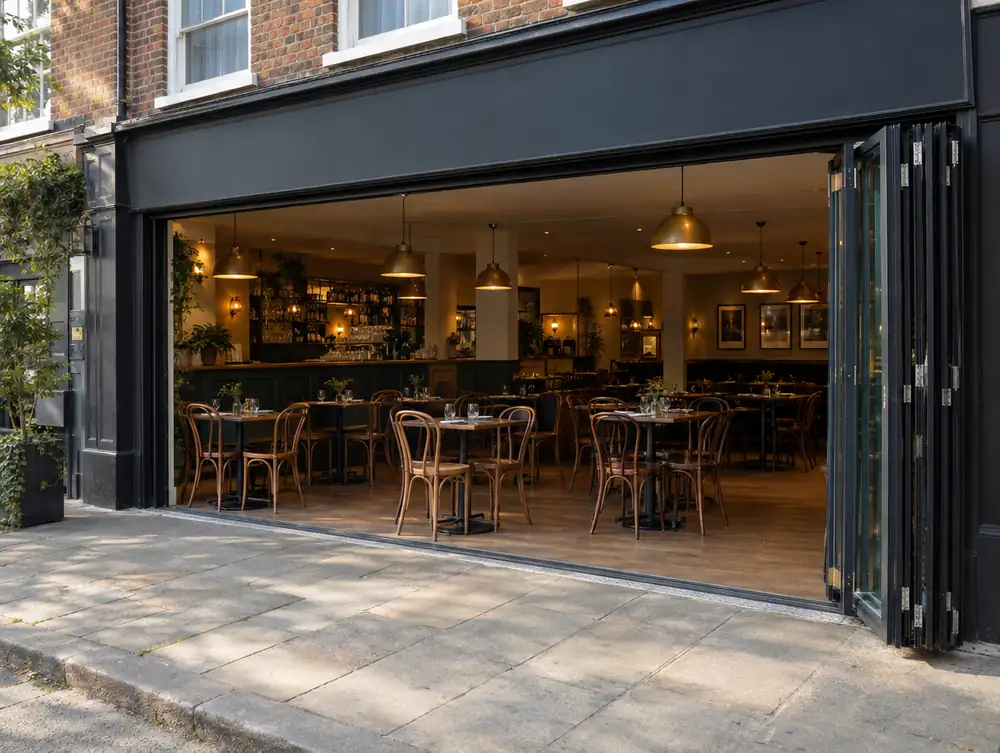
Where should you begin with bi-folding shopfronts in Morley?
A corner plot offers something rare: a front that can open on two sides. For Morley corner premises, we'd look at two sets meeting with no fixed post, provided the structure above can span it.
If your Morley frontage faces the sun, a bi-fold doubles as ventilation. We'd pair it with an awning so the room stays usable at midday, and look at solar control glass for the days the set stays closed.
If there are storeys above the shop, the frontage should feel like the base of the building and not a sign stuck on it. Lining up mullions with the windows overhead is a small move that settles the whole elevation at Morley premises.
What sign-off might you need for bi-folding shopfronts in Morley?
England has no permitted development route for changing a shopfront. Part 7 Class A of the General Permitted Development Order 2015 excludes creating, altering or replacing one, and it allows no alterations at all on article 2(3) land. That leaves two outcomes for bi-folding shopfronts at premises in the Morley area: a planning application, or work that doesn't materially affect the external appearance.
Morley applications for planning permission or advertisement consent are normally handled by Leeds City Council. Our survey includes a check of the position for your address.
What price should you expect for bi-folding shopfronts in Morley?
The guide for bi-folding shopfronts is £5,195 to £13,995 plus VAT for a typical opening. Expect the lower end for simple work with clear access, and the upper end where detail, finish or awkward conditions add hours.
| Town | Morley |
|---|---|
| Area | West Yorkshire |
| Postcode districts | LS10, LS11, LS27, WF17 |
| Planning authority | Leeds City Council |
| Building approval | Building Regulations (Approved Documents) |
| Distance from Great Barr | About 83 miles |
| Survey | Free for new work |
Does Leeds City Council publish shopfront guidance?
Yes, Morley Shopfront Design & Maintenance Guide (2025). It covers Morley town centre only, so it doesn't apply across the whole council area. A few of the things it asks for:
- Fascias in Morley should typically be no taller than 600mm and should not run unbroken across neighbouring buildings.
- Internal security screens must be lattice or scissor types, as solid or pinhole-perforated versions will be rejected.
- uPVC is very rarely appropriate for any shopfront element, and silver or grey aluminium should be avoided on historic buildings.
Questions about bi-folding shopfronts in Morley
Will I lose a table to the stack in my Morley restaurant?
Possibly one, but careful layout usually avoids it. We draw the folded panels on your floor plan, then look at moving the stack to a quieter corner or splitting the set in two.
Can the threshold be level at my Morley premises?
It can be close to level, depending on the floor and drainage. We'd check the levels at survey, because a track sitting flush with the pavement still needs somewhere for water to go.
Which way should the panels fold at my Morley premises?
Inward is the usual answer, since panels folded into the room stay clear of people on the pavement. We'd draw the options where the room allows, and you choose against your seating plan.
Do roller shutters need planning permission in the Morley area?
Usually yes. Installing or replacing a security grill or shutter on a shopfront is expressly outside England's shop permitted development rights, so the only way to avoid an application is work that doesn't materially affect the appearance. Ask the council before ordering.
Does the Equality Act apply to a shop entrance in the Morley area?
Yes. The Equality Act 2010 applies in England, as across Great Britain, and it requires reasonable steps to remove, alter or avoid physical features that disadvantage disabled people. The duty is anticipatory, so it looks at disabled people generally, and a new Services Code replaced the 2011 Code on 5 August 2026.