A well-chosen awning gives Aston premises shade, shelter and a stronger presence, then folds away when the weather turns. Projection, headroom and fixings are settled before anyone chooses a fabric.
Your survey is where the price gets real, because widths, heights, levels and access are all taken on site in Aston.
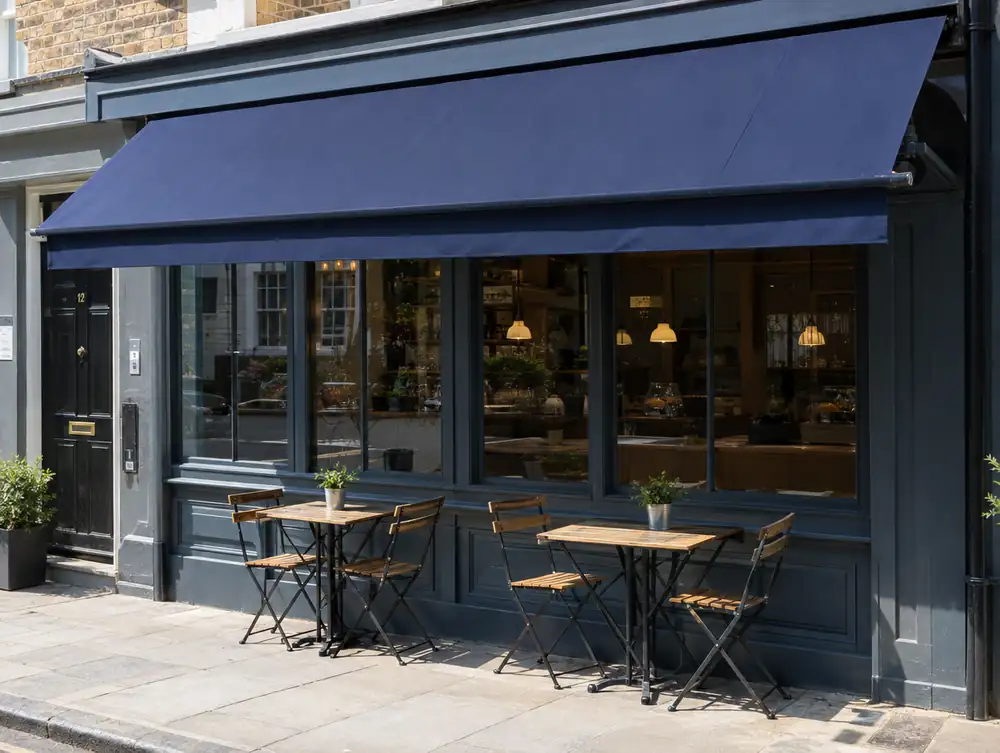
How do you design around the building when planning canopies and awnings in Aston?
If your Aston premises sell food from the front, we would avoid a strong fabric colour that tints the display. Neutral or striped canvas keeps produce looking natural.
Should your frontage still have an old blind box, we open it up at survey. A sound box can take a new roller and cover, and it keeps a detail worth having.
Where the building has good brick or stone around the opening, set the frame back in the reveal so the masonry can be seen. On Aston premises with a flat elevation, that deep reveal throws a shadow line that adds real depth in low sun.
What might canopies and awnings cost in Aston?
Until the survey is done, plan on £1,495 to £9,995 plus VAT per canopy or awning. Unusual sizes, fine detail and phased working push the figure up, while a simple brief and clear access keep it toward the lower end.
What permissions should you check for canopies and awnings in Aston?
England has no permitted development route for changing a shopfront. Part 7 Class A of the General Permitted Development Order 2015 excludes creating, altering or replacing one, and it allows no alterations at all on article 2(3) land. That leaves two outcomes for canopies and awnings at premises in the Aston area: a planning application, or work that doesn't materially affect the external appearance.
Class 4B, England's class for lit signs, isn't available in conservation areas, Areas of Outstanding Natural Beauty, National Parks or the Broads, so a lit sign there normally needs advertisement consent. In an area of special control it is unavailable too, and Class 5 drops to a 3.6m top height, 0.3m letters and one-tenth of the building face up to 3.6m. Ask the council which designations cover premises in the Aston area.
Aston applications for planning permission or advertisement consent are normally handled by Birmingham City Council. Our survey includes a check of the position for your address.
| Town | Aston |
|---|---|
| Area | West Midlands |
| Postcode districts | B19, B4, B6, B7 |
| Planning authority | Birmingham City Council |
| Building approval | Building Regulations (Approved Documents) |
| Distance from Great Barr | About 4 miles |
| Survey | Free for new work |
Questions about canopies and awnings in Aston
Will an awning hide the sign on my Aston premises?
It should not, if it is designed properly. We place the box and valance so the name reads with the cover out, or we add lettering to the valance.
Can an awning in Aston be motorised?
Yes, most can. A tubular motor sits inside the roller, with a remote or wall switch, and a wind sensor can be added. You will need a power supply near the box, which we check at survey.
Can the awning match other premises I run in the West Midlands?
Yes. Send a photograph and any fabric reference, and we match the cloth, valance and lettering as closely as current ranges allow. Fabric lines change over time, so we show you a sample first.
What rules apply to a fire exit door through a shopfront in the Aston area?
It must open in the direction of escape and can't be locked against immediate use, and a dedicated fire exit can't be a sliding or revolving door. In England that comes from article 14(2) of the Regulatory Reform (Fire Safety) Order 2005, and the duty sits with the responsible person, normally the employer or whoever controls the premises for a business, otherwise the owner. An outward door can clash with section 153 of the Highways Act 1980 where it opens onto the footway, so raise it early.
Do I need planning permission to change a shopfront in the Aston area?
Usually yes, if the work materially affects the building's external appearance. England's shop permitted development rights exclude creating, altering or replacing a shopfront, so there is no shortcut. A true like-for-like replacement usually needs no application, and the council confirms the position.