Fixed canopies give Dungannon entrances year-round shelter, in steel, fabric or glass. We design the frame around the structure behind it, so it looks part of the frontage.
A survey in Dungannon usually starts outside, looking at the whole elevation before any tape comes out, because the frontage has to answer the building above it.
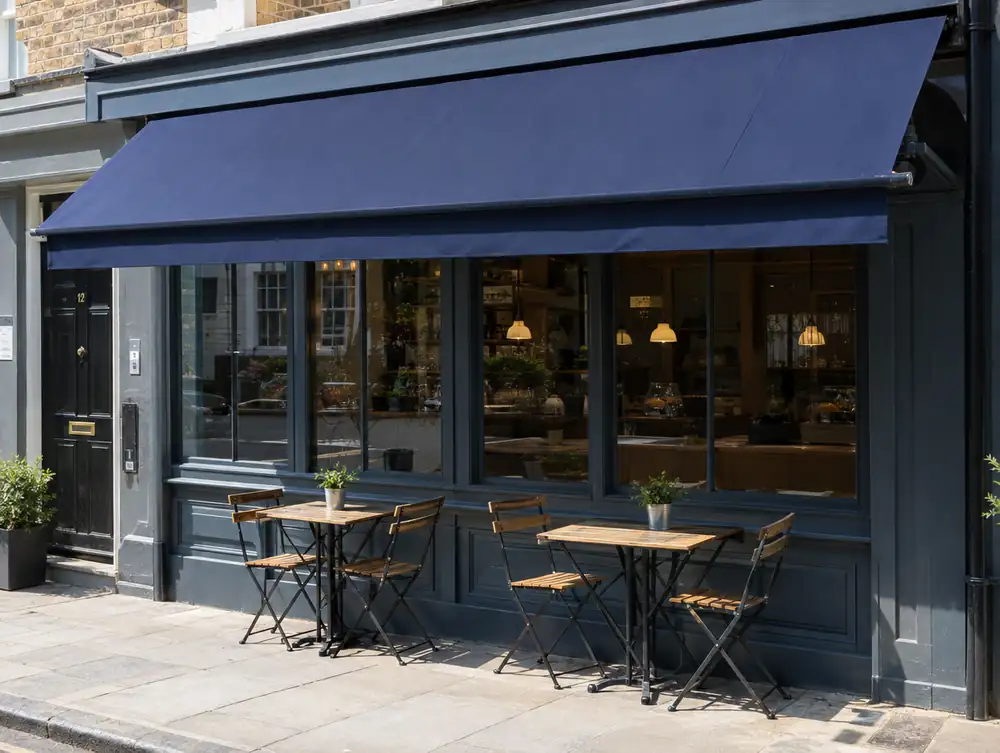
How do you design around the building when planning canopies and awnings in Dungannon?
Where your sign sits on the fascia, the awning box goes above or below it without covering the name. If that cannot be done, we letter the valance so people can still read who you are.
Where the pavement is narrow, a long arm will reach too far, so we would look at a shorter projection or a drop-arm blind. Headroom and the kerb line are measured before we suggest a size.
Where the building has good brick or stone around the opening, set the frame back in the reveal so the masonry can be seen. On Dungannon premises with a flat elevation, that deep reveal throws a shadow line that adds real depth in low sun.
What might canopies and awnings cost in Dungannon?
A sensible starting budget is £1,495 to £9,995 plus VAT per canopy or awning. What shifts the figure is whatever can't be seen yet, such as the condition behind the old frontage or the services running through it.
What permissions should you check for canopies and awnings in Dungannon?
Shutters in Northern Ireland are treated like the rest of the frontage: as no permitted development route appears to exist, they usually fall to the appearance test. Building work that materially affects the external appearance needs planning permission, for canopies and awnings at premises in the Dungannon area as for anything else on the frontage, while a true like-for-like usually doesn't. Ask the council where a particular job stands.
A lit projecting sign in Northern Ireland can generally reach 1m² per surface and 1m high under Class 4(2). Projection is limited to 1m or two-thirds of the footway, so work to the smaller figure. At premises in the Dungannon area, anything bigger needs advertisement consent, and so does a lit sign in a conservation area.
Planning and advert applications for Dungannon premises normally go to Mid Ulster District Council. We check the position for your address at survey.
| Town | Dungannon |
|---|---|
| Area | County Tyrone |
| Postcode districts | BT71 |
| Planning authority | Mid Ulster District Council |
| Building approval | Building Control (Technical Booklets) |
| Survey | Free for new work |
Questions about canopies and awnings in Dungannon
Will an awning or canopy be measured before I get a price in Dungannon?
Yes. Every price comes from a measure-up, because wall construction and pavement width affect the design. You then receive an itemised quotation, valid for 90 days.
Do you replace awning fabric in Dungannon?
Yes, provided the frame is sound. We measure the frame, check the arms and roller, then make a new cover in your chosen canvas and colour.
How long will an awning last on Dungannon premises?
A good frame typically lasts 15 years or more, and acrylic canvas typically lasts 7 to 10 years. Regular cleaning and retracting in high wind make the biggest difference.
What rules apply to a fire exit door through a shopfront in the Dungannon area?
It must open in the direction of escape, it can't be locked against immediate use, and a dedicated fire exit can't be sliding or revolving. In Northern Ireland that comes from regulation 13(2) of the Fire Safety Regulations (Northern Ireland) 2010, and duties sit with dutyholders, meaning the employer and any person with control of the premises, whom the Fire and Rescue Service calls the appropriate person. An outward door may also need Department consent under Article 56 of the Roads (Northern Ireland) Order 1993.
Do I need planning permission to change a shopfront in the Dungannon area?
Usually yes, when the work materially affects the external appearance. Northern Ireland's 2015 Order appears to offer no permitted development route for a shopfront. The council confirms the position, and a true like-for-like replacement usually needs no application.