A well-chosen awning gives Harwich premises shade, shelter and a stronger presence, then folds away when the weather turns. Projection, headroom and fixings are settled before anyone chooses a fabric.
Measuring the opening is the easy part of a survey in Harwich. We also look at the beam above, the pavement fall and any meters or drains nearby.
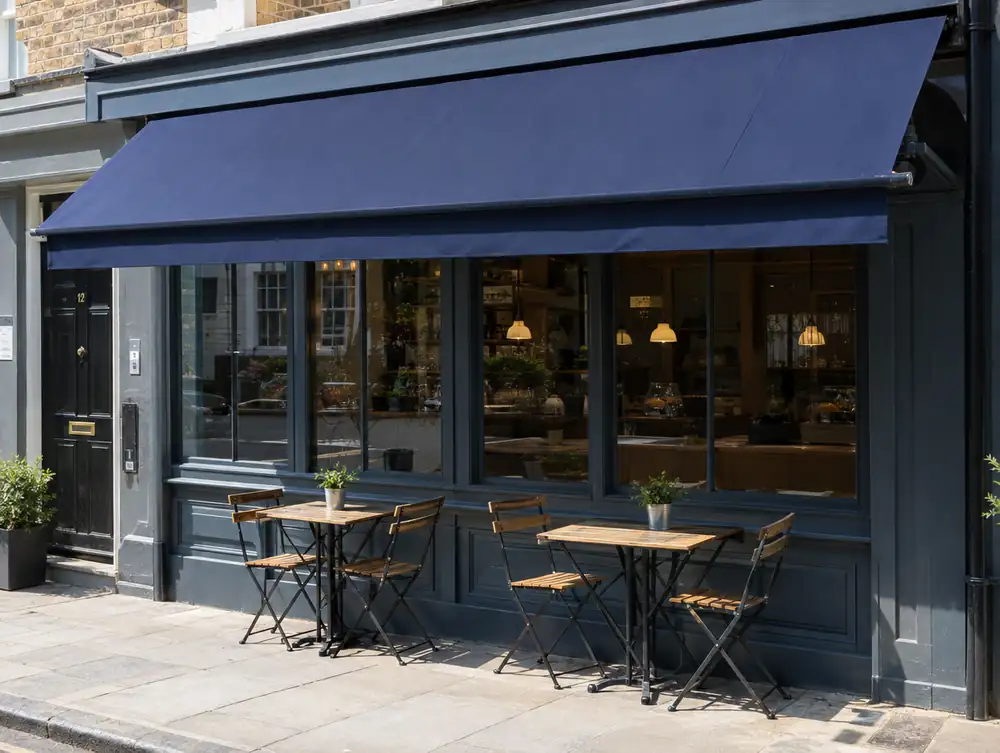
Where should you begin with canopies and awnings in Harwich?
If you only need cover at the door, a small fixed canopy or Dutch canopy over the entrance may do the job at a fraction of the cost of a full-width awning. We would draw both, so you can compare them on your elevation.
If the wall is rendered or cavity-built, we check what lies behind it before designing brackets. Long anchors or a spreader plate can take the load where a standard fixing would pull out.
Where the footway outside your Harwich premises is narrow, a recessed entrance earns its keep. It gives people a dry place to pause out of the walkway, and it adds a longer run of display glass either side of the door.
What price should you expect for canopies and awnings in Harwich?
The guide for canopies and awnings is £1,495 to £9,995 plus VAT per canopy or awning. Expect the lower end for simple work with clear access, and the upper end where detail, finish or awkward conditions add hours.
What sign-off might you need for canopies and awnings in Harwich?
England has no permitted development route for changing a shopfront. Part 7 Class A of the General Permitted Development Order 2015 excludes creating, altering or replacing one, and it allows no alterations at all on article 2(3) land. That leaves two outcomes for canopies and awnings at premises in the Harwich area: a planning application, or work that doesn't materially affect the external appearance.
Lighting moves a sign out of Class 5 in England, because that class allows illumination only for medical-type notices. Class 4B then applies at premises in the Harwich area: halo or character-only lighting, static, with the lowest part at least 2.5m up. Brightness is capped at 600 cd/m² on signs up to 10m² and 300 cd/m² above that, and anything outside these limits needs advertisement consent.
Harwich applications for planning permission or advertisement consent are normally handled by Tendring District Council. Our survey includes a check of the position for your address.
| Town | Harwich |
|---|---|
| Area | Essex |
| Postcode districts | CO12 |
| Planning authority | Tendring District Council |
| Building approval | Building Regulations (Approved Documents) |
| Distance from Great Barr | About 142 miles |
| Survey | Free for new work |
Questions about canopies and awnings in Harwich
Will an awning hide the sign on my Harwich premises?
It should not, if it is designed properly. We place the box and valance so the name reads with the cover out, or we add lettering to the valance.
Can the awning match other premises I run in Essex?
Yes. Send a photograph and any fabric reference, and we match the cloth, valance and lettering as closely as current ranges allow. Fabric lines change over time, so we show you a sample first.
How long will an awning last on Harwich premises?
A good frame typically lasts 15 years or more, and acrylic canvas typically lasts 7 to 10 years. Regular cleaning and retracting in high wind make the biggest difference.
What rules apply to a fire exit door through a shopfront in the Harwich area?
It must open in the direction of escape and can't be locked against immediate use, and a dedicated fire exit can't be a sliding or revolving door. In England that comes from article 14(2) of the Regulatory Reform (Fire Safety) Order 2005, and the duty sits with the responsible person, normally the employer or whoever controls the premises for a business, otherwise the owner. An outward door can clash with section 153 of the Highways Act 1980 where it opens onto the footway, so raise it early.
Do I need planning permission to change a shopfront in the Harwich area?
Usually yes, if the work materially affects the building's external appearance. England's shop permitted development rights exclude creating, altering or replacing a shopfront, so there is no shortcut. A true like-for-like replacement usually needs no application, and the council confirms the position.