From measured survey to handover, awnings and canopies across Hayling Island and Hampshire sit under one contract, alongside any sign or shopfront work on the same frontage. Your named contact treats the fabric, the frame and the fixing as one job.
Nothing gets ordered off the back of a survey in Hayling Island, because its job is to give us the numbers to draw and price from.
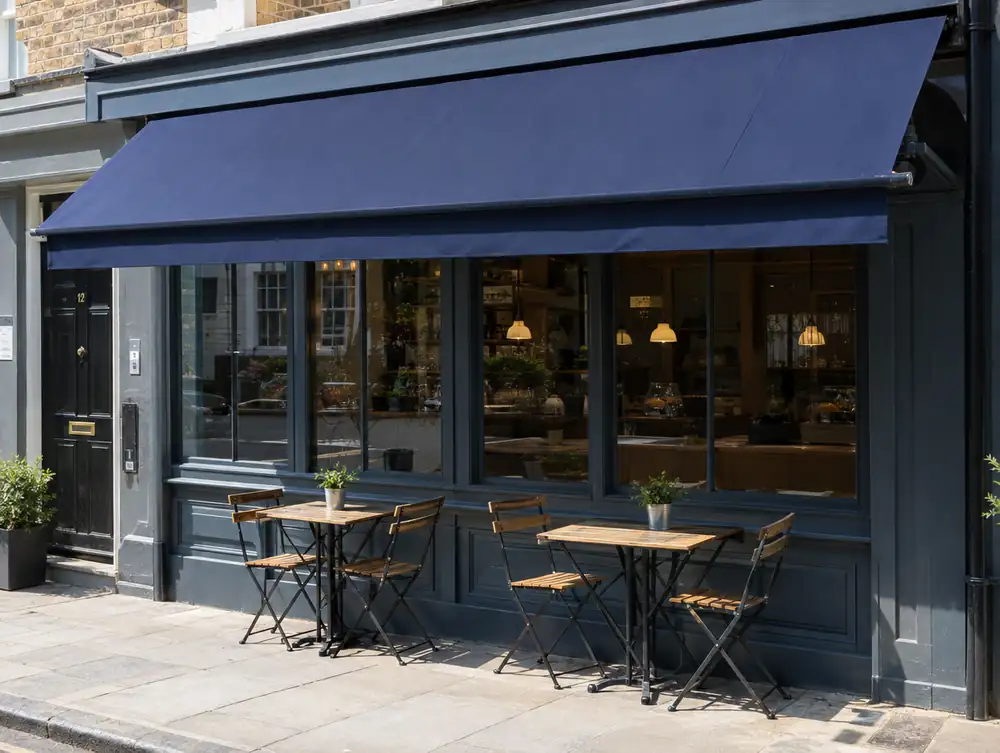
How do you design around the building when planning canopies and awnings in Hayling Island?
If your Hayling Island premises sell food from the front, we would avoid a strong fabric colour that tints the display. Neutral or striped canvas keeps produce looking natural.
Where the pavement is narrow, a long arm will reach too far, so we would look at a shorter projection or a drop-arm blind. Headroom and the kerb line are measured before we suggest a size.
Where the footway outside your Hayling Island premises is narrow, a recessed entrance earns its keep. It gives people a dry place to pause out of the walkway, and it adds a longer run of display glass either side of the door.
What permissions should you check for canopies and awnings in Hayling Island?
Security grilles and shutters are named in England's rules: installing or replacing one on a shopfront sits outside the shop permitted development rights. The frontage itself is treated the same way, so for canopies and awnings at premises in the Hayling Island area, building work that materially affects the appearance needs planning permission. Confirm the position with the council before anything is ordered.
Lighting moves a sign out of Class 5 in England, because that class allows illumination only for medical-type notices. Class 4B then applies at premises in the Hayling Island area: halo or character-only lighting, static, with the lowest part at least 2.5m up. Brightness is capped at 600 cd/m² on signs up to 10m² and 300 cd/m² above that, and anything outside these limits needs advertisement consent.
At survey we check how things stand for your building, although applications for planning permission or advertisement consent here normally go to Havant Borough Council.
What might canopies and awnings cost in Hayling Island?
The guide for canopies and awnings is £1,495 to £9,995 plus VAT per canopy or awning. Expect the lower end for simple work with clear access, and the upper end where detail, finish or awkward conditions add hours.
| Town | Hayling Island |
|---|---|
| Area | Hampshire |
| Postcode districts | PO11 |
| Planning authority | Havant Borough Council |
| Building approval | Building Regulations (Approved Documents) |
| Distance from Great Barr | About 128 miles |
| Survey | Free for new work |
Questions about canopies and awnings in Hayling Island
Can the awning match other premises I run in Hampshire?
Yes. Send a photograph and any fabric reference, and we match the cloth, valance and lettering as closely as current ranges allow. Fabric lines change over time, so we show you a sample first.
Will an awning hide the sign on my Hayling Island premises?
It should not, if it is designed properly. We place the box and valance so the name reads with the cover out, or we add lettering to the valance.
How long will an awning last on Hayling Island premises?
A good frame typically lasts 15 years or more, and acrylic canvas typically lasts 7 to 10 years. Regular cleaning and retracting in high wind make the biggest difference.
Does a new shopfront in the Hayling Island area need Building Regulations approval?
Assume yes until building control says otherwise. England has no like-for-like exemption, though registered installers can self-certify replacement windows and doors in non-dwellings. That route doesn't cover structural glass, curtain walling or revolving doors.
Do roller shutters need planning permission in the Hayling Island area?
Usually yes. Installing or replacing a security grill or shutter on a shopfront is expressly outside England's shop permitted development rights, so the only way to avoid an application is work that doesn't materially affect the appearance. Ask the council before ordering.